Amazing USO program has helped service members share over 125,000 stories with their kids while deployed

Army Capt. Justin Meredith used the Bob Hope Legacy Reading Program to read to his son and family while deployed in the Middle East.
One of the biggest challenges deployed service members face is the feeling of being separated from their families, especially when they have children. It's also very stressful for children to be away from parents who are deployed for long periods of time.
For the past four years, the USO has brought deployed service members and their families closer through a wonderful program that allows them to read together. The Bob Hope Legacy Reading Program gives deployed service members the ability to choose a book, read it on camera, then send both the recording and book to their child.
Bob Hope Legacy Reading Programwww.youtube.com
The program was created through a partnership between the Bob & Dolores Hope Foundation and the USO. Hope was one of the most beloved comedians of his generation, and he traveled the world for over six decades, putting on USO shows to boost the morale of the nation's service members.
In 2019, families shared more than 39,000 stories through the program.
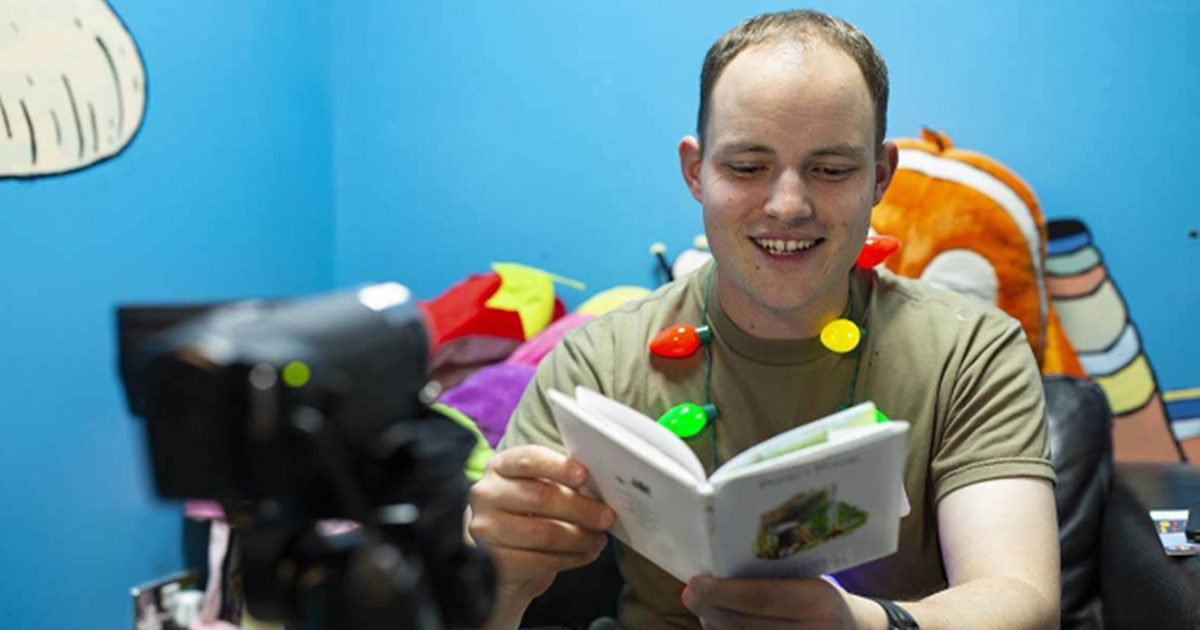
The program has been an incredible way for U.S. Army Captain Justin Meredith to connect with his young son Jayden and express himself creatively. Just before he was set to be deployed to the Middle East, he checked into the local USO center where he was introduced to the program. At first, he felt a little awkward in front of the camera but soon took a real shine to making the videos.
When he arrived, he became a regular at USO Camp Buehring in Kuwait where he'd show up every day to read a new book to his son. He began to really liven things up by adopting funny voices, wearing costumes, and using props.
"The zanier that I am on the camera and the goofier the voices, the characters, the props, the more he just really engages with it," Justin said. "My son is so engaged, and he's so happy and he lights up seeing me."
Justin's nightly readings to Jayden had a profound effect on the family by keeping them close while he was away.
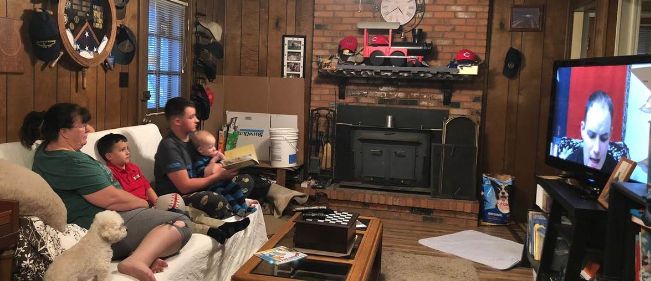
"It became a life-changing thing, a better way to stay connected, and it was great because while my wife [was] technically raising him [while I was deployed], I could use the books to help influence and mold and help him out with some of the initial things that he's going through," Justin said.
Army Sgt. 1st Class Ruben Pimentel is a father of three and uses the Bob Hope Legacy Reading Program to connect with his family while he's deployed. He loves that the recordings will live on long after he's returned from his service overseas.
"I know I'm not there, but I'm able to connect with my family. Even when I'm 60 years old, I'll be able to look back and see myself reading to my kids. It's a family heirloom," Pimentel said.

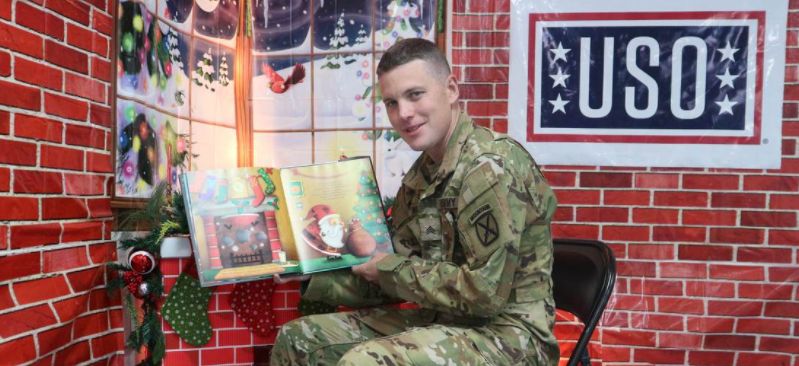
The program is especially popular during the holidays. In 2019, the USO held a special event where service members read "The Night Before Christmas" in front of a festive, fake fire in a costume of their choice.
Sgt. Nick Masi, a father of four, thought the program helped him feel close to his loved ones during the holidays.
"It felt as though the reading program had transported me to be with my family, even if just for one story," he said.
The USO had to temporarily shut down in-person events in centers last year due to the COVID-19 pandemic, but that didn't stop service members from keeping the tradition of reading to their families alive. Service members who are USO volunteers at USO Erbil in Iraq outfitted the back of a pickup truck with a trifold to make a "room" for them to read to their families.

The USO team decorated their makeshift set, grabbed some books, and set up a chair.
Then, they hit the road, sharing their studio with service members on-base, stopping at popular places as well as remote areas. The USO's goal was to reach as many service members as possible.
Deployment is hard on service members and their families, but they do it so we can all enjoy peace and freedom at home. So, it's our job to keep them as happy and comfortable as possible during their times of sacrifice.
Click here to see how you can contribute to the USO and support services like the Bob Hope Legacy Reading Program, which has helped over 100,000 service members and their families be together, or share a story, when they're miles apart.
- This vet surprised everyone after his Mom turned him into an ... ›
- How military families stay connected over the holidays - Upworthy ›
- 5 ways to connect with your loved ones this holiday season, even if ... ›


a man sitting at a desk with his head on his arms Photo by
Can a warm cup of tea help you sleep better? If you believe it, then yes. Photo by 
A woman is getting angry at her coworker.via
A man with tape over his mouth.via
A husband is angry with his wife. via 
Three women sit on a blanket in the park. 
Two women engaging in a pleasant conversation inside a coffee shop
Two men engaging in a peaceful disagreement.
Resurfaced video of French skier's groin incident has people giving the announcer a gold medal
"The boys took a beating on that one."
Downhill skiing is a sport rife with injuries, but not usually this kind.
A good commentator can make all the difference when watching sports, even when an event goes smoothly. But it's when something goes wrong that great announcers rise to the top. There's no better example of a great announcer in a surprise moment than when French skier Yannick Bertrand took a gate to the groin in a 2007 super-G race.
Competitive skiers fly down runs at incredible speeds, often exceeding 60 mph. Hitting something hard at that speed would definitely hurt, but hitting something hard with a particularly sensitive part of your body would be excruciating. So when Bertrand slammed right into a gate family-jewels-first, his high-pitched scream was unsurprising. What was surprising was the perfect commentary that immediately followed.
This is a clip you really just have to see and hear to fully appreciate:
- YouTube youtu.be
It's unclear who the announcer is, even after multiple Google inquiries, which is unfortunate because that gentleman deserves a medal. The commentary gets better with each repeated viewing, with highlights like:
"The gate the groin for Yannick Bertrand, and you could hear it. And if you're a man, you could feel it."
"Oh, the Frenchman. Oh-ho, monsieurrrrrr."
"The boys took a beating on that one."
"That guy needs a hug."
"Those are the moments that change your life if you're a man, I tell you what."
"When you crash through a gate, when you do it at high rate of speed, it's gonna hurt and it's going to leave a mark in most cases. And in this particular case, not the area where you want to leave a mark."
Imagine watching a man take a hit to the privates at 60 mph and having to make impromptu commentary straddling the line between professionalism and acknowledging the universal reality of what just happened. There are certain things you can't say on network television that you might feel compelled to say. There's a visceral element to this scenario that could easily be taken too far in the commentary, and the inherent humor element could be seen as insensitive and offensive if not handled just right.
The announcer nailed it. 10/10. No notes.
The clip frequently resurfaces during the Winter Olympic Games, though the incident didn't happen during an Olympic event. Yannick Bertrand was competing at the FIS World Cup super-G race in Kvitfjell, Norway in 2007, when the unfortunate accident occurred. Bertrand had competed at the Turin Olympics the year before, however, coming in 24th in the downhill and super-G events.
As painful as the gate to the groin clearly as, Bertrand did not appear to suffer any damage that kept him from the sport. In fact, he continued competing in international downhill and super-G races until 2014.
According to a 2018 study, Alpine skiing is a notoriously dangerous sport with a reported injury rate of 36.7 per 100 World Cup athletes per season. Of course, it's the knees and not the coin purse that are the most common casualty of ski racing, which we saw clearly in U.S. skier Lindsey Vonn's harrowing experiences at the 2026 Olympics. Vonn was competing with a torn ACL and ended up being helicoptered off of the mountain after an ugly crash that did additional damage to her legs, requiring multiple surgeries (though what caused the crash was reportedly unrelated to her ACL tear). Still, she says she has no regrets.
As Bertrand's return to the slopes shows, the risk of injury doesn't stop those who live for the thrill of victory, even when the agony of defeat hits them right in the rocks.