These 14 mesmerizing photos show Earth’s many forces juxtaposed against each other.
We all contain contradictions. It’s part of what makes us human. Walt Whitman wrote, in “Song of Myself”: “Do I contradict myself?Very well then I contradict myself,(I am large, I contain multitudes.)” And it’s true. You can be conservative but want to stop climate change. You can be liberal but support rights for gun owners.…
We all contain contradictions. It’s part of what makes us human.
Walt Whitman wrote, in “Song of Myself”:
“Do I contradict myself? Very well then I contradict myself, (I am large, I contain multitudes.)”
And it’s true. You can be conservative but want to stop climate change. You can be liberal but support rights for gun owners. And though at first glance this juxtaposition, these side-by-side comparisons, might seem fraught, these combinations can also be beautiful.
In fact, the entirety of planet Earth has always been made up of a harmony of forces: fire and ice, wind and water.
These 14 images show that these contradictions and juxtapositions aren’t just OK — they’re a natural part of the world we live in.
1. Check out the soothing balance between lights deep in Antarctica. One above. One below. Both beautiful.
2. Meanwhile, in Russia’s Kamchatka Peninsula, fire and ice – ancient mythical enemies – create an amazing vista together.
Image from iStock.
3. And yeah, lava can be destructive, like this fiery eruption winding its way through a vibrantly green forest.
Lava from the 2007 eruption of the Piton de la Fournaise volcano on the island of Réunion. Image from Richard Bouhet/AFP/Getty Images.
4. But though fire is powerful, forests are nothing if not resilient. Like this new tree growing after a fire wiped out a forest in Australia.
Photo by Lucas Dawson/Getty Images.
5. In fact, fires open up the forest canopy, giving many plants a chance to grow, like these beautiful wildflowers. Some plants, like lodgepole pines, actually require fires to spread their seeds.
Image from iStock.
In many places it’s the juxtaposition between these two forces — plant life and fire — that create truly beautiful forests.
6. Sometimes places on Earth seem to defy the laws of physics, like these incredible, balancing mountains in China where green trees thrive against the pale, steep, rock face.
Zhangjiajie National Park, China. Image from iStock.
7. Our weather is a balancing act too.
A storm approaches Sydney, Australia. Image from Cameron Spencer/Getty Images.
8. A balance that can be both beautiful and tremendous.
Image from iStock.
9. Sometimes it’s a balance of what’s inside versus outside. This infrared scan of a hurricane highlights the incredible juxtaposition between the howling winds and peaceful eye of the storm.
10. Sometimes it’s the opposite. Things are peaceful outside and roiling inside.
Image from iStock.
11. The ocean is also great at showing this juxtaposition. The Earth is really two worlds, after all — one above the waves and one below.
Image from iStock.
12. Not to mention the way the human world bumps up against the wild one just beyond our carefully constructed borders.
Image from Ryan Pierse/Getty Images.
13. In the grand scheme of things, humankind is just another part of the balance. Balanced both with ourselves…
A single shot shows both the new and the old in Rio de Janeiro. Image from iStock.
14. …and with nature. Nairobi is one of Africa’s fastest growing cities, but just outside its borders is the wilderness of the savanna.
Photo by Peter Macdiarmid/Getty Images.
It’s sometimes easy to see the divisions in everyday life and wish we could all be the same. It’s tempting to say that we don’t need labels or boxes because they divide us, but when you step back and look at Earth from a distance, you can see that it’s the balance of multiple different forces that brings it — that brings us — together to make it beautiful.
A single door can open up a world of endless possibilities. For homeowners, the front door of their house is a gateway to financial stability, job security, and better health. Yet for many, that door remains closed. Due to the rising costs of housing, 1 in 3 people around the world wake up without the security of safe, affordable housing.
Since 1976, Habitat for Humanity has made it their mission to unlock and open the door to opportunity for families everywhere, and their efforts have paid off in a big way. Through their work over the past 50 years, more than 65 million people have gained access to new or improved housing, and the movement continues to gain momentum. Since 2011 alone, Habitat for Humanity has expanded access to affordable housing by a hundredfold.
A world where everyone has access to a decent home is becoming a reality, but there’s still much to do. As they celebrate 50 years of building, Habitat for Humanity is inviting people of all backgrounds and talents to be part of what comes next through Let’s Open the Door, a global campaign that builds on this momentum and encourages people everywhere to help expand access to safe, affordable housing for those who need it most. Here’s how the foundation to a better world starts with housing, and how everyone can pitch in to make it happen.
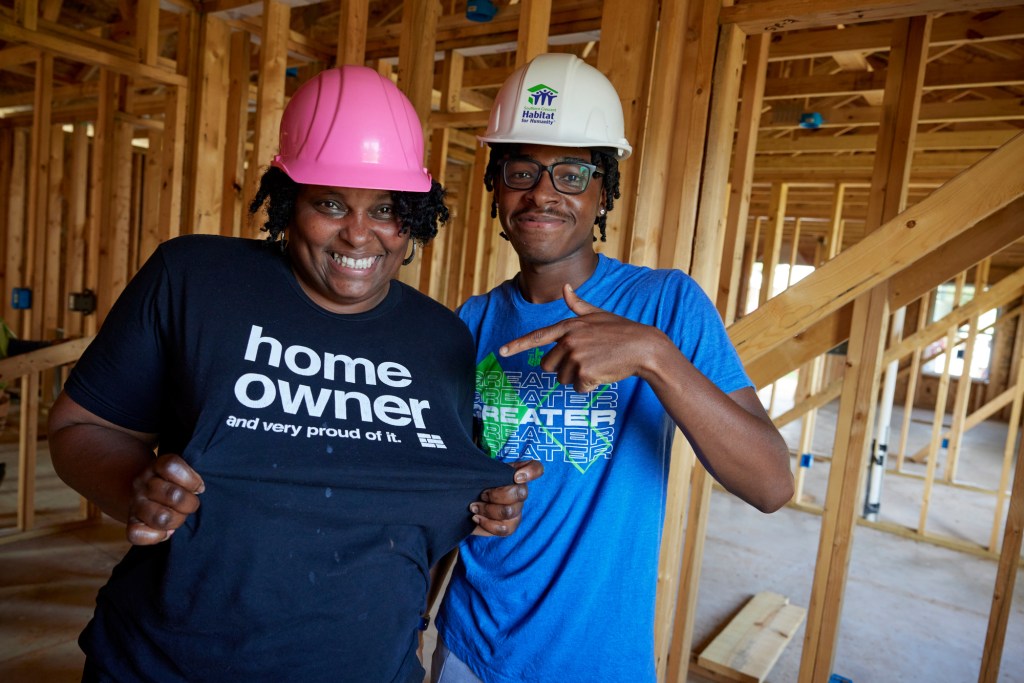
Volunteers raise a wall for the framework of a new home during the first day of building at Habitat for Humanity’s 2025 Carter Work Project.
Globally, almost 3 billion people, including 1 in 6 U.S. families, struggle with high costs and other challenges related to housing. A crisis in itself, this also creates larger problems that affect families and communities in unexpected ways. People who lack affordable, stable housing are also more likely to experience financial hardship in other areas of their lives, since a larger share of their income often goes toward rent, utilities, and frequent moves. They are also more likely to experience health problems due to chronic stress or environmental factors, such as mold. Housing insecurity also goes hand-in-hand with unstable employment, since people may need to move further from their jobs or switch jobs altogether to offset the cost of housing.
Affordable homeownership creates a stable foundation for families to thrive, reducing stress and increasing the likelihood for good health and stable employment. Habitat for Humanity builds and repairs homes with individual families, but it also strengthens entire communities as well. The MicroBuild® Initiative, for example, strengthens communities by increasing access to loans for low-income families seeking to build or repair their homes. Habitat ReStore locations provide affordable appliances and building materials to local communities, in addition to creating job and volunteer opportunities that support neighborhood growth.
Marsha and her son pose for a photo while building their future home with Southern Crescent Habitat for Humanity in Georgia.
Everyone can play a part in the fight for housing equity and the pursuit of a better world. Over the past 50 years, Habitat for Humanity has become a leader in global housing thanks to an engaged network of volunteers—but you don’t need to be skilled with a hammer to make a meaningful impact. Building an equitable future means calling on a wide range of people and talents.
Here’s how you can get involved in the global housing movement:
Speaking up on social media about the growing housing crisis
Volunteering on a Habitat for Humanity build in your local community
Travel and build with Habitat in the U.S. or in one of 60+ countries where we work around the globe
Join the Let’s Open the Door movement and, when you donate, you can create your own personalized door
Every action, big and small, drives a global movement toward a better future. A safe home unlocks opportunity for families and communities alike, but it’s volunteers and other supporters, working together with a shared vision, who can open the door for everyone.
Jimmy Carter was the 39th president of the United States (1977 to 1981). Looking back on his achievements both in and out of office, it’s easy to say that he was a man ahead of his time. He was far ahead of the mainstream when it came to advocating for social justice, human rights, and the environment.
The former peanut farmer and Navy Lieutenant from Plains, Georgia, was also far ahead of his time when supporting gay rights. In 1976, while running for president, he said he would sign the Equality Act, an amendment to the 1964 Civil Rights Act that would prohibit discrimination based on sexual orientation. “I will certainly sign it, because I don’t think it’s right to single out homosexuals for special abuse or special harassment,” he said.
He continued to advocate for gay rights as president. In 1977, the first gay delegation visited the White House. He also campaigned against California’s Proposition 6, which would have barred gays and lesbians from teaching in the state’s schools and was the first Democratic president to endorse gay rights in the party’s platform in 1980.
It may seem unusual for Carter, a confessed born-again Christian, to be a staunch advocate for gay rights. But he has publicly said that he believes that being pro-gay is wholly aligned with the teachings of Jesus Christ. Carter’s advocacy found itself in the spotlight once again after a meme featuring his thoughts about Christ and homosexuality from 2012 went viral on Reddit’s MadeMeSmile forum on April 8, 2024.
“A lot of people point to the Bible for reasons why gay people should not be in the church or accepted in any way,” the interviewer Rev. Paul Brandeis Raushenbush said. But Carter responded by correctly noting that Jesus Christ never said anything about homosexuality.
“Homosexuality was well known in the ancient world, well before Christ was born and Jesus never said a word about homosexuality. In all of his teachings about multiple things—he never said that gay people should be condemned. I personally think it is very fine for gay people to be married in civil ceremonies,” Carter said. “I draw the line, maybe arbitrarily, in requiring by law that churches must marry people. I’m a Baptist, and I believe that each congregation is autonomous and can govern its own affairs.
“So if a local Baptist church wants to accept gay members on an equal basis, which my church does, by the way, then that is fine. If a church decides not to, then government laws shouldn’t require them to,” he continued.
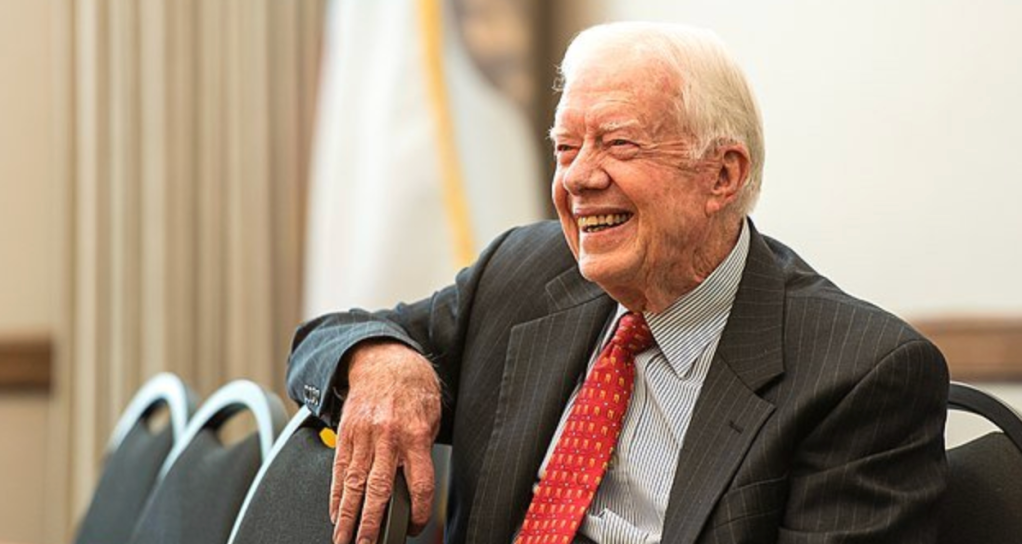
Jimmy Carter in the White House.
Three years later, Carter shared the same sentiments in another interview with the Huffington Post, this time shortly after the U.S. Supreme Court legalized same-sex marriage. “I think Jesus would encourage any love affair if it was honest and sincere and was not damaging to anyone else, and I don’t see that gay marriage damages anyone else,” Carter said.
Jimmy Carter’s belief in gay rights stems from his faith as a Christian, but it’s also in complete alignment with his values as an American. Carter believed that the United States was a “beacon” for human rights, and in his 1981 presidential farewell address, he reminded the nation that the job was an ongoing struggle.
“The battle for human rights–at home and abroad–is far from over,” Carter said. “If we are to serve as a beacon for human rights, we must continue to perfect here at home the rights and values which we espouse around the world: A decent education for our children, adequate medical care for all Americans, an end to discrimination against minorities and women, a job for all those able to work, and freedom from injustice and religious intolerance.”
Jimmy Carter passed away on December 29, 2024, at the age of 100 years old. He was the longest-lived U.S. president. After his passing, President Joe Biden wrote that Carter, “stands as a model of what it means to live a life of meaning and purpose, a life of principle, of faith and humility. His life was dedicated to others.” He will forever be remembered as a man who fought for human rights both at home and abroad.
This article originally appeared two years ago. It has been updated.
Isn’t it wild to think that spies are actually real? Governments all over the world send secret agents to other countries to steal information or conduct missions. The key element that makes a spy, of course, is the secretive nature of their work. They go undercover, sometimes even wearing disguises, and carry out their missions without attracting attention. That means they’re masters of psychology and social science rather than combat and weaponry.
In a revealing interview with Steven Bartlett on his “Diary of a CEO” podcast, former Secret Service Special Agent Evy Poumpouras shared how to get people to do what you want them to do. The key, according to Poumpouras, is to understand what motivates them. Once you know the psychological framework behind what makes them tick, you can persuade them to behave as you like.
“The biggest mistake people make is they talk a lot,” Poumpouras said in the video clip. “Steven, if I’m doing all the talking and you’re doing all the listening, you’re learning everything about me. You’re learning about what I care about, my values, my belief systems, getting a good read on me and I’m learning nothing about you.”
The former Secret Service Agent says that you should listen to determine the subject’s motivational mindset. Are they motivated by money, sex, admiration, status, freedom, relationships, or safety?
“Everybody’s motivated by something different. But I have to hear you and pay attention to you to understand what that is. Everybody’s purpose is different,” she continued. “If you give people enough space, they will reveal themselves to you.”
To be clear, Poumpouras isn’t in the business of helping people trick others. Instead, she hopes the techniques she teaches will, “Increase your self-confidence, your self-worth, and your ability to trust and believe in yourself.”
The commenters on TikTok loved the advice:
“People are so interested in themselves and want to talk about themselves… We give our power away by talking.”
“Changed my life when I was told to stop filling the silence”
“As a parent, I needed this reminder too.”
Yes, the parents came out in full force to support Poumpouras’ tip. Perhaps no one, other than espionage experts, better understands the importance of learning how to get other people to do things without threats and violence. (OK, sometimes there are threats).
It’s also a wonderful tactic because your subject will have no idea they are part of a manipulation because they are the ones doing the talking. It’s nearly impossible to give yourself away when you’re sitting in silence.
Understanding what motivates people is essential when protecting the safety of the nation’s most important assets and dealing with shady, dangerous people. But it’s not only useful for spies and double agents.
This so-called “trick” can also benefit the layperson by giving us a framework to understand people better. Knowing what motivates someone is very important, whether you’re on a date, in a business deal, or in a leadership role at work. It’s also very important when raising children or training an animal.
The data agrees. Forbes writes about the experiments of Dan Ariely, who found that, “People are much more likely to go above and beyond for tasks that they’re emotionally (rather than financially) invested in.” So, if you want people to do things that benefit you, sure you can pay them or convince them that it’s in their best interest, but you’ll have far better luck if you appeal to their core principles and desires. To do that, you first have to listen and find out what they are.
Understanding your personal motivators is also essential for making the best choices in life.
It helps us determine which actions will be genuinely beneficial. It’s also a great way to ensure that we are involved with people, organizations, and activities for the right reasons.
In other words, digging into someone else’s (and your own) core beliefs and motivation can be used for good! Not just protecting state secrets and preventing assassinations.
Productivity consultant Ashley Janssen says the key to understanding your motives is knowing your values.
“When you know what you value, you can identify how an activity or goal will support and foster those values,” Janssen writes. “When you decide to try something, consider whether it’s what you think you should want to do or what someone else has said you should do. Those conditions are often not enough to sustain a behavior or activity. It’s hard to keep moving forward on something that you don’t really care about or are not invested in.”
This article originally appeared two years ago. It has been updated.
The evolution of candles from lighting necessity to scented ambience creator is kind of funny. For thousands of years, people relied on candles and oil lamps for light, but with the invention of the light bulb in 1879, fire was no longer needed for light. At that time, people were probably relieved to not have to set something on fire every time they wanted to see in the dark, and now here we are spending tons of money to do it just for funsies.
We love lighting candles for coziness and romance, relishing their warm, soft light as we shrink from the fluorescent bulb craze of the early 2000s. Many people use candles for adding scent to a room, and there are entire candle companies just for this purpose (Yankee Candles, anyone?). As of 2022, candles were an 11 billion dollar business.
With their widespread use, you’d think we’d know a thing or two about candles, but as it turns out, a whole bunch of us have been burning candles wrong our entire lives without knowing it.
Wax on wax off: avoiding the ‘memory ring’
A recent post on Twitter X started the education session:
“Just learned that my fiancé, who buys candles all the time and we literally always have candles burning, did not actually know how they work and blew out a medium first burn candle 30 minutes after I lit it when I wasn’t paying attention and ruined it,” the user wrote.
Many people had no idea what she was talking about. In fact, the original since-deleted post went viral with hundreds of people asking: Huh? So the OP explained.
“If a candle is not burned for long enough on first burn to melt edge to edge it will create a ‘memory ring.’ Once a candle has a memory ring, it will continue to tunnel and never burn all the way across.”
Now THAT’S something almost everyone has experienced. Candles are pretty expensive, so it’s frustrating when all that delicious-smelling wax gets left behind. Apparently, a short first burn (in this case, just 30 minutes) is one of the main culprits of a ruined candle.
Memory rings are also called ‘tunnels’
Tunneling is the name of the phenomenon where a narrow tube-shaped area of candle continues to burn deeper and deeper, leaving lots of “waste” wax around its edges. Experts agree that the first burn should last 2-4 hours at least to avoid an uneven or narrow memory ring. However, burning a candle for over 10 hours at a time can cause carbon buildup on the wick.
“This is why you should not light a large candle at night, which is unlikely to burn all the way across before you need to blow out to go to bed. Allow at least one hour per inch of candle width,” she went on.
So that’s why candles always end up with a hole in the middle, making us think the candle companies are just running a scam to make us go through candles faster. Nope. It’s a user error, and many people were flabbergasted by this realization.
“This is the most useful information I’ve been given my entire adult life,” wrote one person.
“This skill should be taught in schools,” shared another. “The amount I’ve wasted on half burnt candles is outrageous, the amount of times I’ve used Algebra since leaving school = 0.”
“When I worked at Pier 1 in the 90s I got to go to some candle workshop that taught us the correct way to use (and therefore sell) candles and that is probably some of the most useful knowledge I’ve carried in my head this long life,” shared another.
Well, never say ‘never,’ because here’s the good news: a tunneled candle can be fixed!
How to fix an existing tunnel
Probably the easiest way is to avoid tunneling your candles in the first place by burning them long enough upon first burn to liquify the entire top layer of wax. Again, that’s usually 2-4 hours.
It also helps to care for the wicks regularly! Good wicks allow for a clean, even burn. Trim the burnt ends before lighting the candle and, if possible, use a snuffer instead of blowing out the flames with your mouth. Using a candle warmer is another way to get an even melt; with the added perk of making the scented wax last much, much longer.
But even if you do accidentally “ruin” a candle, it can be recovered. Placing a ring of foil around the candle with just a small opening at the top for the flame will help trap heat and help the edges of the wax melt on the next burn. Once the memory ring evens out, you can burn the candle like normal again.
In fact, you can even use a candle warmer to melt the wax back to even and then resume burning. Some clever candlers even put candles on the hot pad of their coffee makers as a DIY hack.
What about indoor air quality?
The candle posts also prompted a separate discussion about candles and indoor air quality and the volatile organic compounds that are released when they are burned.
Some people equated burning candles with having a small engine running in your living room, though according to the Cleveland Clinic, there’s scant evidence that the amount of toxins released by burning candles is actually hazardous to your health, especially if you use high quality candles in a well-ventilated area.
But if you tolerate them, feel free to enjoy as recommended,—just make sure that first burn melts the wax all the way to the edges to avoid the dreaded tunneling.
This article originally appeared 2 years ago. It has been updated.
Like the space flights before it, the Artemis II mission revolves around hard science and data. But what has captivated us most here on Earth is the beauty and humanity it reveals. We’ve enjoyed the astronauts’ joyful camaraderie as they reach farther into space than any humans have gone before. We’ve been touched by the reminder that we are all one people. And we’ve wept at the naming of a moon crater after Commander Reid Wiseman’s late wife.
And now, we’re hearing from the lone Canadian onboard, sharing how Indigenous elders’ wisdom has helped guide him through this mission.
In preparation for the Artemis II launch, mission specialist Jeremy Hansen said he sought advice that led him to Indigenous wisdom. Asked what he learned from Indigenous elders, Hansen shared his response from space.
“I’ve had many Indigenous elders spend time with me in my travels across the country, and I’ve always enjoyed it,” he said. “If I can give you one piece of advice, sit with your elders and ask questions. But listen intently. Every time I’ve stopped to listen, I’ve just learned these amazing things.”
Hansen pulled out the personal mission patch he carried onboard.
‘This encompasses a few of the things I learned from the elders,” he said. “But when I left the vision quest, I had a better understanding of it. These animals in this patch, that was created by Anishinaabe artist Henry Guimond from the Turtle Lodge, these animals represent some things that I try to think about every day. My mantra when I wake up is I am just going to try to spend my day walking with these attributes. And so I start with courage, humility, respect, love, honesty, wisdom, and truth.”
Hansen said the crew named their Orion spacecraft “Integrity,” which he says encapsulates those attributes.
“For me, being ‘in integrity’ is walking in accordance with these seven sacred laws, and it’s just something that helps guide me through life,” he said.
The Canadian Space Agency (CSA) explains the “Seven Sacred Laws” represented by the animals on Hansen’s patch. The following descriptions come from Sabe, Leader of Turtle Lodge, and have been edited for concision by the CSA:
Buffalo – Respect
The buffalo represents respect. It gives its entire being to feed the people, for them to live. Elders teach that when you respect others, you give of yourself, you give your life to help people around you to create a better existence for all.
Eagle – Love
The eagle represents love. Grandmothers say that one of the most powerful medicines we have is love, that love is a powerful healer. The eagle also symbolizes vision and sight. It is important to see ahead, to have a vision of one’s purpose and to work towards it. Elders teach that one’s true purpose is always rooted in love and in support of others.
Bear – Courage
A very physically powerful animal, the bear represents courage.A mother bear is fearless in the protection of her cubs. It is natural for her to display courage and strength, to do what is right in life. It is not always easy to face challenges, follow one’s purpose and do the right thing. Only with the courage and resilience of the bear will you be able to face and overcome the challenges that could prevent you from living out your life’s purpose.
Sasquatch – Honesty
Sasquatch or Bigfoot – Sabe or ‘giant’ in the Ojibway language – represents the importance of honesty and being true to one’s word. Say what you mean and be honest with yourself and others. Elders often exemplify this trait; when they say something, their word is a commitment and can be counted upon. Honesty is also speaking true and good words about others and avoiding gossip.
Beaver – Wisdom
The beaver represents wisdom. It has an incredible gift to build and create, as well as the wisdom of how to use this gift. The beaver’s creation harnesses life-giving water to create important ecosystems that support and enable life. It can even channel water back into an area following a devastating forest fire, renewing and revitalizing that ecosystem.
Like the beaver, we all have a special gift to offer others. Use the wisdom of the beaver to acknowledge your gifts and put them to use in the service of others: this is the source of life satisfaction and happiness.
Wolf – Humility
The wolf represents humility, acknowledging that there is a higher power and natural laws governing the universe. Showing gratitude for our life and our existence, while acknowledging that we are all equal is a sign of humility. The sun shines on us all equally, and no one is better or less than others.
Turtle – Truth
The turtle is truth. The Elders say that in order to know and understand truth, we have to learn to understand the six other teachings: respect, love, courage, honesty, wisdom, humility. The turtle leaves a trail, truth, for us to follow. As we are constantly faced with challenges, we should do our best to follow that trail and live truthfully.
Ahead of #NDTR on Monday, we invite you to reflect and learn about the diverse cultures of the Indigenous Peoples. You can also read about the Seven Sacred Laws depicted on @astro_Jeremy’s personal mission patch for his journey to the Moon on Artemis II. https://t.co/TDUkxwv1CF
The patch has some obvious symbols, such as the Big Dipper, the North Star (with five points to represent Hansen’s five family members), the Canadian flag, and the Royal Canadian Air Force astronaut wings.
But it holds other symbolism as well, the CSA explains. The bow represents Artemis, the twin sister of Apollo and the goddess of the moon and the hunt. She launches her arrow with the astronauts, taking off from Turtle Island—the Indigenous name for the Americas—toward Grandmother Moon. The silver border represents the Orion spacecraft. The blue border beneath it represents the light, or spirit, in all living things that travels with the crew through space.
What a beautiful reminder of our connection to Earth, and of the meaningful lessons we carry with us when we leave it.
At 88 years old, Marie McLaren has done a lot in her life. Before retirement, she worked as a sales assistant, a factory worker, and a cleaner—all while raising three children, who now have kids of their own. But in her golden years, she’s pursuing a new challenge: stand-up comedy.
Most up-and-coming comedians make their debut at small shows or open mics. McLaren, however, had the added pressure of performing a five-minute set as part of the Glasgow International Comedy Festival. It would be understandable to flop or fumble under those conditions. Instead, McLaren nailed it like a pro.
McLaren decided to give stand-up comedy a try after years of encouragement from family and friends. In fact, she was practically pushed into it. Her daughter signed her up for a four-week stand-up comedy course for seniors.
“I’ve always liked making people laugh. I’ve been a bit of a joker all my life and I’ve never had much time for folk that just complain and moan,” McLaren told Chortle. “My friends used to say I should try stand-up, so when my daughter signed me up for this I thought, ‘Well, I’ll give it a go.’ I might be 88 but that doesn’t mean you should stop trying new things.”
The class, taught by award-winning Scottish comedian Viv Gee, teaches senior students how to write and develop original material. It also focuses on building confidence and controlling the room in front of a live audience. The course is promoted in partnership with Age Scotland.
Age Scotland is a charity focused on the social and mental well-being of older adults. It helps fund and promote programs that provide activities, care, and companionship. These efforts aim to address the loneliness epidemic among elderly communities.
A new star is born
Once the course ended, McLaren and her classmates performed at the Social Hub in Scotland. The class and the show were organized in partnership with Age Scotland. The name of the seniors’ comedy show? The Old Ones Are the Best.
McLaren credits her successful debut to her teacher.
“Viv has been brilliant. She explains everything properly and gives you the confidence to try it,” she said. “You come in thinking you don’t know what you’re doing and then suddenly you’re writing things down and thinking, ‘I can do this.’”
While this was her first time writing and performing stand-up comedy, McLaren has always had a performance bug. Prior to her comedy debut, she and her husband joined a talent agency for walk-on roles in film and TV. Most notably, she appeared in a music video for The Proclaimers, directed by Matt Lucas.
While the class is over, McLaren’s journey into the comedy world is just beginning.
“If I was asked to do more, I would definitely say yes. As long as I can still stand up and make people laugh, I’ll keep going,” she said. “I don’t think you should ever stop. If something comes along and you fancy it, just do it.”
There’s no doubt that the role aunts and uncles play in a child’s life is important. Typically, these are the people who are raising the cousins that often serve as your child’s first best friends. But many Millennials are part of a growing group of adults opting not to have children.
Instead of raising their own children, they’re leaning into their childfree status and the additional bandwidth it affords them. “Rich auntie” status is not new. It’s the endearing nickname given to women who chose to forego children to maintain the lifestyle they worked for. It replaced the more derogatory term of “childless cat lady,” which replaced “spinster.”
Though the idea of a childless aunt or uncle isn’t new, the prevalence is. This phenomenon was once so rare that it caused speculation around sexuality and sanity. Clearly, there must be something wrong with you if you didn’t have children. Today, people are celebrating the mutually beneficial role childless adults play. Not only do they bring fun and adventure to a child’s life, but they also serve as a trusted babysitter for a much-needed evening out.
It’s not only the kids and parents that benefit, but the childless adults also gain. TikToker Amanda Vanhook says, “I’m very much single, no interest in dating, none. And I’m very happy that way. I’m very happy in my life.” Later, she adds, “I’m also very fortunate that I had a sister that gave me two little crazy hooligans, my four-year-old nephew and my two-year-old niece, and I would not change that for the world because they are the light of my life.
I would go above and beyond, go over the moon, and wouldn’t even blink an eye for those two. So I get the best of both worlds. I get to spoil myself, treat myself whenever I want, and enjoy my quiet time life, but I also get my nuggets, who I want to spend all this time with. I want to show them the world, I want to show them the great things of life.”
Adults remain childless for a variety of reasons. Struggles with fertility, not finding the right partner, or simply not having the desire to raise a child full-time are some of the most prominent. No matter the reason for being child-free, though, the mutual benefit of those without kids having close relationships with those who do have them shouldn’t be understated. One family has a tradition they’ve shared online for others to see. Since their aunt doesn’t have children, instead of Mother’s Day, they created a special day just for her called “Auntie Lynn Day.”
Man holding young girl like an airplane. Photo Credit: Canva
Every year, the family gathers for a cookout complete with decorations and a cookie cake, declaring it “Auntie Lynn Day.” It’s a day filled with love and smiles, acknowledging how valued her role is in their family.
Another woman, Jillian Gerhardt, explains the importance of having childless friends who double as aunties and uncles to your children. “Every parent needs a childless auntie or uncle friend. They’re not real aunts and uncles, but they’re that friend that shows up smelling like independence and freedom.” She advocates that their role is vital to remind parents who they were before they had children, to keep them grounded in their sense of self.
Mike Mancusi, a childless uncle, makes an argument for those on the fence about becoming a parent. “Anyone that’s on the fence about having kids or not having kids, I’m going to propose to you a third option, and it is by far the best option–being an aunt or an uncle. It is the best. It’s all of the good parts of parenting and none of the bad parts.” He adds, “You get to hang out with these kids, you get all of the joy, all the endorphins, and then as soon as they start being annoying, you just get to hand them off to the people that are legally required to take care of them.”
The consensus of the childfree aunts and uncles is that they get to be the fun-havers. They come in like a superhero to either give parents a break while they spoil them, or rile the kids up right before bedtime. Either way, they get to go home or drop the kids back off with their parents when they’re overstimulated.
Parents who appreciate the childless aunties and uncles celebrate what they bring to their lives. Childless aunts and uncles appreciate that they get to share parenting with their sibling or friend without the full-time responsibility. It’s a win-win-win. A win for the parents, a win for the childless person, and a win for the kids.
“The DINK, Auntie and Funcle life is really underrated,” one person says. DINK stands for Dual Income No Kids.
“It really is the best option. Also, when they become teenagers, they only fight with their parents and have a great relationship with you and ask for your advice and will listen to you,” someone writes in response to Mancusi’s video.
An adult child reveals, “My Auntie is my favorite human. 42 years later that woman is my go to for just about EVERYTHING.”
Someone else adds, “Childless auntie here! My besties kids are my world. My weekends are spent at soccer games, cheer games, etc and then I get to go home at night and read my book in silence. Someday we will build a compound so they can just walk to my house whenever lol.”
CNN had created a remembrance video for the Back to the Future star, titled “Remembering the life of Michael J. Fox.” Now, it’s fairly standard practice for news outlets to make these sorts of posthumous tributes in advance. But publishing them before the celebrity actually passes away? Not so much.
And yet, on Tuesday, April 7, that’s what happened. But when Fox saw the accidental announcement of his death, he met it with a bit of philosophical humor.
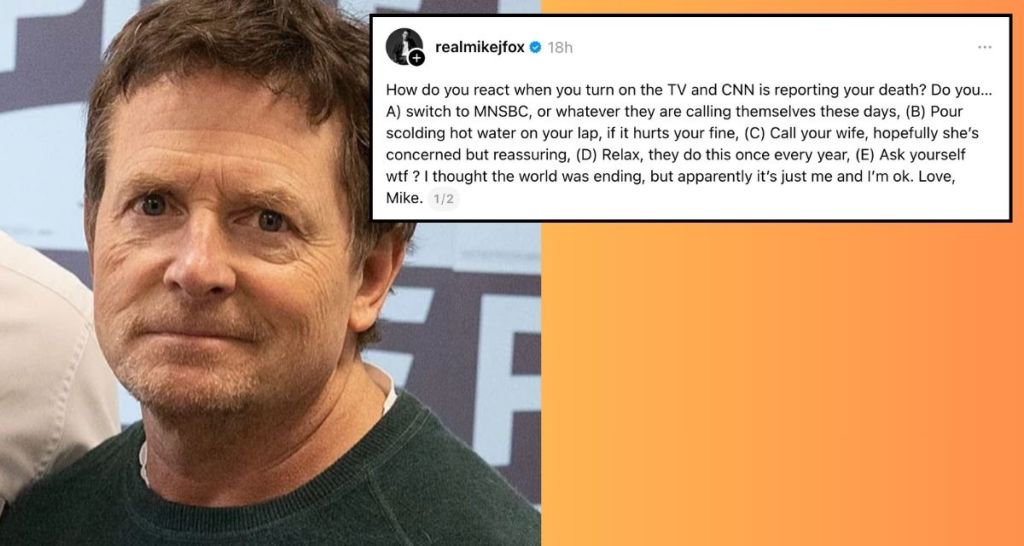
On Threads, Fox wrote, “How do you react when you turn on the TV and CNN is reporting your death? Do you…A) switch to MNSBC, or whatever they are calling themselves these days, (B) Pour scolding hot water on your lap, if it hurts your fine, (C) Call your wife, hopefully she’s concerned but reassuring, (D) Relax, they do this once every year, (E) Ask yourself wtf ?”
@realmikejfox Threads
Ending with just a dash of self-deprecation, he concluded, “I thought the world was ending, but apparently it’s just me and I’m ok. Love, Mike.”
As to be expected, fans were quick to “yes and” Fox’s sense of humor.
“Go outside and ask the first person you come across: ‘Can you see me?’ Glad you’re ok btw!” wrote one person.
Meanwhile, actor Kathy Griffin quipped, “You’re a helluva ghost. ❤️😂.”
In CNN’s defense, the tribute, however premature, did respectfully honor Fox’s legacy not only as a beloved actor, but also as an active Parkinson’s advocate.
According to Entertainment Weekly, the narrator in the now-deleted video said of Fox: “He came into our living rooms on the small screen each week as Alex P. Keaton [on Family Ties] and eventually onto the big screen as Marty McFly in [Back to the Future]. But Michael J. Fox had a compelling third act as a Parkinson’s sufferer and stem cell research advocate.”
“His most lasting role may have been as a tireless voice against Parkinson’s, a performance the Academy of Motion Pictures Arts and Sciences honored with the Jean Hersholt Humanitarian Award in 2022,” the clip went on. “In the end, Fox came to understand that his battle against the disease brought out the best in him.”
A CNN spokesperson also stated: “The package was published in error; we have removed it from our platforms and send our apologies to Michael J. Fox and his family.”
On Wednesday, Fox’s rep assured TMZ that “Michael is doing great.”
So great, in fact, that he was out and about in Los Angeles speaking on a panel for the Apple TV series Shrinking, in which he filmed a three-episode guest arc playing a character who also deals with Parkinson’s disease. The guest spot marked his first on-screen appearance since 2020. Harrison Ford, who also plays a character with Parkinson’s on the show, regarded Fox as “an extraordinarily powerful person” after meeting and working with him on set.
So, Michael J. Fox is still kickin’. And he’s still meeting each moment with a tremendous amount of humility and humor, lifting our spirits as he does it.
For millions of people, this sort of run-of-the-mill sleep advice feels like being handed a pamphlet about umbrellas in the middle of a tropical storm. The advice isn’t wrong, not really. But it’s basic. Generic. It fails to account for the wildly diverse reasons people struggle with sleep in the first place.
A new study from Concordia University feels radical for a simple reason: Instead of lumping all sleepers into “good” and “bad” categories, researchers identified five distinct sleep profiles, each with its own causes, brain patterns, and emotional fingerprints. Once you know which one sounds like you, the advice actually starts to make sense.
What they found: Your sleep isn’t just about what happens when you close your eyes. It’s deeply intertwined with your brain wiring, your emotional life, and how you move through the world during the day. These findings align with the current sleep-deprivation crisis. Six in ten adults aren’t getting enough sleep, according to the National Sleep Foundation, and the Centers for Disease Control and Prevention reports that one in three adults is chronically sleep-deprived. But not all of those sleepers are struggling for the same reasons, and that distinction matters more than previously realized.
Your sleep profile isn’t a quirky, fun fact like an astrological sign. Knowing which profile you belong to could unlock a good night’s rest—not just tonight, but for a lifetime.
Does this sound familiar? You get into bed exhausted, lie there for an hour, and suddenly your brain wants to review every awkward conversation you’ve had since 2009. When you do sleep, it’s shallow. You wake up wondering why you even bothered.
LC1, known as the Struggling Sleeper, is the most prevalent and clinically significant sleep profile. It is defined by a potent combination: sleep difficulty and underlying mental health struggles, including anxiety, depression, low mood, and poor concentration. These factors are so closely linked that it’s almost impossible to tell which came first. Research has consistently shown that insomnia and anxiety and depression have a bidirectional relationship, with each feeding and amplifying the other in a self-reinforcing cycle. Treating only the sleep without addressing the emotional root is like mopping the floor while the faucet is still running.
Brain scans reveal another neurological layer: Individuals with LC1 exhibit hyperactivity in emotional processing regions and reduced connectivity in areas tied to rumination and focus. The brain gets stuck in a loop. So when it’s 2 a.m. and you’re mentally planning contingencies for catastrophes that haven’t happened, this is your brain’s wiring, not a personal failure.
This one’s surprising. While Resilient Sleepers often carry real psychological stress—attention difficulties, low mood, pressure that would flatten most people—somehow, they sleep.
This profile offers a fascinating contrast to LC1. People in LC2 experience similar levels of psychological burden as those in Profile 1, but their sleep does not break down under that pressure. Researchers think this may reflect a neural resilience pathway—a different kind of wiring that prevents stress from taking over the sleep system.
Their brain scans reveal something intriguing: strong attention and control networks that act as a buffer, preventing emotional noise from flooding the sleep system at night. You might even underestimate your own sleep quality, thinking it’s worse than it actually is. Researchers believe this profile could be key to understanding what the brain can learn to defend, and whether those defenses can be developed in other sleepers.
For the Medicated Sleeper, sleeping aids are non-negotiable. Photo credit: Canva
Profile 3: The Medicated Sleeper (LC3)
Melatonin gummies, sleepy tea, a glass of wine, a Benadryl “just this once” that became every night—if sleep aids have quietly become non-negotiable, you probably recognize this profile.
Medicated Sleepers are often doing well by most measures—they’re socially active and physically healthy—but simply can’t fall asleep on their own without a little chemical assist. The trade-off? Mild declines in visual memory and emotional regulation, as sedating medications have been shown to affect both perceptual and emotional processing.
An important note: The researchers found that LC3, LC4, and LC5 were less robust than LC1 and LC2, suggesting these profiles may be more variable across populations and should be interpreted with caution.
Short Sleepers don’t need less sleep—they’re sleep-deprived. Photo credit: Canva
Profile 4: The Short Sleeper (LC4)
You’re efficient. You’ve adapted. So five and a half hours of sleep is fine—you’ve been running on it for years.
Here’s the hard truth: The brain scans of Short Sleepers look nearly identical to those of people who have pulled a full all-nighter. No, not just tired people—people who literally haven’t slept. As you can imagine, the cognitive costs of this sleeper profile accumulate quickly, often below the threshold of what we can feel but well above what researchers can measure.
LC4 is characterized by regularly sleeping fewer than six to seven hours per night, and the cognitive impacts are measurable: slower reaction times, decreased problem-solving ability, lower emotional patience, and difficulty managing interpersonal frustration. You may pride yourself on needing little sleep, having built an identity around efficiency. But your partner notices you snap more easily. You’ve forgotten three appointments this month. You’re not superhuman. You’re sleep-deprived, and your brain is working overtime to hide it from you.
You spend eight hours in bed, but you wake up exhausted. Throughout the night, everything in the world seems to keep you from rest—discomfort, noise sensitivity, a partner who snores—and despite spending plenty of time technically “sleeping,” Disturbed Sleepers rarely feel rested. The quality of sleep is just too fractured.
This was the only profile in the study to show a notable gender difference, with women scoring significantly higher—consistent with research showing that women experience greater sleep fragmentation over their lifetimes.
Why your sleep type matters
The stakes go well beyond feeling groggy. Each of these profiles carries unique long-term health risks, and the brain research is truly concerning.
The dementia connection
Every night, while you’re asleep, your brain quietly does something extraordinary. It activates what scientists call the glymphatic system—a built-in janitorial crew of fluid channels that weave between your brain cells. Their job? To flush out toxic proteins that accumulate during the day, including amyloid beta and tau. These are the same proteins that clump and tangle in the brains of people with Alzheimer’s disease.
When this system fails over time—as it does in people with the Struggling Sleeper, Short Sleeper, and Disturbed Sleeper profiles—toxic proteins don’t just linger; they build up. They cluster together. They trigger inflammation, worsening the problem. It’s a slow, silent spiral that can develop for years before anyone notices anything wrong.
The anxiety-depression loop
The relationship between sleep and mental health isn’t a one-way street where anxiety causes bad sleep. It’s more like a revolving door. Decades of research have confirmed that insomnia predicts the onset of depression, and depression predicts the worsening of insomnia. Each one fuels the other, back and forth, in a cycle that can go on for years.
If you treat depression alone and ignore sleep, you’ll often get incomplete results. If you treat only the sleep and overlook the underlying anxiety, the same issue occurs. The two are so closely connected that addressing one without the other usually leaves the whole thing unchanged.
The biggest takeaway from the research is the idea that sleep problems don’t all stem from the same place. They can’t all be fixed in the same way. What helps a Struggling Sleeper might do nothing for a Short Sleeper. What a Disturbed Sleeper needs is a completely different conversation from what a Medicated Sleeper needs. Here’s a rundown of what your sleeper profile requires for genuine rest:
Congrats! You’re doing something right, even if you’re not sure what it is.
Take a minute to take stock of your stress-management habits; something in your routine is actively protecting your sleep. Jot this down, whatever it is, and try not to trade it away when life gets busy. It’s doing more for your mental health than you realize.
One gentle caution: Resilience isn’t a permanent condition. Major life disruptions—loss, burnout, significant transitions—can shift your profile over time. Keep checking in.
If you’re a Medicated Sleeper (Profile 3):
No judgment here: a lot of people are in this category, and most of them didn’t plan to be.
Let’s name the thing directly: The belief that you’ve adapted to six hours is one of the most common and most convincing lies the sleep-deprived brain tells itself.
True Short Sleepers—people who genuinely thrive on less than seven hours due to a rare genetic trait—represent less than 3% of the population. Everyone else who “only needs six hours” has simply stopped noticing the deficit. Treat 7–8 hours the way you treat eating or exercise: a non-negotiable, not a nice-to-have.
If you’re a Disturbed Sleeper (Profile 5):
Sleep hygiene alone probably isn’t going to fix this, because the root is often physical, and physical problems need physical solutions.
A consistent sleep and wake schedule also helps anchor your circadian rhythm, making it easier for your body to build the biological pressure for sleep that actually gets you through the night.
Knowing your profile isn’t just interesting self-knowledge. It’s a starting point for solving the problem and finally getting the kind of sleep that makes everything else in life feel a little more possible.