When you see a gymnast doing this, you know they’ve worked for years to train their muscles and perfect their gymnastics skills:
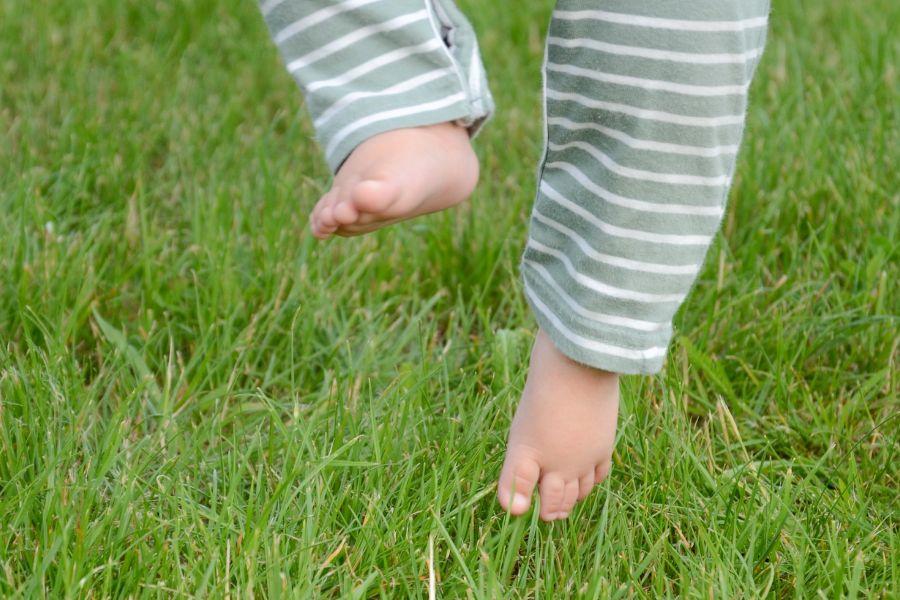
But when you see a baby hovering in the air, legs in splits, you know there’s probably a big ol’ patch of grass beneath them.
Grass?!? you may be thinking. Seriously? Aren’t babies, the purest among us—unspoiled by the trappings of modern life and technology—naturally drawn to the earth?
Apparently not if that earth is covered in grass, nope. For them, the lawn is lava.
Babies—or at least a good portion of babies—will do pretty much anything to not let any part of their bodies touch grass. Viral videos have demonstrated this fact, with parents holding their wee ones over a patch of lawn and lowering them toward the ground.
The way these tiny tots will twist themselves into gymnast-like positions to keep some daylight between them and the lawn is both impressive and hilarious. Watch:
You would think these parents were holding their kids above a pot of boiling oil, not the cool, refreshing grass. So what’s happening here? Why are these babies so averse to touching grass?
“Some babies lift their feet out in the air when a parent attempts to put them down on the grass because as a baby’s nervous system develops, sights, sensations, and sounds are intense,” Hafeez told Romper. “The ticklish, sharp blades of grass can catch a baby off guard, and some babies are often scared of it, as they are used to softer, more comfortable surfaces such as wood, tile, or carpet.”
“The prickly texture and feel of grass is far different than softer and more comfortable feeling of carpet, tile, and wood surfaces on their feet, hands, and body, so babies are often scared of it.” Grass can also be itchy and cause rashes, she said, which can make babies more averse to it.
Another explanation may be more innate and evolutionary. In a 2014 study published in Cognition, researchers reported evidence that “human infants possess strategies that would serve to protect them from dangers posed by plants.”
“Across two experiments, infants as young as eight months exhibit greater reluctance to manually explore plants compared to other entities,” the researchers shared. So perhaps babies simply don’t trust grass.
According to another study published in 2019, there may be something to that distrust idea. Researchers found that babies between 8 and 18 months old “exhibited more social looking toward adults when confronted with plants compared to other object types.” The study authors pointed out that learning about which plants are beneficial and which ones are harmful is something humans can’t do alone, and noted that infants tended to look to older adults for social cues about plants they encounter before touching them.
“This social looking strategy puts infants in the best position to glean information from others before making contact with potentially dangerous plants,” researchers wrote.
So, we have a few options here. Is it possible that those babies in the video weren’t able to glean social cues from their caregivers that the grass was safe? Yes. Is it possible that they’d already touched grass once and found it too “tickly”? Yes. Is it possible that babies do all kinds of surprising, seemingly inexplicable things just to keep their parents guessing and always on their toes? Sure feels like it.
Whatever the reason, watching babies blatantly reject the “touch grass” advice the rest of us keep getting is hilarious. Who says the grown-ups know best? Trust your instincts and do you, babes.
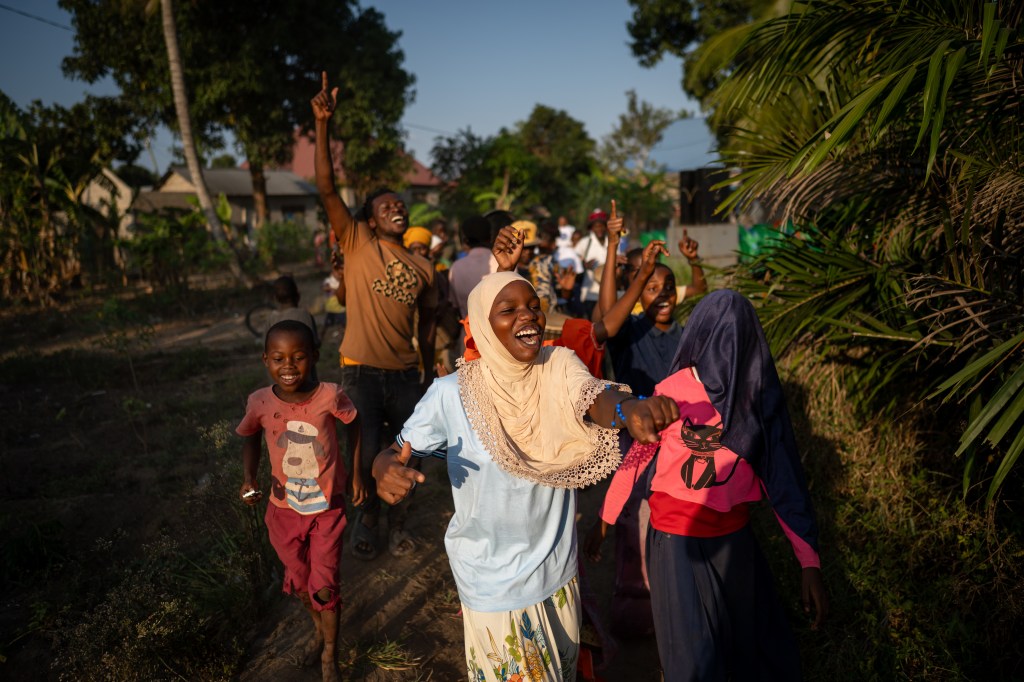
In a small village in Pwani, a district on Tanzania’s coast, a massive dance party is coming to a close. For the past two hours, locals have paraded through the village streets, singing and beating ngombe drums; now, in a large clearing, a woman named Sheilla motions for everyone to sit facing a large projector screen. A film premiere is about to begin.
It’s an unusual way to kick off a film about gender bias, inequality, early marriage, and other barriers that prevent girls from accessing education in Tanzania. But in Pwani and beyond, local organizations supported by Malala Fund and funded by Pura are finding creative, culturally relevant ways like this one to capture people’s interest.
The film ends and Sheilla, the Communications and Partnership Lead for Media for Development and Advocacy (MEDEA), stands in front of the crowd once again, asking the audience to reflect: What did you think about the film? How did it relate to your own experience? What can we learn?
Sheilla explains that, once the community sees the film, “It brings out conversations within themselves, reflective conversations.” The resonance and immediate action create a ripple effect of change.
MEDEA Screening Audience in Tanzania. Captured by James Roh for Pura
Across Tanzania, gender-based violence often forces adolescent girls out of the classroom. This and other barriers — including child marriage, poverty, conflict, and discrimination — prevent girls from completing their education around the world.
Sheilla and her team are using film and radio programs to address the challenges girls face in their communities. MEDEA’s ultimate goal is to affirm education as a fundamental right for everyone, and to ensure that every member of a community understands how girls’ education contributes to a stronger whole and how to be an ally for their sisters, daughters, granddaughters, friends, nieces, and girlfriends.
Sheilla’s story is one of many that inspired Heart on Fire, a new fragrance from the Pura x Malala Fund Collection that blends the warm, earthy spices of Tanzania with a playful, joyful twist. Here’s how Pura is using scent as a tool to connect the world and inspire action.
A partnership focused on local impact, on a global mission
Pura, a fragrance company that recognizes education as both freedom and a human right, has partnered with Malala Fund since 2022. In order to defend every girl’s right to access and complete 12 years of education, Malala Fund partners with local organizations in countries where the educational barriers are the greatest. They invest in locally-led solutions because they know that those who are closest to the problems are best equipped to solve and build durable solutions, like MEDEA, which works with communities to challenge discrimination against girls and change beliefs about their education.
But local initiatives can thrive and scale more powerfully with global support, which is why Pura is using their own superpower, the power of scent, to connect people around the world with the women and girls in these local communities.
The Pura x Malala Fund Collection incorporates ingredients naturally found in Tanzania, Nigeria, Pakistan, and Brazil: countries where Malala Fund operates to address systemic education barriers. Eight percent of net revenue from the Pura x Malala Fund Collection will be donated to Malala Fund directly, but beyond financial support, the Collection is also a love letter to each unique community, blending notes like lemon, jasmine, cedarwood, and clove to transport people, ignite their senses, and help them draw inspiration and hope from the global movement for girls’ education. Through scent, people can connect to the courage, joy, and tenacity of girls and local leaders, all while uniting in a shared commitment to education: the belief that supporting girls’ rights in one community benefits all of us, everywhere.
You’ve already met Sheilla. Now see how Naiara and Mama Habiba are building unique solutions to ensure every girl can learn freely and dare to dream.
Naiara Leite is reimagining what’s possible in Brazil
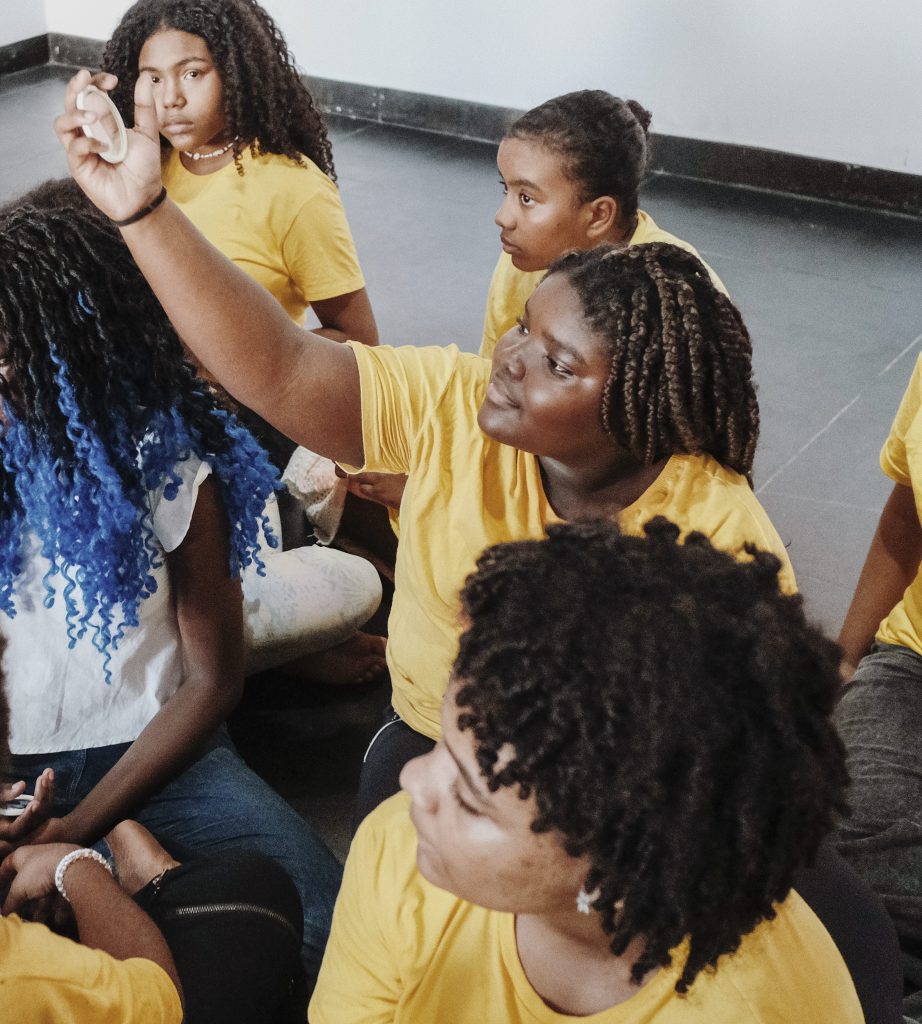
Julia with Odara in Brazil. Captured by Luisa Dorr for Pura
In Brazil, where pear trees and coconut plantations cover the Northeastern Coast, girls like ten-year-old Julia experience a different kind of educational barrier than girls in Tanzania. Too often, racial discrimination contributes to high dropout rates among Black, quilombola and Indigenous girls in the country.
“In the logic of Brazilian society, Black people don’t need to study,” says Naiara Leite, Executive Coordinator of Odara, a women-led organization and Malala Fund partner. Bahia, the state where Odara is based, was once one of the largest slave-receiving territories in the Americas, and because of that history, deeply-ingrained, anti-Black prejudice is still widespread. “Our role and the image constructed around us is one of manual labor,” Naiara says.
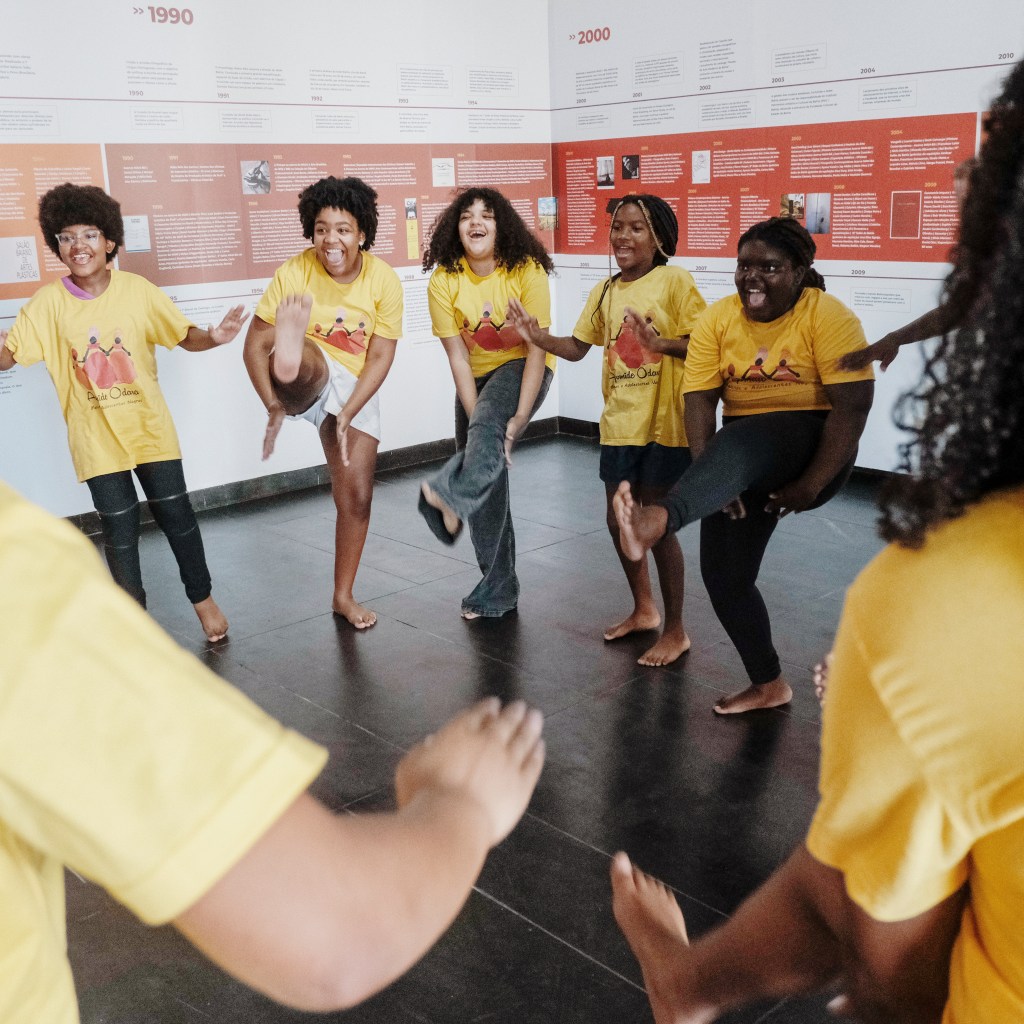
But education can change that. In 2020, with assistance from a Malala Fund grant, Odara launched its first initiative for improving school completion rates among Black, quilombola, and Indigenous girls: “Ayomidê Odara”. The young girls mentored under the program, including Julia, are known as the Ayomidês. And like the Pura x Malala Fund Collection’s Brazil: Breath of Courage scent, the Ayomidês are fierce, determined, and bursting with energy.
Ayomidês with Odara in Brazil. Captured by Luisa Dorr for Pura
Ayomidês take part in weekly educational sessions where they explore subjects like education and ethnic-racial relations. The girls are encouraged to find their own voices by producing Instagram lives, social media videos, and by participating in public panels. Already, the Ayomidês are rewriting the narrative on what’s possible for Afro-Brazilian girls to achieve. One of the earliest Ayomidês, a young woman named Debora, is now a communications intern. Another former Ayomidê, Francine, works at UNICEF, helping train the next generation of adolescent leaders. And Julia has already set her sights on becoming a math teacher or a model.
“These are generations of Black women who did not have access to a school,” Naiara says. “These are generations of Black women robbed daily of their dreams. And we’re telling them that they could be the generation in their family to write a new story.”
Mama Habiba is reframing the conversation in Nigeria
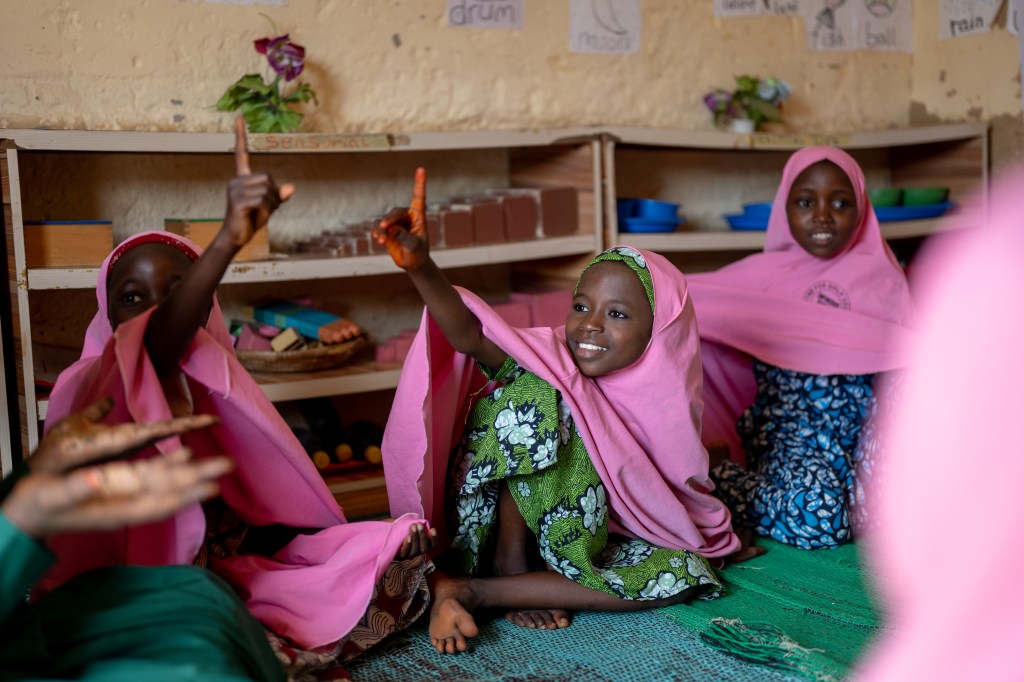
Centre for Girls' Education, Nigeria. Captured by James Roh for Pura
In Mama Habiba’s home country of Nigeria, the scents of starfruit, ylang ylang and pineapple, all incorporated into the Pura x Malala Collection’s “Nigeria: Hope for Tomorrow,” can be found throughout the vibrant markets. Like these native scents, Mama Habiba says that the Nigerian girls are also bright and passionate, but too often they are forced to leave school long before their potential fully blooms.
“Some of these schools are very far, and there is an issue of quality, too,” Mama Habiba says. “Most parents find out when their children are in school, the girls are not learning. So why allow them to continue?”
When girls drop out of secondary school, marriage is often the alternative. In Nigeria, one in three girls is married before the age of 18. When this happens, girls are unable to fulfill their potential, and their families and communities lose out on the social, health and economic benefits.
Completing secondary school delays marriage, and according to UNESCO, educated girls become women who raise healthier children, lift their families out of poverty and contribute to more peaceful, resilient communities.
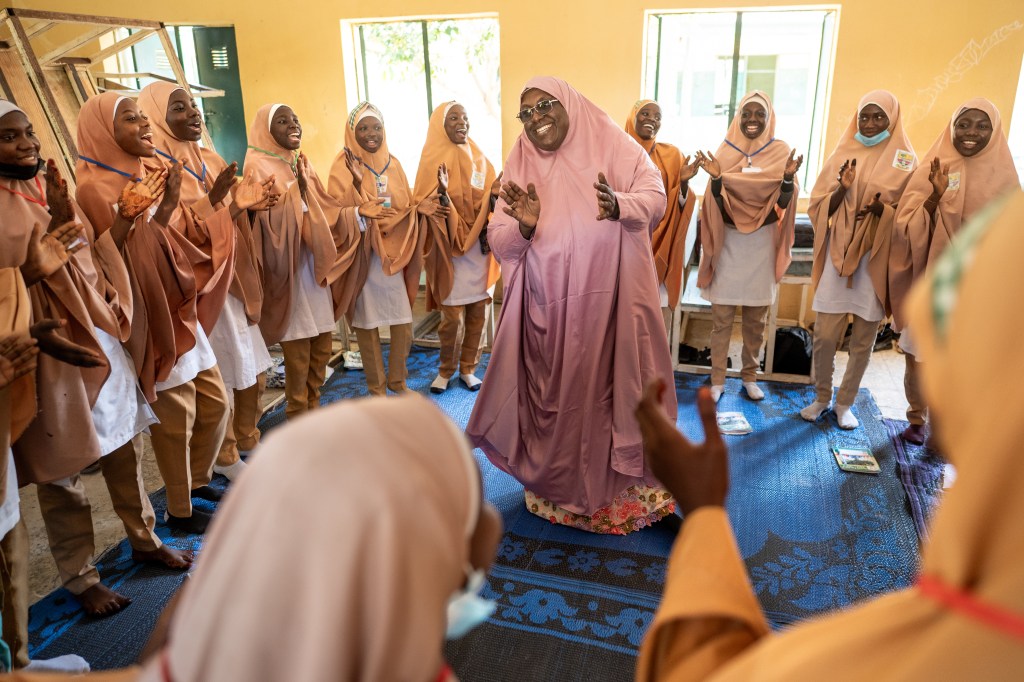
Centre for Girls’ Education, Nigeria. Captured by James Roh for Pura
To encourage young girls to stay in school, the Centre for Girls’ Education, a nonprofit in Nigeria founded by Mama Habiba and supported by Malala Fund and Pura, has pioneered an initiative that’s similar to the Ayomidê workshops in Brazil: safe spaces. Here, girls meet regularly to learn literacy, numeracy, and other issues like reproductive health. These safe spaces also provide an opportunity for the girls to role-play and learn to advocate for themselves, develop their self-image, and practice conversations with others about their values, education being one of them. In safe spaces, Mama Habiba says, girls start to understand “who she is, and that she is a girl who has value. She has the right to negotiate with her parents on what she really feels or wants.”
“When girls are educated, they can unlock so many opportunities,” Mama Habiba says. “It will help the economy of the country. It will boost so many opportunities for the country. If they are given the opportunity, I think the sky is not the limit. It is the starting point for every girl.”
From parades, film screenings to safe spaces and educational programs, girls and local leaders are working hard to strengthen the quality, safety and accessibility of education and overcome systemic challenges. They are encouraging courageous behavior and reminding us all that education is freedom.
Experience the Pura x Malala Fund Collection here, and connect with the stories of real girls leading change across the globe.
It seems kids are becoming less and less welcome in public spaces. For one thing, fewer Americans are choosing to have children at all. Couple that with social media, and the trend has only served to amplify the disruption kids cause in traditionally adult spaces like breweries and brunch spots. An eternal struggle exists between busy parents with no babysitter who still want to enjoy avocado toast and the folks who’d prefer to do so without noisy kids around.
But surely, one place where families are always welcome would have to be church—the original community gathering space. A place where all are not only welcome, but embraced. Even loud kids. However, this has turned out not to be strictly true either.
Over the years, many churches have separated children from the main worship space and instead provided them with age-appropriate activities. It’s a noble idea, but many parents say the practice feels exclusionary and forces families to spend that time apart. Even in the supposedly loving environment of church, there are plenty of folks who want to hear the service without the wail of a toddler in a tantrum.
Julie, a blogger and pastor’s wife, writes, “If you walk into a church that doesn’t have a heart for kids, you’ll know almost instantly. Congregants will look annoyed at childlike behavior and sounds, they’ll strongly discourage children from staying in the worship service, and folks will appear generally disinterested in them.”
One church is going viral for its cleverly worded “new policy” when it comes to noisy kids attending services.
Many churches don’t allow children in the main worship area, or at least frown upon it. Photo credit: Canva
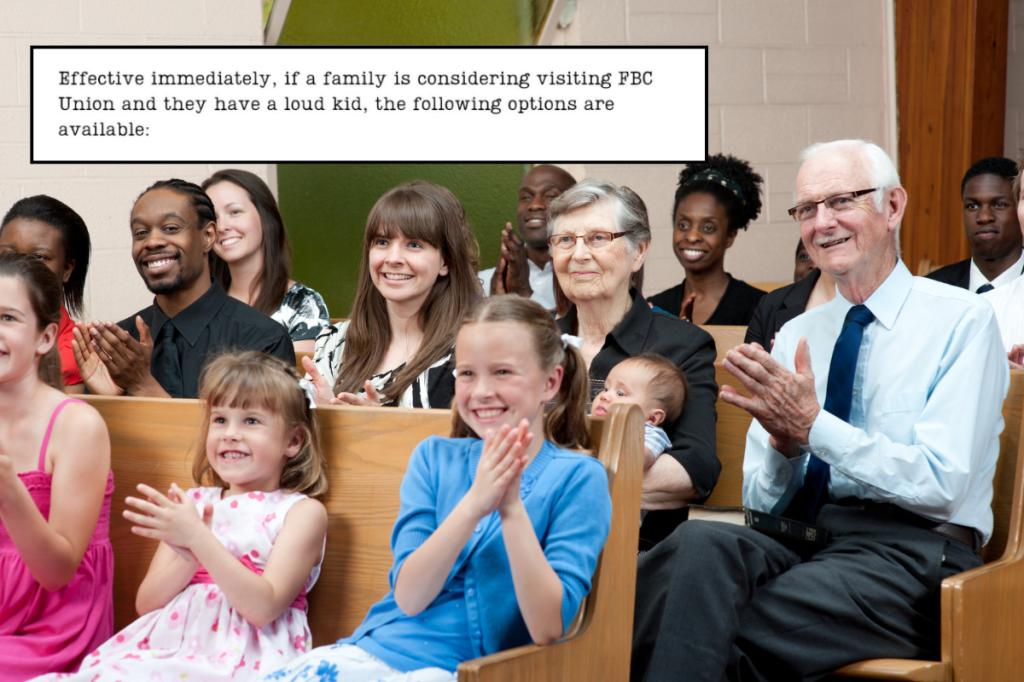
First Baptist Union in Union, Mississippi, recently posted an announcement on its Facebook page regarding loud kids at church.
“There have been updates to the Loud Kid Policy at FB Union,” the post read. “If you have a loud kid, then this is for you. I know it might ruffle some feathers, but we had to do the right thing.”
The whole memo has to be read to be fully appreciated, but in short, church leaders announced they would offer “five” options for families who wanted to visit with loud children. With a little clever wordplay, all of the options amounted to the same thing: Bring them.
“We believe the sound of children in worship is not a distraction. It is evidence of life, growth, and the future of the church. If your child makes noise, you are not bothering us. You are blessing us.”
The post was a viral hit. Not only was it re-shared hundreds of times by the Union community, but it also reached far beyond Mississippi. The original memo and slight alterations of it were posted by churches across the country.
Reactions were largely positive. Many parents and church members chimed in to comment on how much they appreciated the tongue-in-cheek gesture:
“I’m not even a member of FBC so I’m unsure as to why I’m seeing this, however, this is great. A pastor once said that a church without children is the signs of a dying church. Bring in the little ones!!”
“A friend shared your post with me and wow! What a relief! Someone from leadership [at my church] called me and told me that my 18month old foster son was very distracting and then he asked me 1) Do I know we have a nursery? And 2) Why am I not utilizing it. I was livid.”
“I once heard a preacher say, ‘If I can’t preach over a crying kid, it’s time for me to stop preaching,’ when someone got up to take a loud child out of the sanctuary.”
“Not a member but I love this. When I first came to our church I was so worried cuz all of my kids are loud. When they would be loud id look at the older adults and would see smiles. Now I bring our baby in and they all love seeing him. Its so nice not to feel like I can’t sit thru a service because my baby is fussy.”
However, not everyone was on board with the sentiment, especially as the announcement began reaching a wider audience. After New York Times columnist David French reposted it, a few folks took umbrage.
“I don’t love it at all. If your child is being unruly, loud, or disruptive during a church service, you should be considerate of everyone else and step out with them. If they’re old enough, they should be disciplined appropriately. Assuming it’s acceptable to let a child scream and whine through the service is ridiculous.”
“No. When the Word of God is preached, we should have an environment that eliminates distractions. I have 5 beautiful children, but if they’re starting to fuss, or just be a normal 2-4 year-old, we remove them and take them to children’s church or out in the foyer.”
With its post about loud kids at church, First Baptist Union unintentionally sparked a fascinating debate about the presence of children in public, even in family-friendly spaces. Whether we like it or not, children come pre-packaged with noise, movement, and disruption—and it’s not always the result of poor parenting. Whether you find their childish chaos beautiful and invigorating or extremely annoying is a matter of personal taste.
One thing is for sure. With more and more breweries outright banning children and airlines separating young children from their parents during the seating process, thereby sparking wars in the economy section, it’s refreshing to see at least one place take a stand and allow kids to be seen and heard. No matter how loud.
Few people spend more time with kids than teachers. From the classroom to the playground, teachers have deep and intuitive insight into what their students’ relationships are like with their parents, and many teachers can tell when parents are invested and truly care about their kids.
In a Reddit forum, member @allsfairinwar posed the question: “Teachers of Reddit: What are some small, subtle ways you can tell a child’s parent really cares about them?”
Teachers from all education levels shared their insight. From elementary teachers to high school teachers, these educators offered their firsthand experience with students that informed them about their relationship with parents at home. These are their most powerful observations.
Hit It Bang Bang GIF by Eddie & Laura Burton Realty Group Giphy
“When the parent stops and actually looks at their kid’s art/work/listens about their day before heading home. I know everyone gets busy but damn don’t shove the art your kid is proud of right in their bag without first looking at it. We do the same piece of art for a week. They spent 2 hours on that, spare 2 minutes to show them their effort is worth something to you.” —@Worldly_Might_3183
“When the child speaks, the adult listens. When the adult speaks, the child listens.” —@homerbartbob
“When the parents are familiar with the child’s friends and talk to their child’s friends, I know they’re listening to their child talk about their day at school. Or when parents let slip that they got a full recap of something I said or that happened at school. I know they are having conversations with their child at home, and paying attention.” —@Pinkrivrdolphn
“When the kid is happy/quick to tell their parents about things. Not just serious or important things, but just random bullsh*t. Do I care about Minecraft? Not really. Do I care that my kid cares about Minecraft? Very much. Lay it on me kid. Spare no detail.” —@IJourden
“They let their kids fail and experience natural consequences. Good parents are preparing their children to be adults, and part of that is learning responsibility and accountability. Let your kids make mistakes and learn from them!” —@oboe_you_didnt
“You can tell a lot about home life based on students behavior the week leading up to a break. If they are happy/excited/giddy/endearingly obnoxious I know they are going somewhere safe to someone who cares. The students who don’t have that are often increasingly anxious/angry/withdrawn/acting out.” —@pulchritudinousprout
“The moment that a parent greets the child at the end of the day is very telling. Some parents clearly want to know all about their child’s day and connect with them, some don’t.” —@Smug010
“When I make positive contact home and the parent speaks glowingly about their own kid. It’s great to hear.” —@outtodryclt
“A few years back, I heard a parent ask their kid if they found someone to be kind to today. That made a real impact on me. Now I try to remind my own kids to ‘find someone to be kind to’ if I’m doing drop off and/or ask ‘Who were you kind to today?’ after school.” —@AspiringFicWriter
“When a student asks for help, they actually need the help. They are not doing it just to get your attention.”—@Typical_Importance65
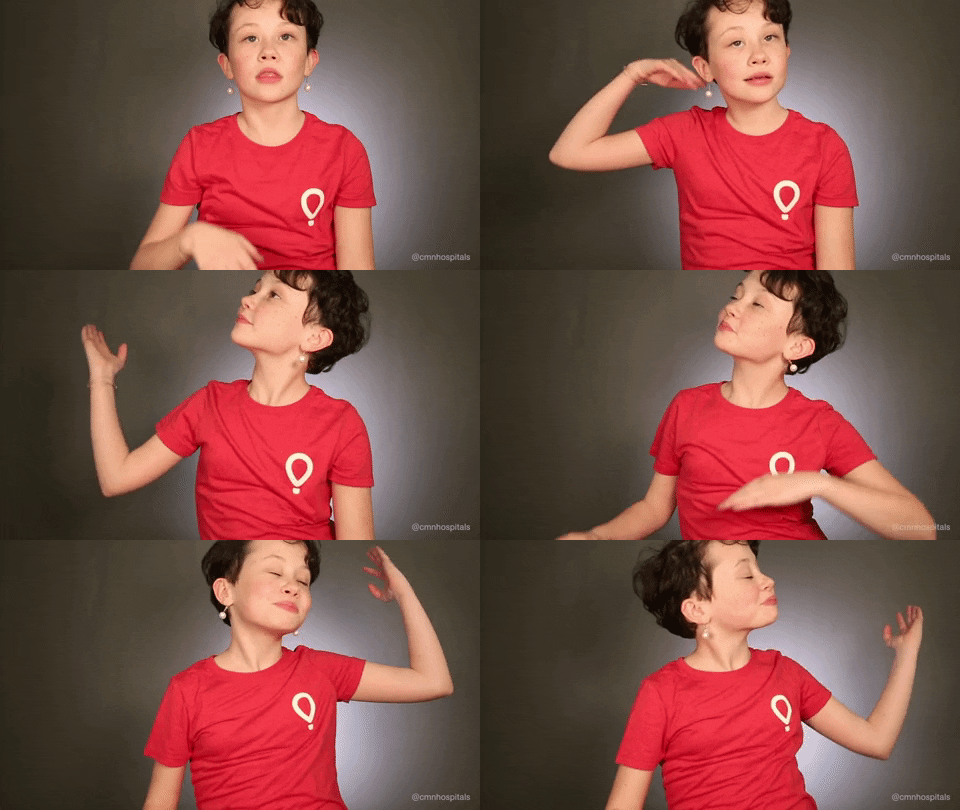
Dance Marathon Reaction GIF by Children’s Miracle Network Hospitals Giphy
“It doesn’t always mean everything is perfect at home, but a child who is well-groomed is always a good sign. That doesn’t always mean the most fashionable clothes or perfect hair, just that the child is clean, their clothes are clean and appropriate for the weather. Also when a child knows how to celebrate their own wins and isn’t afraid of making a mistake or being wrong- that shows that their parents have modeled good emotional regulation.” —@itscornelectric
“They get them services when they’re struggling. I work with kids with disabilities and the learning outcomes/experience of school (and by extension, the greater world) for kids who have their needs met is far different to those who don’t. The number of parents who respond to a teacher saying ‘I think it might be worth John seeing an OT/a speech therapist/ getting his eyes checked’ with something along the lines of ‘f*ck you, what would you know?’ Is astounding. The parents who make appointments, share information from specialists with the school, and are proactive about their children’s abilities or disabilities – their kids see such improvements.” —@prison_industrial_co
“They ask thoughtful questions. Even something that seems routine to adults like, ‘How is/was your day?’ I’m in elementary, and it’s appropriate for kids to talk mostly about themselves. Kids who ask thoughtful questions are doing so because it’s consistently modeled. It’s also not very common (again, age appropriate egocentrism) so it stands out.” —@mundane-mondays
“When you know they’re being exposed to reading at home. Maybe they can read at a higher level or they’re mastering their sight words. For students with learning disabilities, the kids are trying their hardest to read, using context clues, using pictures and making up a story, or even making different voices for characters. When I was in a low functioning Autistic support room, this one little boy couldn’t form words, but he made noises is different voices and used dramatic face expressions on each page to represent characters talking.” —@Mediocre-Bee-9262
“Accountability. A good parent knows that their kids isn’t perfect and if the kid does something wrong (like hitting or bullying other kids) they don’t look for excuses, or for how the other kid provoked that behavior, but helps their kid understand why their behavior was hurtful.” —@SadlyNotDannyDeVito
This article originally appeared last year. It has been updated.
There are so many conflicting ideas about building self-confidence in children. Is there a right way? Could praise be harmful? Should everyone receive a gold star? As with many things in life, sometimes the best solution is the simplest one—hiding in plain sight, or just out of it.
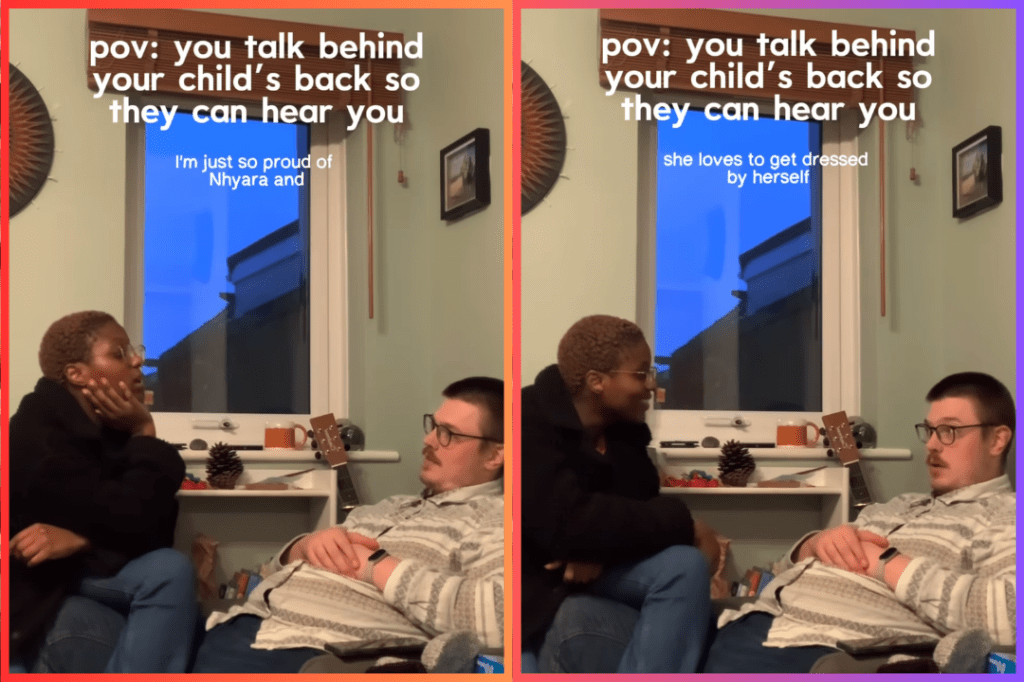
Namwila Mulwanda and her partner Zephi practice “gentle-parenting” with their daughter, Nhyara. Shared in a video on Instagram, one of their techniques is talking about Nhyara when she’s within earshot but out of sight. These aren’t your typical behind-closed-doors parent conversations—no venting about daily frustrations or sharing complaints they’d never say to her face. Instead, they create intentional moments of celebration, offering genuine praise and heartfelt affirmation.
In a viral Instagram post that’s garnered over one million likes, Mulwanda writes, “POV: You talk behind your child’s back so they can hear you.” Self-described as a “passionate mother, content creator, and small business owner,” Mulwanda naturally overflows with ideas: she writes a Substack, She Who Blooms, which is about “blooming in our own time, in our own way.” She also runs Rooted, a shop where she “carefully curates products that embody the essence of growth, empowerment, and staying rooted in one’s true self.”
In the video, Mulwanda and her partner sit in a quiet corner, chatting about their daughter Nhyara while occasionally peeking around to see if she’s listening—which she is. With her within earshot but not directly part of the conversation, they discuss their daughter:
“I’m just so proud of her and the things she does,” her mom starts.
“She works on her reading, like that difficult word that she took the time to really sound out,” adds her dad. They go on to applaud her independence (“She’s always telling me, ‘Daddy, I want to brush my teeth on my own,’” says Zephi), before concluding that she’s amazing.
“She’s amazing,” says Mulwanda. “So, so, so amazing,” Zephi responds.
People in the comments were obviously here for it. Parents shared their own versions of this technique, including one who wrote, “As a solo mom, I pretend to make phone calls to a family member and do this.”
Another parent shared a powerful example:
“My son used to be scared of climbing down the stairs. So, my husband said loudly, ‘He’s very brave! He has shown a lot of courage lately.’ The next day, when we tried carrying him down the stairs, he said, ‘Nope, I have a lot of courage in me.’”
Others reflected on their own childhoods. One commenter wrote, “No exaggeration, I’d be an entirely different person had my parents been like this with me.”
“Stop, I was just thinking last night, ‘When I have kids, I’m going to have loud conversations with my future husband about how much I love our children and how proud I am of them,’” another enthusiastically shared.
Children believe that conversations between adults are more u201cauthenticu201d and honest. Photo credit: Canva
Research indicates that indirect praise has a stronger psychological impact than direct praise, particularly in young children.
“This is such a powerful way of reinforcing positive behavior,” explains parenting influencer Cara Nicole, who also went viral for her unique approach to parenting. “There’s something special about overhearing others talk about you—you know they’re being genuine because they’re not saying it directly to you.”
This effectiveness stems from children’s innate understanding that conversations between adults tend to be more honest than parent-child interactions. From an early age, children recognize that direct conversations with parents often have an intentional, behavior-shaping purpose. In contrast, overheard praise feels authentic and spontaneous, rather than an attempt to influence the child’s self-image.
These techniques work best when praise focuses on effort and process rather than innate qualities. Take Nhyara’s dad’s comment: “She works on her reading, like that difficult word that she took the time to really sound out.”
Yet, it’s crucial to keep praise realistic and measured. Avoid overzealous claims about future achievements, like acing every spelling test for the rest of her life. Children have keen intuition; if they sense insincerity, the strategy can backfire, damaging their trust in parents. Similarly, over-inflated praise—like declaring “incredible” performance for average effort—can burden children with unrealistic expectations.
Keep it simple. A casual remark like, “I noticed how carefully Maya put away her toys without being asked. That was so nice. It really helped keep the house clean.”
The viral response to Mulwanda’s video demonstrates the power of gentle parenting combined with thoughtful, specific praise. It’s heartening to see modern parents sharing their diverse approaches to showing their children love. For many commenters who didn’t experience this kind of upbringing, these conversations offer a path to healing. As Mulwanda eloquently states in her pinned comment:
“To those of you who only heard negative as a child, you were never the problem. You were a child, and you didn’t deserve the experience you had. Your presence on this earth is a blessing, and the fact that you show up every single day is proof of just how amazing you are. You are brave, you are beautiful (you too, boys), and you deserve the world and more. If any of you feel emotions rising up, close your eyes, hug your inner child, and remind them that you’re there.” – Namwila Mulwanda
This article originally appeared last year. It has been updated.
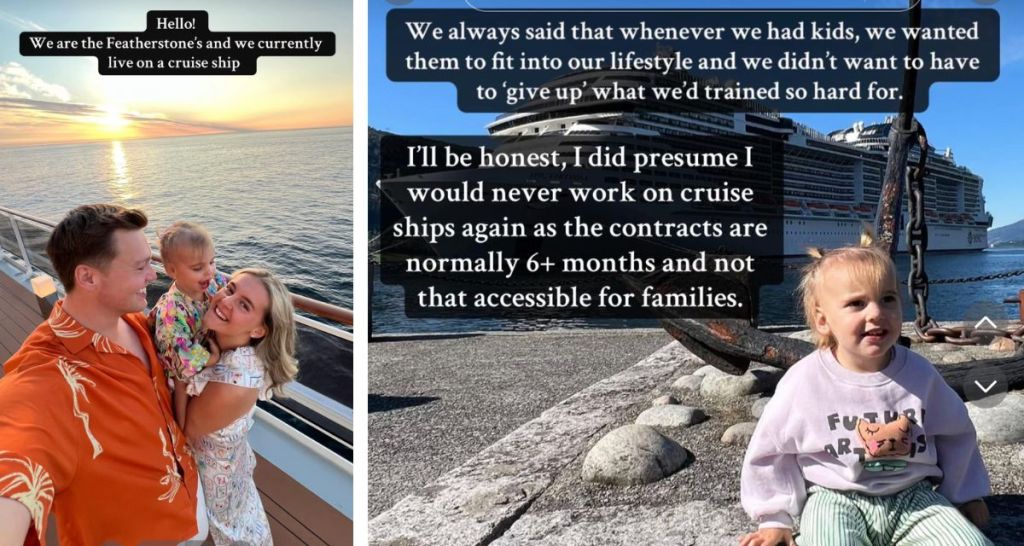
Raising a child on a cruise ship might not be the most conventional parenting choice, but it certainly comes with a view.
Just ask Ben Featherstone, who, in between singing sets aboard the MSC Virtuosa, lives with his wife and their two-year-old daughter, Piper. He documents their adventure along the way for his growing social media audience.
This globetrotting lifestyle wasn’t necessarily something Featherstone originally envisioned. In fact, when he first learned he was going to become a dad, he assumed his cruise ship performing days were behind him. The cruise line he worked for at the time didn’t allow family members to stay onboard, and understandably, fatherhood seemed incompatible with months at sea.
On a whim, he auditioned for a different cruise line. When the contract offer came through, it included an unexpected twist: immediate family members were allowed to stay onboard for up to four weeks at a time. Suddenly, what felt like an ending became a brand-new beginning.
So, Featherstone and his wife decided to give it a go. Their current routine looks a little something like this: every other month, he performs for three days while at sea. During the remaining days of that stretch, the family explores whichever port they’ve docked in—whether that’s a sun-soaked Mediterranean town or a bustling European city. After those weeks onboard, Piper and her mom, who thankfully has flexibility in her own work schedule, return to London for four weeks. Then the cycle repeats.
“Little did I know this [audition] would lead me to create a whole new lifestyle,” Featherstone shared in a video clip.
And for little Piper, life is anything but dull. When she’s not toddling through charming cobblestone streets in a new country, she’s taking full advantage of the ship’s amenities. There are water parks, splash zones, live entertainment, and seemingly endless holiday-themed festivities throughout the year. She also attends the ship’s baby club, where she socializes and plays with other children her age from all over the world. In many ways, the ship has become its own tiny, ever-changing village.
In one particularly heart-melting moment shared online, Featherstone’s castmates serenade Piper for her second birthday as crew members gather to celebrate. The video captures how this unconventional life still manages to create a sense of community. Though constantly on the move, Piper is surrounded by familiar faces who cheer her milestones and help create memories that will last a lifetime.
“What an amazing life!” one viewer commented. It’s kind of hard not to agree.
Of course, the lifestyle isn’t without its challenges. As Featherstone candidly told People, “raising a 2-year-old is quite hard either way.”
Parenting doesn’t suddenly become effortless just because there’s an ocean view. There are still tantrums, sleep schedules, and picky eating to contend with, plus the logistical puzzle of traveling with a toddler. During the four weeks when Piper and her mom return to London, Featherstone deeply feels their absence.
Still, for this family, the trade-offs feel worth it. Instead of choosing between career and parenthood, they’ve found a creative way to blend both—proving that sometimes the most custom-made paths lead to the richest experiences.
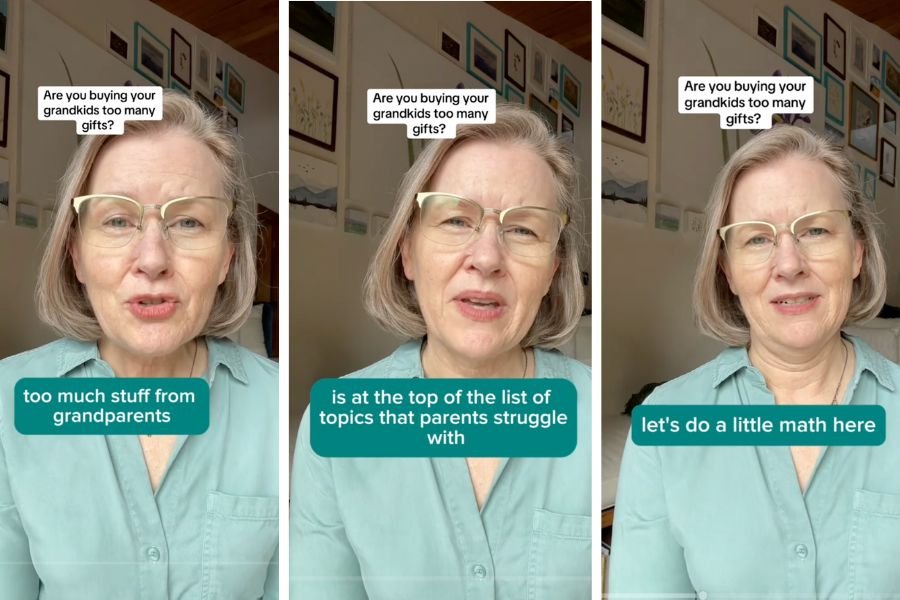
Gift giving should feel good for the giver and the receiver. But around the holidays, it can be a major cause of stress. – Photo credit: @morethangrand/TikTok
Parents and grandparents find themselves at odds frequently. It could be a disagreement over how much screen time the kids get, battles over grandma giving them too many sweets, or arguments around how often grandma and grandpa should be babysitting. Conflict in their relationships is almost a given, and navigating disagreements in a healthy, productive way is key for the relationship to evolve and grow.
One huge source of that conflict comes in the form of… stuff! All parents can relate to the sense of dread they feel at the sight of the grandparents arriving for a visit with a trunk-full of of presents. Toys, furniture, costumes, decor, you name it. And that’s just on a regular Tuesday. Around the holidays, it can get even worse. It’s not that they don’t want their kids getting gifts, it’s just all too much, especially when you live in a home with a finite amount of storage.
“75% of the parents that we surveyed wished grandparents would respect their wishes about gifts,” she explained, noting that while there are myriad reasons why this would be the case, the most common one (and incidentally the one most “waved off” by the grandparents) is the lack of physical space to accommodate.
Now, you might be thinking: How much harm can it really do to give a kid a new card game or a baby doll? Certainly those don’t take up that much room. But when Moore breaks down the math, it’s a bit hard to deny.
“Say your grandson has four other grandparents and four aunts and uncles. Each of these people get him one gift for a second birthday. That’s already nine gifts plus something for mom and dad. We’re up to 10,” she said.
“If all of those grandparents buy him three things, and two of the aunts get him a little extra something, that’s 22 presents for a 2 year old who would be just as happy with a box.”
Add in gifts from friends, and random gift-dumps from grandma when she’s been on a hot-streak at the thrift store, and you’ve got a serious storage problem on your hands.
Yikes, gotta admit that’s a lot. And that’s not counting the additional problems too much gift-giving can incite listed on the More Than Grand website, which included:
Undermining the parent’s values that they are trying to instill to their children
Damaging a child’s ability to use their imagination
Normalizing overconsumption
Teaching children to associate seeing grandma or grandpa with getting a gift, rather than focusing on the actual relationship
(Here’s another one: Too many gifts steals Mom and Dad’s thunder! Parents often put a lot of thought into picking out presents they know their kids will love, only for them to get buried in the avalanche of surprise presents.)
These are all good points, and yet, what to do with all those good intentions and a desire to spoil some precious little nugget? Luckily, Moore has the perfect fix.
“While your grandchildren are faced with getting too many gifts, many children are in the opposite situation. Take some of the things you bought to Toys for Tots or another organization that provides gifts for less fortunate families.”
This allows folks to step into the “true spirit of giving,” Moore concluded.
Viewers by and large seemed to agree, though many also noted how powerful experiential or future-building gifts could be, even if they’re not as cute as toys or as fun to open.
“My in-laws opened up a college fund for both my kids. Instead of stuff they put more money in the account. I’m so grateful!” one person wrote.
Another added, “I am giving experiences and putting money in an account for future needs (college, 1st house, starting business, etc).”
In the vein, here are two other tips grandparents can use for intentional gift-giving…
First and foremost: open up a discussion with the parents. See if they need help with a big ticket item, find out which hobby or sport the child is interested in, ask what’s a definite “no.” this can save a lot of headaches for everyone.
“The gifts should surprise the grandkids, not their parents,” as one commenter wrote on the video.
Second: prioritize memories over stuff. A trip to the zoo, an education membership, a ticket for two to the movies…these are often the gifts that truly keep on giving.
And grandparents, don’t forget: just because you’re honoring boundaries, it doesn’t mean you have to pass up that sweet little something you see in the aisles. After all, shopping is fun, and it’s even better when you find a great deal or a cool discovery. But it can easily go to a little one who could really use it.
For even more tip on all things grandparenting, give More Than Grand a follow here.
This article originally appeared last year. It has been updated.
Parents spend 18 years raising their children (and sometimes more), so it’s hard to pinpoint the exact moment that matters most in their upbringing. Is it helping them with homework when they’re struggling? Inspiring them to get back up after failure? Or is it the example you set when interacting with loved ones?
Kennedy, known online as “Dr. Becky,” is a clinical psychologist and the founder and CEO of Good Inside, a parent-coaching platform designed to “help you solve current challenges and get ahead of future ones.”
On a recent episode of What Now? With Trevor Noah, Dr. Becky shared why repairing relationships is the most important thing a parent can do. Even though she is one of America’s most popular family psychologists, she often falls short of perfection and loses her cool, just like any parent. But these moments of imperfection matter because they allow her to grow with her child—and that’s invaluable.
“I mean it with such honesty that my kids don’t have some Dr. Becky person as a mom,” she said. “I also mean equally that I wouldn’t wish that upon anyone. I mean, we learn the most in our relationships when people take responsibility for their behavior, when people repair. I wouldn’t want to deprive my kids of that opportunity, and that’s such [an important] part of healthy relationships.”
Why repair is so important in relationships
“After all, there’s almost nothing within our interpersonal relationships that can have as much impact as repair,” Dr. Becky said in a 2023 TED Talk. “Repair is the act of going back to a moment of disconnection. Taking responsibility for your behavior and acknowledging the impact it had on another. And I want to differentiate a repair from an apology, because when an apology often looks to shut a conversation down, ‘Hey, I’m sorry I yelled. Can we move on now?’ A good repair opens one up.”
Dr. Becky shares how to repair a relationship with a child
“I often think about three elements: name what happened, take responsibility, state what you would do differently the next time. It could come together like this:
‘Hey. I keep thinking about what happened the other night in the kitchen. I’m sorry I yelled. I’m sure that felt scary. And it wasn’t your fault. I’m working on staying calm, even when I’m frustrated.’
A 15-second intervention can have a lifelong impact.”
Dr. Becky’s advice should be uplifting to parents everywhere because no one is perfect—not even Dr. Becky—and we will all lose our cool at times. But when it happens, it gives us the opportunity to teach our kids the most important interpersonal skill: how to repair a relationship that has ruptured.
When we learn how to repair our relationships, we can ensure they won’t fail at the first sign of trouble. Instead, stronger relationships have the potential to stand the test of time.
There’s a popular trend where parents often share they are creating “core memories” for their children on social media posts, whether it’s planning an elaborate vacation or creating an extra-special holiday moment. While it’s important for parents to want their kids to have happy childhoods, sometimes it feels presumptuous when they believe they can manufacture a core memory. Especially when a child’s inner world is so different than an adult’s.
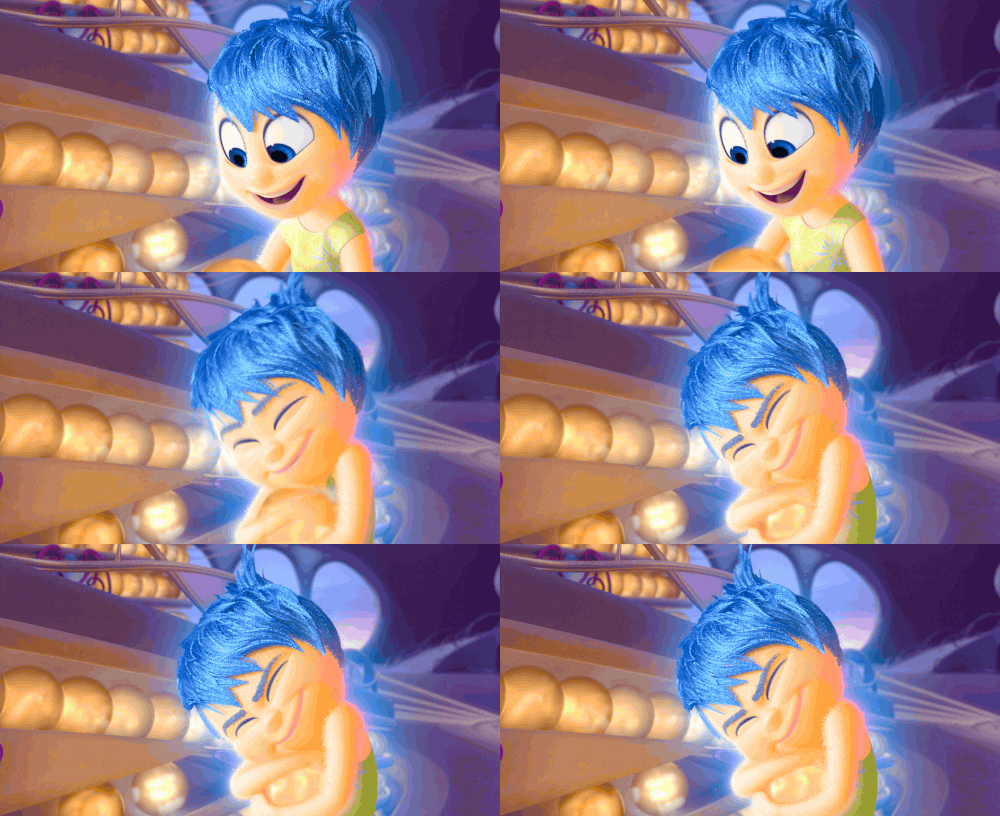
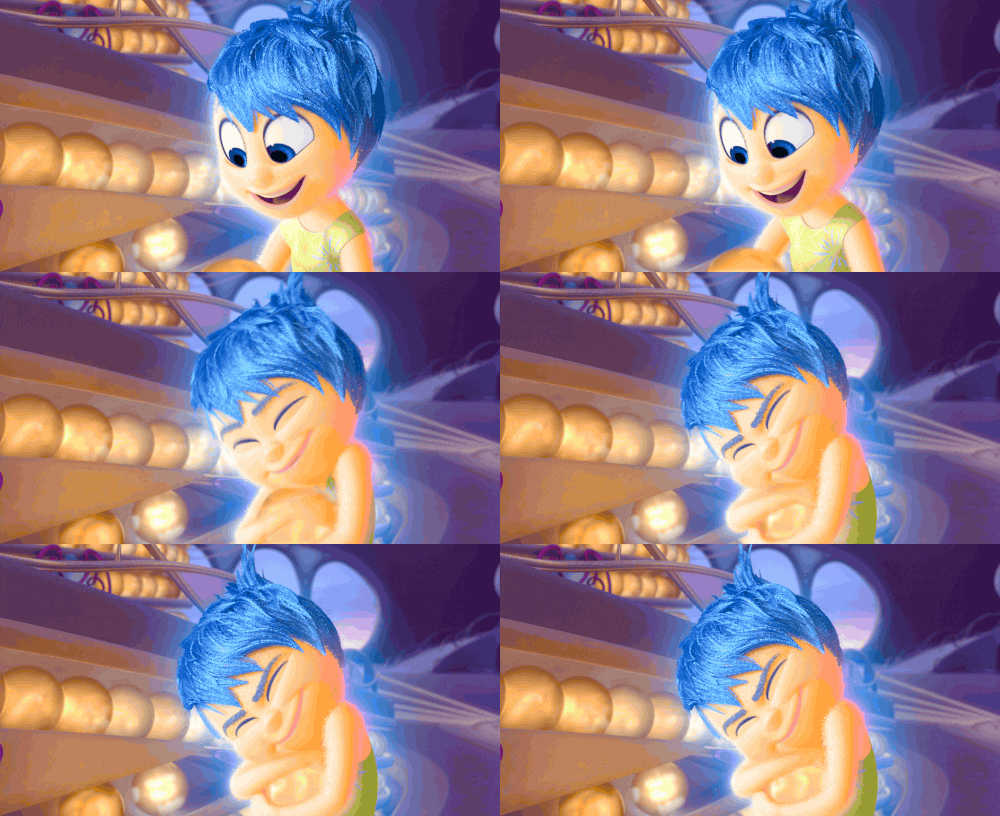
The concept of “core memories” was made mainstream in 2015 thanks to Disney’s Inside Out. In it, “core memories” are born from moments and experiences that majorly shape a part of the main character, Riley’s, personality. The experience(s) can be grand or benign; the point is these moments are ultimately forming Riley into the person she is. Seems pretty hard to manufacture such a moment, but parents are certainly trying.
Carol Kim, a mother of three and licensed Marriage and family Therapist, known as Parenting.Resilience on Instagram, recently shared the “5 Things Kids Will Remember from Their Childhood” on her page. The fascinating insight is that none of the entries had to do with extravagant vacations, over-the-top birthday parties, or Christmas gifts that kids could only dream about.
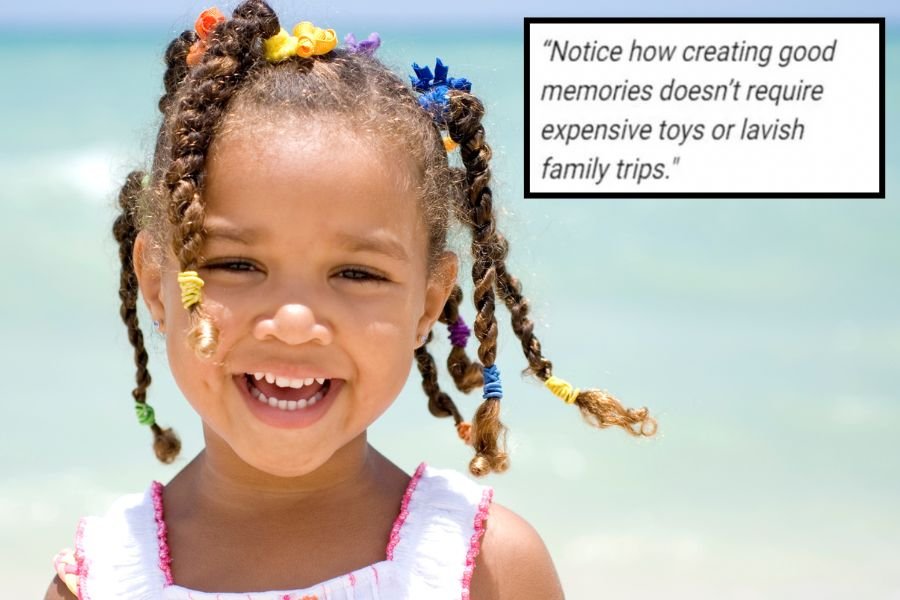
According to Kim, the five things that kids will remember all revolve around their parents’ presence and support. “Notice how creating good memories doesn’t require expensive toys or lavish family trips. Your presence is the most valuable present you can give to your child,” Kim wrote in the post’s caption.
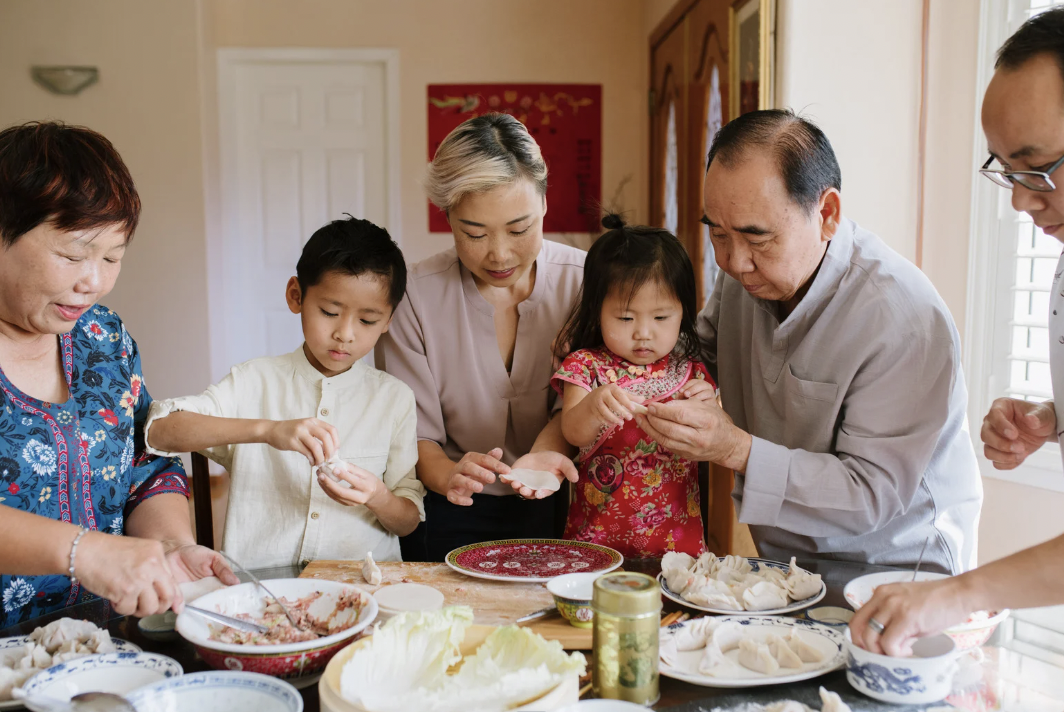
“Taking some time to focus only on your child is very special. Playing games, reading books, or just talking can create strong, happy memories. These moments show your child that you are present with them.”
2. Words of encouragement
“Encouraging words can greatly impact your child during both good times and tough times. Kids often seek approval from their parents and your positive words can be a strong motivator and source of comfort…. It can help kids believe in themselves, giving them the confidence to take on new challenges and keep going when things get tough.”
3. Family traditions
“It creates a feeling of stability and togetherness … Family traditions make children feel like they belong and are part of a larger story, deepening their sense of security and understanding of family identity and values.”
“Seeing and doing kind things leaves a strong impression on children. It shows them the importance of being kind and caring. They remember how good it feels to help others and to see their parents helping too.”
5. Comfort during tough times
“Knowing they can rely on you during tough times makes them feel secure and build trust. … Comforting them when they’re struggling shows them they are loved no matter what, helping them feel emotionally secure and strong.”
Kim’s strategies are all beautiful ways to be present in our children’s lives and to communicate our support. However, these seemingly simple behaviors can be challenging for some parents who are dealing with issues stemming from their pasts.
“If you find barriers to providing these things, it’s important to reflect on why,” Kim writes in the post. “There could be several reasons, such as parenting in isolation (we’re not meant to parent alone), feeling overstimulated, dealing with past trauma, or struggling with mental health. Recognizing these challenges is the first step to addressing them and finding support.”
It’s getting harder to distinguish adult drinks from kids’ drinks these days. In recent years, adult beverage makers have created new versions of traditionally “soft“ drinks and made them “hard,” whether it’s seltzer, kombucha, soda, lemonade, or juice boxes. So, it’s easy to be fooled when reaching into the back of the fridge for a kids’ drink and finding a Cutwater 11% ABV Lemon Drop Martini instead.
Recently, the South Fulton Police Department in Georgia shared a post about a Cutwater Lemon Drop Martini can in a lunch box. For the uninitiated, Cutwater drinks have double, and sometimes triple, the alcohol content of the average can of beer. With sweet flavors like Tiki Rum Mai Tai, Strawberry Margarita, and Rum Mojito, some mistake them for kids’ drinks.
To call attention to the problem, the South Fulton Police Department posted a pretty hilarious warning on Facebook, urging parents to watch what their kids bring to school:
“Say Twin…
Before you send them babies off to school… CHECK. THE. LUNCHBOX.
That is NOT Capri Sun. That is NOT Apple Juice. That is a whole ‘Parent had a long night’ starter pack.
Now little Johnny done pulled up to 3rd period talking about: ‘Who want fruit snacks?’ knowing good and well he got a Lemon Drop Martini in the zipper pocket.
TIGHTEN UP TWIN!
We know mornings can be hectic… But your child shouldn’t be the only one in the cafeteria with a beverage that requires an ID.
If it says 12% ABV… it does NOT belong next to a PB&J.
Check the lunchbox before the school resource officers gotta do inventory at recess.”
‘Say Twin’ has become a local catchphrase
The department’s use of “Say Twin” in its messaging has been a hit with locals. “‘Hey twin!’ It’s a term of endearment that’s here that has just taken off, especially in Atlanta,” South Fulton Mayor Carmalitha Gumbs told Atlanta News First. “It’s bringing light to real issues that we’re facing in our community. We’re meeting residents where they are, so they can actually get it.”
Coming Soon! Cutwater Lemon Drop Martini 🍋 🍸🤩
A perfect balance of their award winning vodka, tart lemon juice and a splash of sweetness ✨ pic.twitter.com/DcC60GLWMP
After the story went viral, media outlets began poking around and asking South Fulton schools about the incident to find out where it happened. However, it didn’t. After the initial post, the South Fulton Police Department admitted the story wasn’t true.
It posted a clarification in the comments:
“Important: This did NOT happen in the City of South Fulton or in Fulton County Schools.
We’re sharing this because media outlets have started contacting local schools asking where it happened, and we don’t want any confusion in our community.
The real takeaway here is awareness. Across the country, there’s growing concern about alcoholic drinks being packaged to look like non-alcoholic ones and even being placed near them in stores, which can lead to honest mix-ups.
Friendly reminder to:
Double-check lunchboxes and backpacks
Keep alcohol stored safely and out of reach
Talk with kids about only drinking what a trusted adult gives them
We appreciate y’all helping us spread awareness and keep our community safe “
Was the update a clever backtrack after getting caught creating a fake story? Or was the original post a playful way to educate parents about a real problem the department never expected to be taken seriously? That’s for the people of South Fulton to decide.
The post inspired some hilarious comments
Even though the story was later proven false, the comments on the post are still pretty hilarious.
“Idk about y’all, but those 12% ABV be hitting pretty hard with that Smuckers Uncrustable on a hot summer’s day on the lake,” one person wrote.
“That kid was trying to get a little turnt at school today,” another added.
Some folks in the comments thought the drink may have been for the kid’s teacher. One joked, “… it was really sent for the teacher as a peace offering.”
Kids mistaking adult beverages for soft drinks is a real problem
A teacher in the San Antonio, Texas, area made a big mistake last summer, proving South Fulton’s warning wasn’t entirely unwarranted. The educator accidentally handed out Hard Mountain Dew drinks to students on the last day of seventh grade. One child went to the hospital after ingesting a Hard Mountain Dew Baja Blast Pineapple. The student drank nearly half a can and felt disoriented while at school.
“He says it tasted a little different,” Aaron Corso, the boy’s father, shared with KENS 5 News. “But he didn’t think too much of it. Because he doesn’t drink too much soda. He hardly drinks soda at all.”
This story from Texas and the warning out of Georgia are reminders to parents everywhere to be mindful of where they store alcoholic beverages, especially those that resemble soft drinks.









 CHECK. THE. LUNCHBOX.

 “
“