upworthy
Add Upworthy to your Google News feed.
Google News Button
Pop Culture

Rural residents share things that people who've always lived in cities won't understand

Humans share so much in common, but our daily lives can be drastically different.

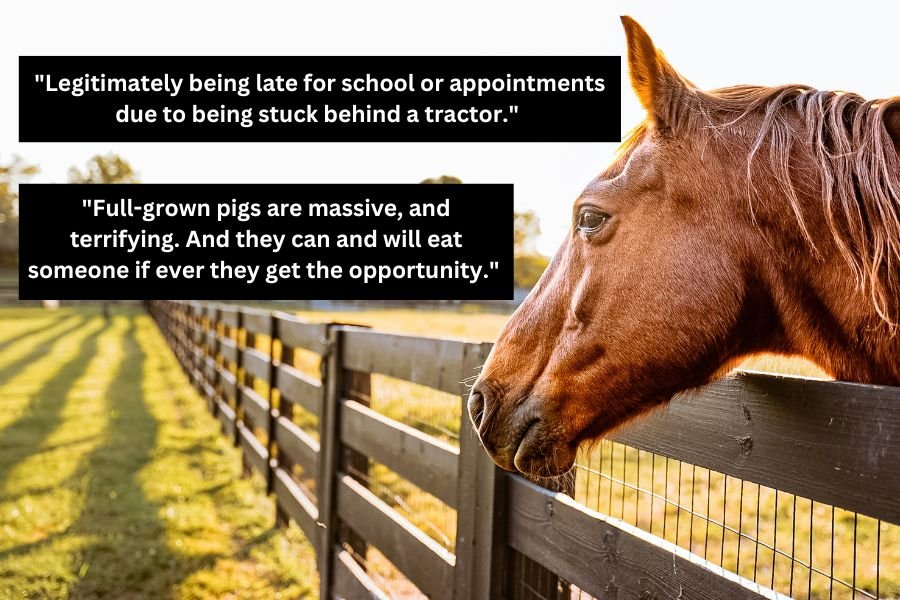
horse behind a fence on a farm

Country life has its own unique quirks.

If you were to travel around the U.S., you'd see probably note some cultural differences between various regions, from the East Coast to the West Coast, from the South to the Midwest. But what really gives Americans different experiences and perspectives is rural life vs. city life.

Americans have a huge expanse of land we call home, some of which is made up of densely populated cities with intertwining highways and some of which is vast farmland dotted with small towns. Rural and city folks share the most important things in common, of course—the desire to live in peace, the ability to take care of our families, the need for a community we can count on, the appreciation of beauty and nature—but our daily lives can look totally different from one another in sometimes dramatic ways.


Someone on Reddit asked, "Rural folks, what are the things city folks won't understand?" and the answers are a fascinating peek into life in the country for people who have lived their whole lives in cities. Here are some of the most popular responses:

There may not be traffic, but there are tractors

"Legitimately being late for school or appointments due to being stuck behind a tractor."Bimblelina

"I would always leave my house super early when it was planting season and harvest season."Sadimal

"We drove our tractors to high school one day per year to celebrate the agriculture that was all around us, wild times."TwinTowwa69

"When I was dating my now wife, we were long distance. I grew up in the middle of nowhere Missouri and has several farms around where I lived. One time I was talking to my then girlfriend on the phone and told her 'Ah crap, I'm stuck behind a tractor. Gonna be a long drive.'

She was silent for a moment before saying '....a tractor? What?' Then it occurred to me that her having grown up in a suburb of Atlanta, had never experienced such a thing."paddjo95

Personal wars with the wildlife

"You or someone you know has a personal vendetta against a wild animal in the area."NFL_MVP_Kevin_White

"I've never seen my father be more creative than when he's plotting against a racoon that has wronged him." reinvent___

"Oh my gosh yes. My dad's at war with a woodpecker. He’s even printed out an info pamphlet on woodpeckers and wrote in big letters “know thy enemy”. The amount of whirligigs and nets around the house is insane."jbird8806

"My uncle was in a war of attrition against beavers for literal decades." KMM2404

"Two of my neighbors have a shoot on sight policy for groundhogs. The one who is the most mild mannered was riding down the road on his side by side, and I see him slam the breaks, do a turnabout in a driveway, then heard a gunshot, then he sped off. Saw the groundhog the next morning. The other one, every time I hear a gunshot I wonder 'snake or groundhog?'"TacticoolPeter

So many random cows

"I own a house that sits smack in the middle of three cattle farms. The other night, I took my dog out to pee well after dark. There was a weird noise, and a pair of glowing eyes at the end of my driveway. It was, of course, a cow. I called my neighbor to the North. He drove his UTV down, inspected the cow, didn't recognize it, and called my neighbor to the south. He sent his teenage son over in a car with no catalytic converter/muffler. He also didn't recognize the cow. Finally, my neighbor from the West was summoned on his ATV. It was his cow. The rest of us stood there drinking beer and watching the Western neighbor drive his cow home with an ATV. Good times."EarhornJones

"My neighbor keeps her horses on our farm because we have some pastures already fenced in and the horses keep the grass level. One of the horses, Rose, loves to get out of the pasture and mosey around the farm — more than once she’s walked up to the house and bumped her nose against the window where I’m working inside to say hello. So of course I have to pop outside and pet her and then walk her back. 🤷🏼♀️ She’s a darling.

Neighbor also has a cow named Star who likes to come up and visit her equine sisters. A bit later, when my neighbor realizes the cow’s missing, I’ll see her trudging up the lane with a lead and then the cow meekly following behind her." Elphaba78

"Our cows got out last year for two days and I swear every old man for five miles was stoked to watch for them and help put them back. Word spread like wildfire they were out. Old men were texting on a group text and mounting their atvs and calling my husband. “I seen them on Troy’s place!” It was super helpful and entertaining."farmchic5038

So many random vegetables

"Leaving your car windows closed at church in the summer so you don't come back out to a car full of zucchini"Armyjeepguy

"There’s no escaping the zucchini. It will be left on the hood, or the roof, or the gardener will straight up accost you after mass and shove a bag of it in to your arms, or trick your children into bringing bags of it out to the car."MrsMeredith

"I'm from western Iowa. Instead of zucchini, it's always sweet corn."ProfessorRoyHinkley

"This is exactly the example I use to explain to people the difference between the city and the country. If you live in the country the only reason you lock your doors to your car is the people don’t put vegetables in it. No one believes it’s not a joke."Overall_Midnight_


There's no such thing as a quick run to the grocery store

"You need to carefully plan out your shopping needs because that trip to Walmart or Home Depot might be a two hour round trip." lockednchaste

"Moving rural taught me how to cook. I had to build up a well stocked pantry and freezer because the grocery store was an hour away. I had to learn how to plan meals because you needed to know what to thaw out. I learned so many substitutions because sometimes you just didn't make it to town and the milk, eggs, butter or what have you ran out. All that also got me more comfortable just throwing skillet dinners together because sometimes there just isn't time for recipes, but I knew what worked well together.

Also, canned and frozen foods. Fresh produce is only good for the first few days after grocery day." HplsslyDvtd2Sm1NtU

"I was on the phone with someone one day and realized I forgot milk at the store. They were utterly flabbergasted that i said it was going to have to wait until a few days later to go get because I was not going to do an hour minimum of driving total just to get one item." HobbyHoarder_

Pigs are much scarier than you'd think

"Full-grown pigs are massive, and terrifying. And they can and will eat someone if ever they get the opportunity."Heroic-Forger

"I'm reminded of my time at the University of Iowa. A fellow I knew, grad student age, but he wasn't actively attending, walked with a cane because of a gimpy leg. He'd broke it when he was a child, but he'd tell anyone who asked that he was mauled by a sow. He said the city people would just laugh it off as a joke. The country people would look at him in horror and say, 'And you're still alive?!?!'" – DrHugh

"Having to explain to my kid why everyone was so scared when Dorothy fell into the pig pen in Wizard of Oz was surreal. I can't even remember when a healthy fear of swine was instilled into me."tikierapokemon

"I've worked with wolves, literally had some of them lick my face. I was significantly more uncomfortable being in a pen with a large pig."Learningstuff247

Talking about the weather isn't just trivial small talk

"Weather changes your life. I've sat on the porch with my parents watching hail destroy our wheat crop days before it was due for harvest. There's nothing you can do. You just watch. I've also stood in a circle with my parents and older brother in the yard while we prayed for rain. For farmers, weather is destiny." Cranialscrewtop

"I took an English lit class in college and we read journal of a woman in the 1860s. Several people were really turned off by how much she wrote about the weather. As the only farm kid in the class I tried to explain to them how much of your life is dictated by the weather. Most of them just stared at me like I was nuts."msjammies73

"I'm not a farmer, I am from Nebraska. My relatives who live in a city in another state their whole lives don't understand why people here talk about the weather so much. It determines the local economy in a lot of ways."bubbajones5963

The sweet sound of snowy silence

"Standing on my back porch in winter and there is absolute dead silence." vankirk

"The absolute quiet during a heavy snow fall. I went out during one once to take pictures. Got some great shots but the experience of being the only one around is the closest I’ll get to being a pioneer and being the first to see something."naughtarneau

"I miss dead silence at night. I grew up with it in a small town, but since college I’ve lived in places with actual civilization. But whenever I’ve brought friends back to my town for a weekend, they’re freaked out by the nighttime silence." Petules

"Silent and DARK. I've lived in huge cities, suburbs, and back-end-of nowhere unincorporated areas. How dark it gets at night just amazed me in the rural areas."Nearby_Reality_5412

"It’s so beautiful. My favorite thing every year is to go for a jog during the first snowfall. No sound but your feet, your breath, and that soft sound of millions of snowflakes landing at once. It’s a bit of peace you just can’t get anywhere outside of a cave."xdrakennx


The Reddit thread has more responses, from not flushing the toilet during a power outage to why having multiple guns doesn't make you a gun nut, that are interesting reads about rural life. And of course, a reverse list could easily be made by city folks for people who have always lived in the country. The better we understand one another's basic daily experiences, the better we're able to see through one another's eyes and understand one another's perspectives.

crowd, unique, personality type, nonconformist
Photo Credit: Canva

A person stands out in a crowd.

So many of us have the desire to compartmentalize our personality traits into neat little boxes. "Oh, she's such an INFJ. Oh, he's such a Gemini." Some of it is rooted (well sort of) in psychology, such as the Myers-Briggs Type Indicator, based loosely on Jungian ideas. Others rely on arguably less scientific data like stars and "rising signs." Humans aren't usually that simple.


That said, there's still value in understanding one's own personality and inclinations. Here's a confession: I've taken countless personality tests because I just couldn't figure out if I was an extrovert or an introvert. Neither description quite fit, and as someone constantly trying to understand what makes me tick, this has been frustrating.


Turns out, there are other options. The term "ambivert" got popularized in the 1930s (after being coined by Edmund S. Conklin in 1923), and it refers to a person "who has features of both an introvert (someone who prefers to spend time alone) and an extrovert (someone who prefers to be with other people) in their personality."

@tedtoks

Replying to @Factura🛄 now knowing what an ambivert is, how would you describe yourself? #ambivert #introvert #extrovert #adamgrant #psychology #TEDTalk #worklife

But for those who still don't quite relate, meet the otrovert. Just recently, psychiatrist Rami Kaminski published The Gift of Not Belonging, in which he discusses his coined term to describe a whole new type of personality. In an Insta-reel captioned "What is an Otrovert?" Kaminski mentions the polarization of introverts and extroverts. "When Jung invented the terms extrovert and introvert, he saw them as two fundamental orientations of the personality. I see the otrovert in the same way. A personality trait that faces away from the group."

He continues, "Extroverts and introverts are inherently communal, while the otrovert is an outsider to the group. In itself, it is not a problem or condition, nor is it a diagnostic label. It simply means that while most people learn to develop a sense of belonging to a specific group through social conditioning, otroverts remain social but not communal."

In writer Sarjna Rai's piece, "Struggle to Fit the Mold? The 'Otrovert' Personality Explains Why" for Business Standard, they write: "Unlike introverts or extroverts, otroverts are not defined by where they draw their social energy. Instead, the concept captures people who constantly feel like outsiders, and tend to look in a different direction altogether, not necessarily aligned with the rest of the group."

While it's impossible to group people into perfect categories, Rai explains that Kaminski claims the main thing that sets otroverts apart is their "reluctance to conform to group norms."

Writer Avery White lists signs one might be an otrovert in the article "7 Signs You Might Be an Otrovert" for VegOut. Among them is preferring "high-signal conversations and low-maintenance relationships." They give this as an example: "You’ll happily spend three hours exploring one idea with one person—and then not speak for weeks without either of you taking it personally. In other words, low pressure, low expectations, high connection.

Another on the list—and this is a big one according to Kaminski—is: "You can look extroverted in public—yet feel fundamentally 'other.'" This is actually the crux of the term, and in fact, what Kaminski formed The Otherness Institute for: as their website says, "those who feel they don't belong."

The site also shares that recognizing aspects of this type in yourself and others (if it applies) will help "balance between your individuality and your function as part of the social matrix that determines your well-being. The experience of otherness in a togetherness-minded world can be emotionally bruising. Often misunderstood and misdiagnosed, otherness may lead individuals to feel strange, lonely, and unwelcome in groups. Left unidentified, otroverts' non-belonging can result in a frustrating, futile lifetime effort of trying to 'fit in.'"

Some Redditors are scrambling to figure out if they fit into this category. In the subreddit r/INTP (referencing one of the Myers-Briggs personality types), the OP asks, "Maybe I am an 'otrovert?'" Under this, they write, "Dr. Kaminski described the otrovert child as 'neurotypical, friendly, curious, well-adjusted, and often popular' yet 'they resist being pressured into group activities.'"

While this can seem inconsequential in childhood, joining the peer group "becomes critically important" in adolescence, said the psychiatrist, and teens "start to gauge their self-worth based on the group’s ranking of popularity (or unpopularity).'

"Membership in a group, no matter how lowly, is better than being an outsider," he added. "Otroverts, however, are comfortable with being outsiders and find it impossible to feel like insiders, regardless of how welcome they are.'

There are a handful of commenters who feel seen, but many push back, claiming the term could easily apply to other personality traits. One writes, "I think it's easy to resonate with this description... but as some warning noted, there aren't enough studies done about this term that people should be running to adopt it. I resonated with it after reading about it... But I have ADHD and persistent depressive disorder... both of which coincide with the descriptions of an otrovert."

Time will tell if this new term sticks, but for now, it's helping a lot of people feel more understood.

This article originally appeared last year.


Humor

The weird history of Spoonerisms: English's silliest slips-of-the-tongue

No, these slip-ups don't mean you have drain bamage.

spoonerism, william archibald spooner, w.a. spooner, english language, english, language, words, diction, phonetics
Bain News Service/Wikimedia Commons & Leslie Ward/Wikimedia Commons

When you accidentally flip the beginning or ending sounds of two words when speaking, that's a Spoonerism.

We all make mistakes when speaking off the cuff. Sometimes we flub a word, stutter, or forget the point we were trying to make. Other times, our slip-ups are far more hilarious, like when we unwittingly swap the beginning or ending sounds of two words in a sentence.

"I'm going to bead a rook," or "I'll see you at Brunday Sunch," may seem like random gaffs, but they are actually a well-documented phenomenon with a strange history and an official, if goofy-sounding, name: Spoonerisms.


It all started with a man named William Archibald Spooner in the 1800s.

Spooner, a tutor and eventually Dean at New College of Oxford, was initially known for his kindness—even though he was also a little odd.

spoonerism, william archibald spooner, w.a. spooner, english language, english, language, words, diction, phoneticse New College, Oxford; the birthplace of the SpoonerismHoncques Laus/Wikmedia Commons

"One touching story describes how Spooner insisted on providing an Egyptian student with extra blankets and warm clothes, as the boy was struggling with the British climate. Another tells of a student who had injured himself while playing hockey. Spooner paid for his medical expenses, as his family could not afford them. Spooner’s odd behaviour could be off-putting at times, but he had his students’ best interests at heart" writes Sami Anderson-Talbi for New College.

Soon after, however, he began to be known for something else: His absent-mindedness and a tendency to flub his words in a peculiar manner. These were quickly dubbed Spoonerisms by his students, and the legend grew rapidly.

Anderson-Talbi writes that a Spoonerism is defined as, "the unintentional mix-up of parts or words, thoughts, and phrases, often resulting in humorous phrases or situations."

Documented Spoonerisms include referring to a "Dr. Childe's Friend" as "Dr. Friend's child," and warning a group of undergraduate students about the "weight of rages" (rate of wages). But soon, Spooner's reputation for misspeaking grew and more and more examples came to light. Some of them were apocryphal, others were complete fiction, including:

  • "It is kisstomary to cuss the bride." (It is customary to kiss the bride.)
  • "You have hissed all my mystery lectures." (You have missed all my history lectures.)
  • "You have tasted two worms." (You have wasted two terms.)
  • "Sew me to another sheet." (Show me to another seat.)
  • "The Lord is a shoving leopard." (The Lord is a loving shepherd.)

But at that point, the reputation stuck.

spoonerism, william archibald spooner, w.a. spooner, english language, english, language, words, diction, phonetics Sadly, Spooner wasn't a huge fan of his silly reputation.Bain News Service/Wikimedia Commons

Spoonerisms were far from an inside joke on the Oxford campus. In 1924, Spooner wrote in his diary that he met an American woman who was thrilled to meet a "celebrity" such as himself.

In fact, the mythical power of Spoonerisms was so strong that Spooner is said to have spoken extremely slowly with many pauses in an effort to make fewer mistakes. But his thought process was also evident in his writings, with many words crossed out and paragraphs rife with errors. "Spooner’s mind seemed to move at a pace faster than his mouth—or in this case pen—could keep up with," writes Anderson-Talbi.

Spooner was not a fan of his reputation for Spoonerisms, and after one speech, sighed and announced, "And now I suppose you will expect me to say one of those things."

- YouTube www.youtube.com

Language Testing International writes that Spoonerisms can be caused by any number of factors. Most commonly, rushing or being distracted when speaking can lead to mixing up your words. So can a sort of computing error in your brain, where the sentence you were planning on saying changes at the very last second and the words come out mixed up. Spoonerisms can also show up more when you're tired, or in children, who have to work harder to focus on correct diction.

It's not just English, either. Different languages have Spoonerisms too.

Frequent Spoonerisms can also sometimes be anecdotally linked to disabilities like Dyslexia or ADHD. Difficulties with speech or any condition where someone's brain is moving "faster" than their mouth can manifest in slip-ups like Spoonerisms.

Ultimately, however, we are all guilty of the occasional Spoonerism. And though Spooner himself didn't love that the flubs were officially named after him, he may have felt better if he knew how much laughter and delight we all get out of each other's Spoonerisms today.

dog experiments, dog tongue cleaner than humans, experiments by kids, cool science, dogs, fun science, experiments, science

A young teen boy holding a beagle.

Dogs come in a wide variety of breeds, along with their own unique personalities and needs. They can be guardians, helpful workers, loyal friends, snuggly companions, but there's one thing almost all dogs have in common: Licking.

Sure, some dogs lick way more than others, but it's rare to find a dog who never licks anyone or anything. Many dogs communicate and show affection by licking, which is sweet—if a little gross—depending on how slobbery they are. There's a common saying that dogs' mouths are cleaner than humans', which is a bit hard to believe when you see what some dogs put in their mouths, but it is true?


What does science say about dog tongues and saliva? Is a dog licking our face something we should worry about?


dog experiments, dog tongue cleaner than humans, experiments by kids, cool science, dogs, fun science, experiments, science A man being licked by a golden retreiver. Photo credit: Canva

It turns out, the answer to whether a dog's mouth is cleaner than ours isn't super straightforward.

An 8th grader named Abby tackled this question in a science experiment that won her a Young Naturalists Award from the American Museum of Natural History in 2011. Her family had gotten a dog and her mom kept telling her not to let the dog lick her face because dog mouths are full of bacteria. Instead of arguing, Abby decided to find out herself if this was true.

"I hypothesized that human tongues would be cleaner than dog tongues," she wrote. "I thought this because humans brush their teeth at least once a day. I hypothesized that dogs' tongues would be dirty because they were always licking dirty things like garbage."

After diving into the research about bacteria that live in and on humans and dogs, Abby decided she had a testable hypothesis. But this wasn't any old middle school science experiment. She applied for and got a grant to the State Hygienic Lab at the University of Iowa, where she was assigned a mentor to work with her.

You can read the nitty-gritty details of her experiment here, but it involved a lab, swabs, agar plates, and more. Here was the conclusion:

dog experiments, dog tongue cleaner than humans, experiments by kids, cool science, dogs, fun science, experiments, science A dog's tongue close-up. Photo credit: Canva

"I concluded that dog and human mouth flora are very different. (Flora means the bacteria found in a mouth or anywhere else.) The bacteria found in human mouths are more similar to another human's oral bacteria than the bacteria found in a dog's mouth.

"I also concluded that dogs' mouths are cleaner than humans' in some ways, and dirtier in other ways. Humans have more bacteria in their mouths than dogs do, based on the total number of bacteria. Most of the humans had a 'moderate' number of bacteria, and most of the dogs had 'few' bacteria. A possible explanation of this might be that dogs pant a lot, and maybe while panting, bacteria falls off their tongues along with their saliva. But dogs had more types of bacteria. The average number of different bacterial colonies in a dog's mouth was about 5.7. The average number of different bacterial colonies in a human's mouth was about 4.1. I think this is so because dogs sniff and lick a variety of things, like carpets, floors, chairs, grass, etc., so they pick up bacteria from many places."

But what about the licking of our faces? That's a bit of a subjective call, but Abby's results gave her some peace of mind:

"In conclusion, will I let my dog continue to lick me? The answer to the question is yes!" she wrote. "I will feel guiltless about letting my dog lick me because I found out that human and dog oral bacteria are different, so my dog's oral bacteria present no harm to me."

What do the experts say?

According to Colin Harvey, professor at the University of Pennsylvania’s School of Veterinary Medicine and executive secretary at the American Veterinary Dental College, comparing dogs' mouths to humans' mouth is "like comparing apples to oranges." As Abby found, the microbes in a dog's mouth are very different than those in a human's.

The American Kennel Club elaborates:

"Most of the bacteria in your dog’s mouth aren’t zoonotic, which means you probably won’t get a disease from a big old doggy kiss. There are exceptions to this. Dogs that eat a raw diet are at an increased risk of contracting salmonella, which can be spread to humans. You also probably shouldn’t share kisses with a dog that regularly raids the litter box.

In other words, kissing your dog is less risky than kissing another human, but that doesn’t mean that your dog’s mouth is necessarily cleaner than a human’s—they just have a mostly incompatible set of germs."

Keeping your dog's mouth healthy through regular teeth cleaning and dental check-ups can also help prevent issues that could potentially come from dog licks.

dog experiments, dog tongue cleaner than humans, experiments by kids, cool science, dogs, fun science, experiments, science A golden retreiver getting their teeth brushed. Photo credit: Canva

So there you have it. If your dog doesn't eat a raw diet and doesn't go snacking in the cat box (or some other equally fecal-bacteria-ridden place), their kisses are probably not going to hurt you. Guilt-free pooch smooches for the win!

This article originally appeared last year.

debate, political debate, disagreement, agreement, consensus,

People debating at a city council meeting.

One of the most challenging things to do as a communicator is to convince someone you disagree with to listen to you. You’re fighting against a host of psychological phenomena that prevent people from changing their minds or listening to those with whom they disagree. Persuasion is incredibly difficult because we’ve evolved to cling to our views no matter what.

One of the most pronounced psychological blockages is the backfire effect, which states that when people are confronted with information that challenges their opinion, even if it is indisputable, they will hold onto their views even more strongly than before.


So, what are we to do in a world where there is so much misinformation and zombie lies flying around? Dr. Alison Wood Brooks, a professor at Harvard Business School who studies conversation and emotion, shares the key to having a constructive dialogue with people we disagree with is: Don’t invalidate them.

stressed couple, couple's therapy, therapist, upset woman, upset man, Couple arguing during therapy.via Canva/Photos

The moment we invalidate someone by saying, “I disagree,” we’ve killed our chance at persuading them. Dr. Books believes that changing people’s beliefs is important, but it only happens over time. So, it's pointless to disagree at the onset of the conversation. “The only way that we change our beliefs is usually across many conversations and we're around someone we like talking to and respect and have admiration for. And then over time, we sort of bend to the gentle pressure of their differing viewpoint,” she told Bartlett.

Dr. Brooks shared her strategy in a recent appearance on the Diary of a CEO podcast with Steven Bartlett.

- YouTube www.youtube.com

Three steps to disagreeing with someone without invalidating them

1. You don’t need to be certain

“Even if you're right, like it's not about being right or wrong in that moment. The goal here is to keep the conversation in an emotional place where it can continue. So, you can continue to engage. And that's what these researchers find in this receptiveness recipe,” Dr. Books said. The receptiveness recipe is a research project by Harvard and the University of British Columbia that created a formula for the most effective way to disagree with someone.

2. Hedge your claims

“I think often people think of these types of things as weakness because it's like our instinct is to try to win and be right. And instead, what I'm saying is no, hedge your claims. Show that you're uncertain about stuff. Validate their feelings. Divide yourself into disagreeing parts because you're not certain about anything, in order to keep the conversation going, so that you have any shred of hope of persuading them over the longer term.”

If they say the sky is purple:

“That’s interesting. I'd love to hear more.”

“As a painter, who knows a bit about color, that is so intriguing.”

The key is to make it an emotionally safe dialogue and show you’re interested in what they have to say. In turn, they'll be more receptive to your thoughts.

argument, debate, coworkers, art, questions, why Two coworkers debate each other.via Canva/Photos

3. Hold back your disagreement

“I wrote this chapter in my book called 'Do Not Disagree.' It's an intentionally provocative chapter because people think, ‘What do you mean, never disagree with anybody?’ But I mean, don't make the first thing you say 'I disagree,'" Bartlett adds.

“That's right. It can come later,” Dr. Books added. “It can come later, but first has to come like ‘Oh, it's so intriguing that you said that. I'm so fascinated, and it makes sense that you might feel that way. I wonder if…’ and then you can go on instead of ‘I disagree.’”

Ultimately, the key is understanding that changing someone’s mind takes time and is nearly impossible if we shut down the conversation by invalidating them. By delaying the instant gratification of saying, “You’re wrong! I got you, here are the facts,” you can create a space where they are more open to listening to what you have to say. You've validated their beliefs, so they'll be more likely to consider yours.

retirement, retired couple, park, relaxation, where to retire

Where will you retire?

If you're fortunate enough to live long enough to stop working and enjoy your golden years in retirement, you may start to wonder where you want to spend them. When you're no longer tied to a place by a job or family obligations, and you're looking for the best bang for your buck along with the amenities you want and need, it's natural to begin searching for the best places to retire.

Many people's first thought when it comes to retirement is "south," which is why some of the places on the U.S. News & World Report’s 2026 list of "Best Places to Retire in the U.S." may come as a surprise. While the rankings are dominated by Florida and Texas, those two states account for only a little over half of the Top 20. Many of the remaining cities, including the No. 1 spot, are located in the northern part of the country, in places that are decidedly not warm come wintertime.


The list was compiled using criteria such as quality of life, overall value, tax rates, senior population/migration trends, and health care quality. Let's go through the Top 10:

1. Midland, Michigan

If you've never heard of Midland, that's probably because it has a population of less than 43,000 people. However, the median home price is just north of $200,000 and rent isn't even $800, so your retirement dollar would go pretty far there. The small city sits at the confluence of two rivers and is also the home of Dow Chemical. Do with that information what you will.

2. Weirton, West Virginia

We're going even smaller for No. 2. Weirton has less than 19,000 people and a median home value of just over $124,000, making it uber affordable. Rent will set you back around $550. And it's only about a 40-minute drive to Pittsburgh, so if you get bored, you can always hit the bigger city.

3. Homosassa Springs, Florida

Ever heard of this one? It has a population of about 15,000 (they're really pushing the small-town retirement angle here) and a median home value of around $219,000. Located in western Florida between Tampa and the Panhandle, the town is home to a state wildlife park, and is undoubtedly warmer than the first two places on the list.

4. The Woodlands, Texas

The Woodlands is a bit bigger, crossing into six-figure population territory at just over 116,000 residents. We also see a jump in home prices in this suburb of Houston, though, with a median price of $474,000 and average rent a bit over $1,400. The city's website refers to it as a "destination whose culture and offerings rival the nation's largest and most vibrant cities," so that sounds promising.

5. Spring, Texas

With a population of around 68,000, Spring is close to, but more affordable than, The Woodlands, with a median home price of about $251,000. Rent isn't much lower, though, at just over $1,300. Definitely look into buying a house instead of renting if this is where you choose to spend your retirement.

6. Rio Rancho, New Mexico

rio rancho, new mexico, best places to retire, retirement, aging Rio Rancho, New Mexico.G. Edward Johnson/Wikimedia Commons

Moving west, Rio Rancho is a northern suburb of Albuquerque. It's home to about 108,000 people, and the median home value is about $310,000. Rent runs about $1,200. If that classic Southwest feel is your thing, this is where to go.

7. Spring Hill, Florida

Lost of springs on this list, eh? If you're looking for a 100,000+ population without a significantly higher cost of living, Spring Hill gives you the best bang for your bigger-city buck. (Not that 100,000 is a big city by most standards, but it's not a small town either.) The median home price is just over $300,000, and rent comes in a little above $1,100.

8. Altoona, Pennsylvania

Altoona is the least expensive place to live among the Top 10, with a median home price under $115,000. (Did anyone know there were still places with home prices like that anymore?) The city has a population of about 43,000, and median rent sits around $660. Not too shabby, price-wise. Not sure what people do in Altoona, but it's probably affordable.

9. Palm Coast, Florida

palm coast, florida, ocean, coast, retirement Palm Coast is on the eastern coast of Florida.Wikimedia Commons/Lance Asper

Palm Coast just sounds like a place to retire, doesn't it? Located on Florida's east coast, north of Daytona Beach, Palm Coast has a median home price close to $380,000 and rent approaching $1,500. It's not the most affordable spot in the Top 10, but hey, palm trees, right?

10. Lynchburg, Virginia

Named for Quaker John Lynch and founded in 1757, Lynchburg is the oldest city in the top places to retire, so if history is your thing, this would be a good option. With about 80,000 residents, it's neither a small town nor a large city, and with a median home price under $224,000 and rent just over $900, it's affordable, too.

Here's how the rest of the Top 20 rounds out:

11. Bismarck, North Dakota

12. Victoria, Texas

13. Palm Harbor, Florida

14. Rochester Hills, Michigan

15. Troy, Michigan

16. Sioux Falls, South Dakota

17. Pearland, Texas

18. Naples, Florida

19. Pensacola, Florida

20. Conroe, Texas

Again, lots of Florida and Texas, but a surprising showing from Michigan and the Dakotas, too.

retirement, retired couple, park, relaxation, where to retire Retirement looks different in different places. Photo credit: Canva

What should people consider when they're looking for a place to retire?

U.S. News & World Report used its own criteria to compile this list, but what should the average person look for when thinking about where they might want to retire? Kiplinger's "A New Guide to Choosing Where to Retire" shares five considerations to keep in mind:

1. Local tax rates

States tax retirement income differently, and property taxes vary widely from place to place. Because retirees need to stretch their retirement funds carefully, taxes are an important factor to look into and understand before settling somewhere.

2. Health care

As we age, our health care needs often change and increase. Additionally, health insurance for retirees may have local limitations, so it's important to make sure your plan lines up well with wherever you end up. The quality of doctors and specialists, along with access to medical facilities, are also big considerations.

3. Lifestyle suitability

Are you active and adventurous? Do you want easy access to cultural experiences and the arts? Do you desire peace and quiet? Is sunshine and warmth important to you? Do you want to garden year-round? Do you plan to travel and want to live near a major airport? All you have is time when you're retired, so thinking through how you'll want to spend it is key.

beach, coast, ocean, retirement, retired couple What kind of environment do you want to be in when you retire?Photo credit: Canva

4. Climate risks

In the 21st century, the way climate change affects different regions is a major consideration. Places prone to natural disasters like wildfires, floods, and hurricanes may be less appealing as those events become more frequent and intense.

5. Sense of community

Who you spend time with matters, and having a sense of community can make a big difference in how your days feel. In retirement, having a community can also help you have a more regular schedule as you set up routine times to get together with others, volunteer, or otherwise be socially active.

Whether you're close to it or just thinking ahead, there's a lot to consider when it comes to where you retire.