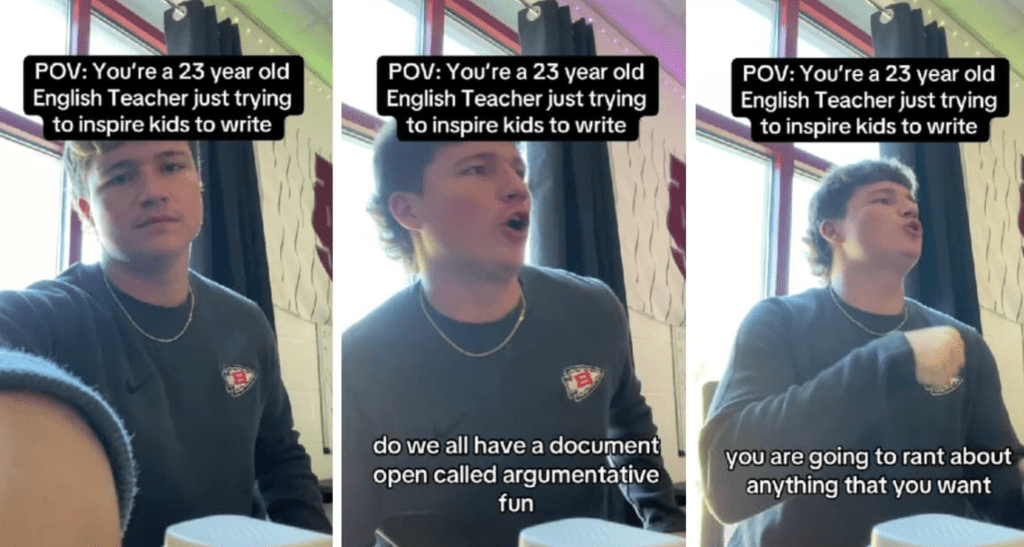
Dean Whitehead is 23 years old and in his first year of teaching high school English. He’d heard enough complaints from students about boring essay topics to know he needed to try something different. So one day he set up a camera in his classroom, opened a shared document he’d titled “Argumentative Fun,” and gave his students an assignment unlike anything they’d been asked to do before.
Ten minutes. Any topic. No grammar corrections, no spelling deductions. The only way to win bonus points was to be genuinely convincing.
“It has to be something you feel so strongly about that you can type for 10 minutes straight,” Whitehead told them, as captured in his TikTok video posted to @mrcoachwhitehead. A few students immediately had questions. One asked for a minute to think. Whitehead gave them eleven. Voice-to-text was off the table.
Students take writing to another level – their own
The essays came in. They were, as promised, unhinged.
One student ranted about curfews, arguing that weekends should be completely free because school is already hard enough. Another went after boys in general. One made a detailed case for wanting to be rich specifically so they could give money to their friends and family. Someone addressed the injustice of teachers confiscating phones. One student, apparently undaunted by the fact that their teacher was reading this, wrote in the middle of their essay that Whitehead wasn’t actually the best teacher.
Caillou hits a big nerve
But the winner, and it wasn’t close, wrote about Caillou.
For those who have blocked the PBS Kids animated series from memory: Caillou is a perpetually four-year-old Canadian child who whines his way through every episode and faces consequences for approximately nothing. The student’s essay, Whitehead reported in a follow-up video that has now been viewed more than 11 million times, cited Caillou’s baldness as suspicious and his ability to get away with everything as a fundamental injustice. “When I say this was the most convincing rant I’d received, I mean it,” Whitehead told his class. “I also hated Caillou.”
Five bonus points, awarded.
Finding passion through freewriting
What surprised Whitehead most wasn’t the content — it was the quality. When students actually cared about their topic, the mechanics followed. “The craziest surprise was they actually did fantastic on their own with grammar and creating full, complete sentences,” he wrote in the comments. “I was super proud of them.”
The technique Whitehead stumbled onto has a real name: freewriting. Teachers have used low-stakes, high-freedom writing exercises for decades precisely because removing the fear of being graded wrong tends to unlock students who’ve otherwise decided they hate writing. The catch is getting them to care about the topic enough to sustain it. Turns out strong opinions about animated characters work just fine.