upworthy
Add Upworthy to your Google News feed.
Google News Button
Pop Culture

People share the 18 things that are a 'subtle sign' someone is really smart

"They effortlessly communicate complex concepts in a simple way."
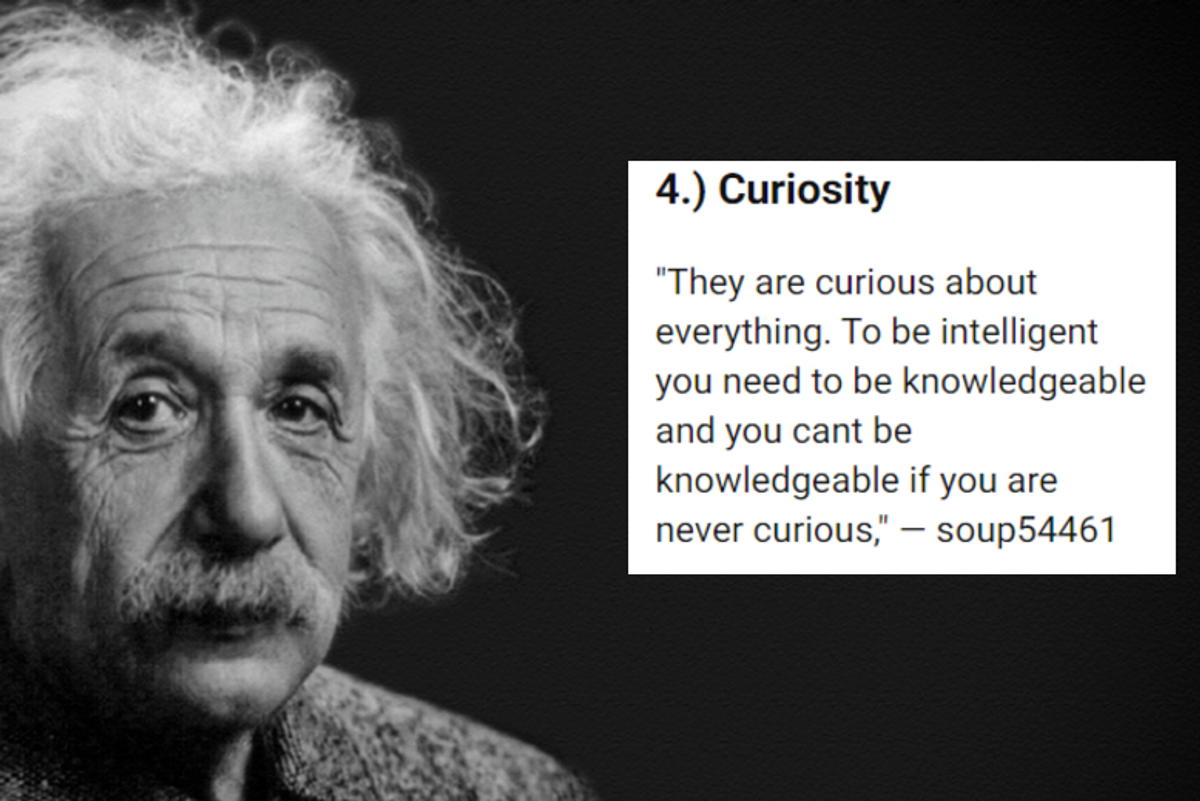
Albert Einstein beside a comment

Albert Einstein

One of the strangest things about being human is that people of lesser intelligence tend to overestimate how smart they are and people who are highly intelligent tend to underestimate how smart they are.

This is called the Dunning-Kruger effect and it’s proven every time you log onto Facebook and see someone from high school who thinks they know more about vaccines than a doctor.

The interesting thing is that even though people are poor judges of their own smarts, we’ve evolved to be pretty good at judging the intelligence of others.


“Such findings imply that, in order to be adaptive, first impressions of personality or social characteristics should be accurate,” a study published in the journal Intelligence says. “There is accumulating evidence that this is indeed the case—at least to some extent—for traits such as intelligence extraversion, conscientiousness, openness, and narcissism, and even for characteristics such as sexual orientation, political ideology, or antigay prejudice.”

Reddit user Gisgiii posed a question to the AskReddit subforum: “What is a subtle sign that someone is really intelligent?”

The answers painted a clear picture of how smart people behave: They tend to be great communicators who understand their audience and are more concerned with getting things right than being right.

Here are 18 of the best answers.

1. They draw wisdom from multiple sources.

"They draw wisdom from multiple sources. Wait but that might be more wise than intelligent... But I guess those two tend to be seen together a lot," — Puzzlehead-Engineer

2. They know their audience.

"They can switch up the way they talk to match the person they're talking to without sounding condescending. They listen to how others learn and explain it in that person's language of understanding," — Wynonna99

3. They develop a keen sense for their job.

"I used to work with a doctor - Tom Howard - and the day I realized he was a genius was the time he guessed every single condition a patient of mine had based on minute pieces of information about him," — Yodei_Mon

4. Curiosity.

"They are curious about everything. To be intelligent you need to be knowledgeable and you can't be knowledgeable if you are never curious," — soup54461

5. They're great at conveying ideas.

"When they explain something they make you feel intelligent," — gwoshmi

6. Considerate questions.

"They spend time thinking before asking a question," — ParkMan73

7. They make hard ideas simple.

"They effortlessly communicate complex concepts in a simple way," — joculator

8. They know what they don't know.

"They know when their knowledge ends and say something to the extent of 'i don't know and anything else i say on this topic is ignorant speculation,'" — blutoboy

9. They ask great questions.

"They can ask really good questions."

"Edit: to anyone not understanding what mean, I’m talking about people who ask “really good questions”, not just any questions, really good ones. I don’t know how one would achieve this skill(I know I haven’t)," — milkmanbran

10. They don't pretend to know everything.

"They aren’t afraid to say they don’t know the answer to a question," — xchernx

11. They change their minds with new information.

"They admit to changing their mind about something," — FarAwayAdventure

12. They pivot well.

"They apply knowledge from one realm into a new and relevant situation," — soubestitch

13. They are open-minded.

"They can genuinely consider an idea which opposes their worldview without necessarily accepting it," — paidshill29

14. They use analogies.

"People who use analogies to explain concepts to others. It’s a form of code-switching and integrating concepts on the fly and is a clear indicator someone is both socially and conceptually intelligent," — SwimmerAutomatic2488

15. They don't argue.

"I think intelligent people are more willing to calmly debate/discuss, rather than argue. Like, you explain to them why you disagree, and they listen to you and ask further questions about your viewpoint before offering a different perspective; as opposed to an unintelligent person, who would just resort to insults when other people disagree with them," — AngelicCinnamonBun

16. They learn from mistakes.

"Admitting when they're wrong and being willing to learn from mistakes," — siyl1979

17. A sense of humor.

"Humor. I think that truly funny people are often very smart and cognizant of the different ways an idea can be humorous on several levels. They also know their audience. I think the difference between say a Jeff Foxworthy and a Dave Chappelle and a Bo Burnham is their audience and their interests," — biscuitboi967

18. A love of learning.

"They say they love learning and they learn something new every day. Then they listen more than talk," — throwingplaydough


This article originally appeared three years ago.

Science

Her groundbreaking theory on the origin of life was rejected 15 times. Then biology proved her right.

Lynn Margulis had the audacity to challenge Darwin. And we're lucky she did.

lynn margulis, lynn margulis symbiosis, biology, scientific breakthroughs, darwin, darwinism, women in science
Facts That Will Blow Your Mind/Facebook

A photo of Lynn Margulis.

Throughout her prolific and distinguished career, biologist Lynn Margulis made several groundbreaking contributions to science that we take for granted as common knowledge today. For example, she championed James E. Lovelock’s “Gaia concept,” which posited that the Earth self-regulates to maintain conditions for life.

But by far, her most notable theory was symbiogenesis. While it was first written off as “strange” and “aesthetically pleasing” but “not compelling,” it would ultimately prevail, and completely rewrite how we viewed the origin of life itself.


In the late 1960s, Margulis wrote a paper titled "On the Origin of Mitosing Cells," that was quite avant-garde. In it, she proposed a theory: that life evolved through organisms merging together to become inseparable.

In essence, cooperation is the driver of life, not competition and domination. This directly went against Darwin’s “survival of the fittest” principle that was considered gospel in scientific circles. Margulis’ paper was rejected by fifteen journals before getting accepted into the Journal of Theoretical Biology.

- YouTube www.youtube.com

Time would be on Margulis’ side, however. By the late ‘70s and early ‘80s, research proved that the two major building blocks of plants and animals, chloroplasts and mitochondria were at one time independent bacteria. This solidified the fact that on a biological level, connection trumps autonomy for longevity. And now that fact is written in textbooks, with no real story of the adversity it overcame to get there.

While it is customary for most new scientific theories to be met with criticism, especially those that completely shift the current narrative, many have noted that sexism played a key part in Margulis’ initial lack of acceptance. On more than one occasion, she herself had hinted that women were seen as mothers and wives first, and scientists second. She recalled that while married to fellow scientist Carl Sagan that “Carl would finish his sentence, unperturbed” while she was expected to “handle all the duties of a 1950s housewife, from washing dishes to paying the household bills.”

And yet, Margulis would have other ideas that were controversial that had nothing to do with her gender. Most famously, she did not believe that AIDS was caused by HIV, and instead believed it was cause by a syphilis-causing type of bacteria, despite there already being decades of research proving otherwise. That view was seen as an endorsement of AIDS denialism, which undermined prevention and treatment effort. Then later in life, Margulis became a vocal proponent of 9/11 conspiracy theories suggesting government involvement the in Twin Towers attacks.

And yet, perhaps this is one of those “you gotta take the good with the bad” situations. Margulis’ inherent contrarian nature gave us both these unfounded, even harmful stances, in addition to entirely new paradigms that altered our understanding of life itself.

And if nothing else, it illuminated the need for science to include multiple points of view in order to unlock the truth. It seems life is, after all, about coming together.

bridgerton, bridgerton season 4, bridgerton season 4 premiere, bridgerton contest, netflix, television, pop culture
Still Watching Netflix/ Youtube

Some hidden-in-plain sights wigs (left) Sarah's surprised reaction (right)

There’s no such thing as a casual Bridgerton fan and the creators of Bridgerton know it. So, as the latest season approached, it was announced that one lucky winner (or “diamond of the season,” better yet) would mark the occasion with the surprise of a lifetime.

That winner was a woman named Sarah from County Durham, England. According to Sarah's bestie Hannah, who nominated her, Sarah works with kids struggling with trauma and mental health issues and takes care of her disabled sister.


In addition, Sarah "absolutely 100 percent is Bridgerton’s number one fan,” says Hannah.

Assuming she’s applying for a quiz show, Sarah gushes about how she identifies with Penelope Featherington, even dying her hair to match Penelope’s reddish-gold locks. She also mentioned that she would “climb Luke Newton like a tree” before giggling, “this isn't [going to be] shown to anybody, is it?”

In the promo clip, we hear Lady Whistledown's voice saying “a most elaborate ruse” was prepared, and let’s just say that truer words were never spoken.

Thinking she and Hannah are on the way to a first aid course for work, Sarah completely misses clues being strewn upon the path, like the voice of Luke Newton announcing an incoming train, a passing carriage, and a wig shop featuring Queen Charlotte’s famously flamboyant bouffants.

Sarah even naively agrees to sign in with a feather quill, which is adorable.

Finally, once the “class” assembles, the “teacher” asks Sarah to come up to the front and write her favorite TV show on a whiteboard. As soon as she does, the walls magically come apart to reveal an extravagant ballroom with Regency-clad dancers like a scene from the series that she can, quite literally, waltz into.

- YouTube www.youtube.com

Clearly at this point, Sarah (make that “Lady Sarah”) is stunned. But the gifts just keep on coming. She is then asked to make her way to the throne, where she is honored as a “most deserving and admirable person,” and told that “in celebration” of all she has done, she and Hannah will be attending the Paris premiere.

Understandably, Sarah cannot contain herself at this point. Between gasps and tears, she jokes, “I think I’m going to have a heart attack.”

The next clip we see is her and Hannah both looking fabulous in Paris as Lady Whistledown’s voice says, “ a reminder that fairytales do not belong solely in make-believe.”

- YouTube www.youtube.com

Everything about this is just so lovely, from the truly impressive attention to detail to seeing how delighted Sarah was to have her dreams come true. It's certainly the little spark of joy we all need right now.

You can now stream Bridgerton Season 4, Part 1 on Netflix. Part 2 drops February 26th.

dance, motherhood, mommy daughter dance, mother daughter relationship, parenting, wholesome
Umi4ika/Youtube

Svetlana Putintseva with her daughter Masha.

In 2005 at only 18 years old, Russian rhythmic gymnast Svetlana Putintseva became a world champion, after which she retired and eventually became a mom. Then, in 2011, Putintseva came out of retirement for one special Gala performance.

Little did anyone know that her then two-year-old daughter named Masha would be the key to making that performance so special.


As the story goes, the young child refused to leave her side that night. But rather than stopping the performance, Putintseva did what so many incredible moms do: she masterfully held space for two different identities.

As we see in the video below, Putintseva simply brought Masha onto the dance floor and incorporated her into the routine—holding and comforting her at times, performing impressive moves while she ran around at others…letting it all become a lively, endearing interaction rather than a rote routine. It became something really touching:

Watch:

Now, a bit of fact-checking as this video has once again started going viral. Despite what many captions say, Putintseva‘s daughter was likely always a planned part of the performance (the tiny leotard is a bit of a giveaway). But that doesn’t really take away from the message behind it: motherhood weaves another soul into one's identity, forever. And one of the biggest lessons it teaches is how to hold someone else steady, all while becoming ourselves.

Every day, moms are engaging in a similar type of “dance”: navigating through the world while guiding and nurturing their little ones. It probably doesn't always feel quite as graceful as what Putintseva put out, and, yet, it is just as beautiful.

dance, motherhood, mommy daughter dance, mother daughter relationship, parenting, wholesome A mother hugging her daughter.Photo credit: Canva

Maybe so many thought it was an improvised moment because improvising is a very real parent superpower. That’s certainly the takeaway we get from some of these lovely comments:

“You cannot control life but you can learn to dance with it. 🤍”

"This is beyond beautiful. 🥲"

“If this isn't a metaphor for motherhood. We improvise so much.”

“A mother’s unconditional love 🥹❤️ She just made my whole month.”

“I do this sometimes while deejaying. My daughter comes up so I hit the slicer and let her chop it up. A few chops and she is happy and goes about her business. 🥰”

“I can see my daughter doing this to me soon whenever I get up on stage on perform. She already stares long and hard at me whenever I am onnstage singing. She doesn't take her eyes off me. Sure she would be running up to stand with me when she starts walking 😂😂 i look forward to it tho”

“Sobbing 😭😭😭😭 As a dancer who hasn’t performed since having a kid, this inspires me in so many ways 🥹🥹 So beautiful and it’s clear that she admires her mom so much 🥰”

- YouTube www.youtube.com

Though not much is written on Putintseva following this performance, one blog post says that Masha has followed in her footsteps by getting into rhythmic gymnastics. Maybe it all started with this one performance. ❤️

maternity care, maternity leave, childbirth, having a baby, healthcare

Having a baby in the U.S. is an outlier experience.

Welcoming a child into the world and your family is a momentous occasion, and one that should be handled with great care. In some places in the world, it is treated as such. The medical care you might need is available and affordable, the expense of caring for a newborn baby isn't a concern, and you can relish the magical newborn time as you begin the physical recovery from childbirth in relative peace and comfort.

In some places, that's the way birth goes. A video from @Anima_Honey compares having a baby in the U.S. vs. having a baby in France, and we see the stark difference between a system that prioritizes profits over a system that prioritizes people. In the U.S. birth, the mom is pushed out of the room because it is needed for someone else. She is charged an exorbitant fee because, even though the hospital was in her insurance network, the doctor and anesthesiologist were not. She is hurried back to work to pay for the hospital bills because she doesn't have any guaranteed paid maternity leave. Meanwhile, in France, the mom not only gets three days in the hospital all paid for, but she also receives a birth grant and other social security funds to help cover the expenses of having a child.


- YouTube www.youtube.com

Americans in the comments shared their birth experiences, making it painfully clear that the video is not exaggerating:

"My son and I were in the hospital 3 days... he was in the NICU for 24 hours...our bill was $40,000 with no insurance and after discharge the finance dept said I needed to pay $20,000 before leaving, I laughed and said 'Nobody has that kind of money on them, including millionaires.'"

"I had a rough birth and was kicked out of the room and the pediatrician who NEEDED to see my baby was out of network and cost almost $1000. She saw my baby for 5 min!!! It’s nuts this healthcare system."

"As a NICU Mom who is still paying off my daughter's hospital birth 2 years ago, and just battled with our insurance company to cover her recent surgery this resonated with me. Our health system is SO BROKEN. There is not enough support for parents. Especially NICU parents! My husband and I couldn’t even get the therapy we needed paid for after all the birth trauma from our daughter’s near-death experience. It’s not right."

maternity care, maternity leave, childbirth, having a baby, healthcare NICU care can be extremely costly without full insurance coverage. Photo credit: Canva

"That bit about some providers were in network but others weren't is so true. They act like you get to choose each provider in the room and not the doctor or hospital themselves. When you go to a hospital you don't vet everyone that walks in your room. Crazy!"

"Speaking as someone who works in insurance, this is chillingly accurate. You can go to a hospital that's in network, but your rendering provider may be out of network, same with the anesthesiologist. I tell patients to check with their insurance to verify if the doctors are in network as well, but even then, the bill could still be sky high, depending on how the insurance plan is set up."

What giving birth is like in other countries

People from other countries shared their own experiences with childbirth where they live, which further highlighted what an outlier the U.S. is on this front. Check out what is possible:

"Same in Trinidad and Tobago. Free pre-natal, delivery and post-natal care, 8 weeks paid maternity leave and a maternity grant."

"In Sweden, you don’t pay for giving birth and every parent gets 180 days from work. And every month until the child is 16 we get childsupport."

maternity care, maternity leave, childbirth, having a baby, healthcare Having a baby shouldn't leave you worried about paying hospital bills.Photo credit: Canva

"In Germany you don't have to pay anything. But you or the father of the child can stay home for up to 3 years, getting parental allowance. And you get child allowance."

"In India we have 6 months maternity leave, and hospitals take care of you until necessary mostly minimum 3 days."

"In Canada we dont pay anything for delivery, 365 days maternity leave with half salary or one and half year whatever you want, your job is secured, paid $500 per child until they turn 16."

"In Costa Rica you get your maternity leave 1 month before delivery and 3 months later. Public hospitals treat you like a human being for free.."

"Well in Slovakia you have 8 months of paid maternity leave and then paid parental leave till your baby is 3 years old (all from social services) and you stay in hospital until you two are ready to leave (4-7 days if you are alright) also you dont pay anything for delivering a baby and you are entitled for almost 900€ from social services, because you gave birth to a human."

maternity care, maternity leave, childbirth, having a baby, healthcare Maternity care looks quite different in other countries. Photo credit: Canva

"In México you don't have to pay anything as well in public hospitals. They give you maternity leave plus your full salary while taking your maternity leave, moreover it has recently approved the paternity leave for both parents to bond with their newborn."

"In Romania the mother can stay at home 2 years with 85% of her salary. Free medical care during birth."

Seeing the contrast between childbirth experiences in the U.S. and most other nations around the world is eye-opening. While some of us might feel enraged by our system in comparison with other places around the world, we can also celebrate knowing what is actually possible. It's easy to normalize what's normal to us, but there's nothing objectively normal about the way maternal care functions and the way maternity leave is handled in the American system. What can we learn from these other countries about how to make our system better? Let's encourage our legislators to find out and advocate for the changes that put people before profits.

jensen huang, nvidia, ai, chips, huang speech, huang 2016

NVIDIA CEO Jensen Huang speaking in 2016.

Artificial intelligence promises to completely upend just about every facet of modern life, from how we work to education, medical care, and the design and manufacture of everyday goods. On a deeper level, it will also change how we see ourselves as humans, placing greater value on the uniquely human skills that no computer can replicate, no matter how powerful the server.

One person who knows a great deal about that is Jensen Huang, the president and CEO of NVIDIA, a company that designs and manufactures chips for accelerated computing and AI data centers. Fortune has named Huang one of the world's best CEOs for his leadership and innovation.


Recently, he appeared on the A Bit Personal podcast with Jodi Shelton, who posed a big question: "Who is the smartest person you've ever met?"

jensen huang, nvidia, ai, chips, huang speech, huang 2016 NVIDIA CEO Jensen Huang.via Raysonho/Wikimedia Commons

Who is the smartest person Huang ever met?

At first, the question sounds like a softball. Of course, Huang might be expected to name someone with exceptional technical talent or a keen eye for design and engineering. He could even point to an important scientist or a tech leader, such as Steve Jobs. Instead, Huang argues that the most intelligent people today are those whose skills can't be duplicated by AI.

"I know what people are thinking, the definition of smart is somebody who's intelligent solves [technical] problems," Huang responded. "But I find that's a commodity and we're not about to prove that artificial intelligence is able to handle that part easiest, right?"

He added that software engineers were once widely seen as the most intelligent, but AI is now challenging that idea.

Huang says truly intelligent people know the "unknowables"

"I think long term ... and my personal definition of smart is someone who sits at that intersection of being technically astute but [has] human empathy," Huang said. "And having the ability to infer the unspoken around the corners. The unknowables. People who are able to see around corners are truly, truly smart. To be able to preempt problems before they show up, just because you feel the vibe. And the vibe came from a combination of data analysis, first principle life experience, wisdom, sensing other people, that vibe. That's smart. I think it's gonna be the future definition of smart, and that person might actually score horribly on the SAT."

jensen huang, nvidia, ai, chips, huang speech, huang 2016 NVIDIA CEO Jensen Huang speaking in 2023.via Wikimedia Commons

The podcast's Instagram post received hundreds of comments. "This is a very smart answer to make everyone sound like they have a chance of being smartest person," one popular commenter wrote. Another joked, "Bro knows he's the smartest person he's ever met."

Ultimately, as we enter the AI era, it's becoming clear that the edge humans have isn't processing power, but the skills that make us most human: empathy, perception, wisdom, emotional intelligence, and the ability to read the room at both micro and macro levels. Huang understands that true human intelligence, something that can't be created in a data center, is, for now, still the most valuable asset of all.

Watch the full podcast interview below:

- YouTube www.youtube.com