Spring cleaning has been around since long before Martha Stewart.
Historians think the tradition of spring cleaning evolved because, especially in colder climates, people tended to hole up in their houses during the winter. Families spent most of their time indoors with fires and wood stoves burning because of the cold weather. You can imagine how grimy your house might get if you were trying to stay warm for several months without electricity or central heat.
When spring came and brought warmer weather with it, families (OK, let’s be real — women) threw open the windows, let the fresh air in, and cleaned out all the soot and dust that had accumulated over the winter.
That makes a lot of sense to me. This winter, I learned about the concept of koselig, which means “cozy” in Norwegian. People in Norway get through long, dark winters by embracing koselig: staying inside with blankets, lighting candles, drinking hot chocolate. So that’s what I did. I went out less and invited friends over to my house for wine more. I lit candles every night. I walked around the house in a blanket draped over my shoulders like a cape.
Pretty much sums up my winter.
Of course, winter in Texas is a lot shorter than winter in Norway. But still, by the time daylight saving time came around, I was ready to pack up my coats and blankets and have a major cleaning day.
A couple of weeks ago, I spent my entire Saturday deep-cleaning my house — for the very first time.
Don’t get me wrong. I clean my house regularly. I’m not Oscar the Grouch. But I hadn’t done a full, capital-A Adult, all-day spring cleaning before. Here’s what I learned.
1. The best way to avoid throwing away junk is to stop buying junk.
Half of spring cleaning is just going through all the stuff you own and throwing away what you don’t want or need. I found things that I’ve bought over the past year that I haven’t even used once: a vegetable steamer, cookbooks, clothes that I only wore once or twice. After taking a long, hard look at my “get rid of it” pile, I’m going to be a lot more cognizant about my purchases this year. It’s a win-win: saving money and cutting down on waste.
2. You can donate or recycle pretty much anything.
Lots of reusable items end up in landfills when they could have found new homes. It’s bad for the Earth, and it just feels better to donate your stuff instead of trashing it.
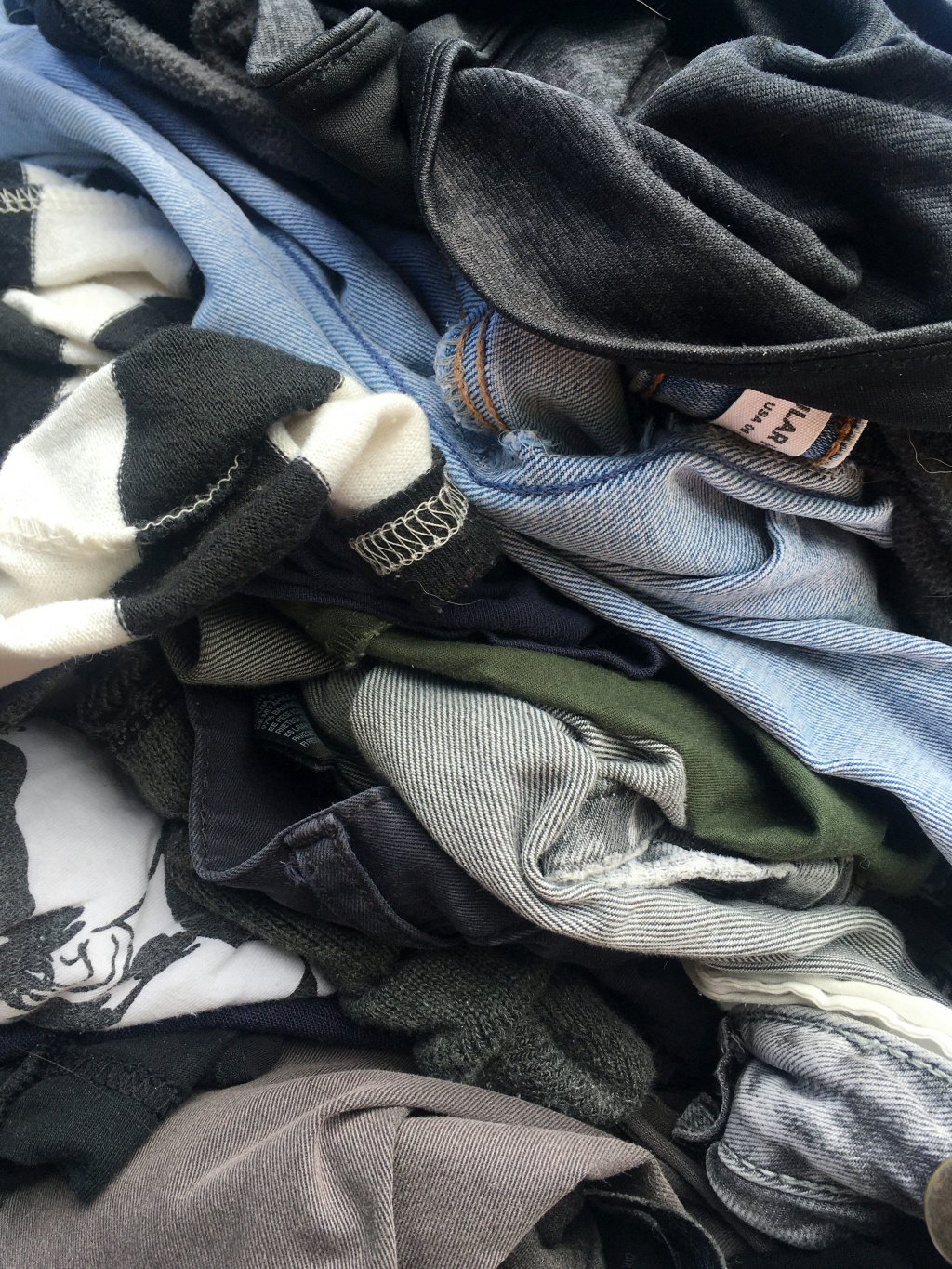
Clothing and textiles are some of the worst offenders. Even those holey jeans and worn-down shoes that can’t be resold could eventually be recycled and repurposed into home insulation or rags. But 85% of recyclable clothing ends up in the trash. Make sure to donate all of your old clothes and towels, not just the ones you think would sell.
Wow, this person is organized.
3. Having less stuff makes us value the stuff we do have more.
Seriously. Marie Kondo hasn’t sold millions of copies of her book for naught. Making a conscious choice to keep the clothing and other household items I love and to send the ones I’m done with on to their next owner — who, with any luck, will love them just as much as I once did — is empowering. Plus, living in a tidy environment is good for your mental and physical health, and a great way to keep your home tidy is by having less stuff to tidy up.
Clothes are much happier here than in a landfill.
So what are you waiting for? Go forth and clean! And when it’s time to take all your old stuff to a resale shop, snap a pic and post it on our Facebook page.
A single door can open up a world of endless possibilities. For homeowners, the front door of their house is a gateway to financial stability, job security, and better health. Yet for many, that door remains closed. Due to the rising costs of housing, 1 in 3 people around the world wake up without the security of safe, affordable housing.
Since 1976, Habitat for Humanity has made it their mission to unlock and open the door to opportunity for families everywhere, and their efforts have paid off in a big way. Through their work over the past 50 years, more than 65 million people have gained access to new or improved housing, and the movement continues to gain momentum. Since 2011 alone, Habitat for Humanity has expanded access to affordable housing by a hundredfold.
A world where everyone has access to a decent home is becoming a reality, but there’s still much to do. As they celebrate 50 years of building, Habitat for Humanity is inviting people of all backgrounds and talents to be part of what comes next through Let’s Open the Door, a global campaign that builds on this momentum and encourages people everywhere to help expand access to safe, affordable housing for those who need it most. Here’s how the foundation to a better world starts with housing, and how everyone can pitch in to make it happen.
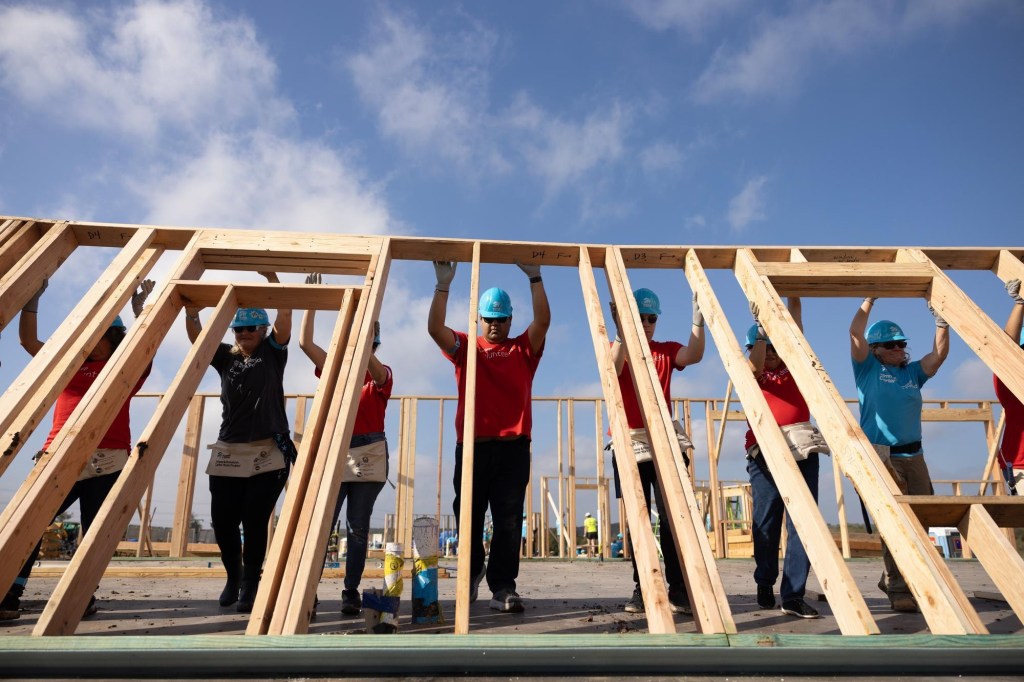
Volunteers raise a wall for the framework of a new home during the first day of building at Habitat for Humanity’s 2025 Carter Work Project.
Globally, almost 3 billion people, including 1 in 6 U.S. families, struggle with high costs and other challenges related to housing. A crisis in itself, this also creates larger problems that affect families and communities in unexpected ways. People who lack affordable, stable housing are also more likely to experience financial hardship in other areas of their lives, since a larger share of their income often goes toward rent, utilities, and frequent moves. They are also more likely to experience health problems due to chronic stress or environmental factors, such as mold. Housing insecurity also goes hand-in-hand with unstable employment, since people may need to move further from their jobs or switch jobs altogether to offset the cost of housing.
Affordable homeownership creates a stable foundation for families to thrive, reducing stress and increasing the likelihood for good health and stable employment. Habitat for Humanity builds and repairs homes with individual families, but it also strengthens entire communities as well. The MicroBuild® Initiative, for example, strengthens communities by increasing access to loans for low-income families seeking to build or repair their homes. Habitat ReStore locations provide affordable appliances and building materials to local communities, in addition to creating job and volunteer opportunities that support neighborhood growth.
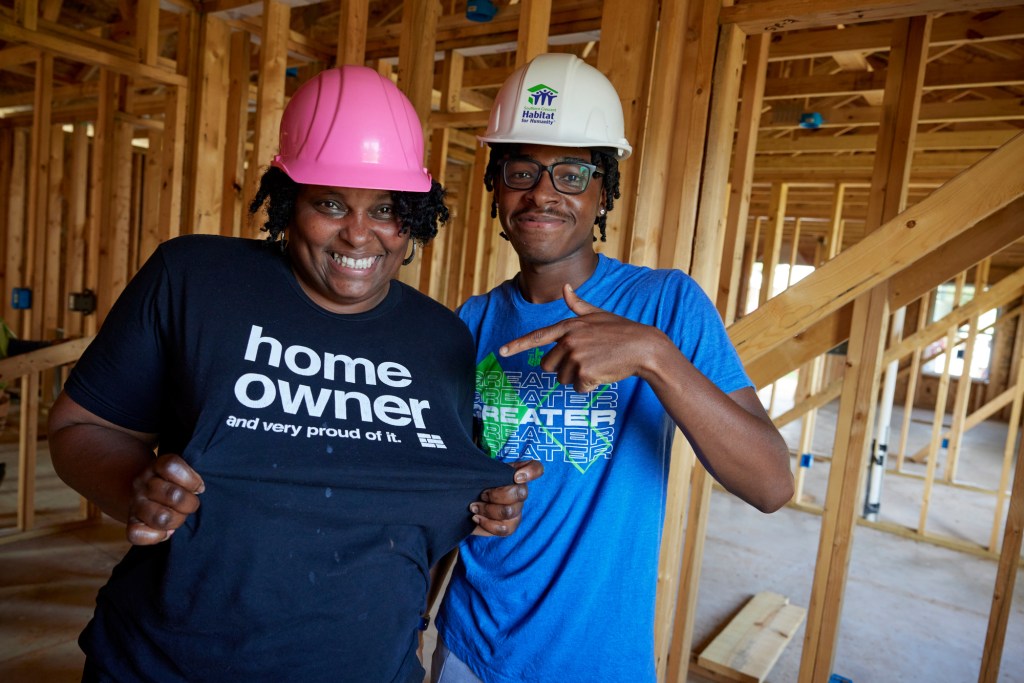
Marsha and her son pose for a photo while building their future home with Southern Crescent Habitat for Humanity in Georgia.
Everyone can play a part in the fight for housing equity and the pursuit of a better world. Over the past 50 years, Habitat for Humanity has become a leader in global housing thanks to an engaged network of volunteers—but you don’t need to be skilled with a hammer to make a meaningful impact. Building an equitable future means calling on a wide range of people and talents.
Here’s how you can get involved in the global housing movement:
Speaking up on social media about the growing housing crisis
Volunteering on a Habitat for Humanity build in your local community
Travel and build with Habitat in the U.S. or in one of 60+ countries where we work around the globe
Join the Let’s Open the Door movement and, when you donate, you can create your own personalized door
Every action, big and small, drives a global movement toward a better future. A safe home unlocks opportunity for families and communities alike, but it’s volunteers and other supporters, working together with a shared vision, who can open the door for everyone.
For a while, the homeowner couldn’t figure out what was happening. His five-gallon gas can kept coming up nearly empty, even though his lawnmower had a one-quart tank. The math didn’t add up.
He had a suspicion about the neighbor but no proof. So before security cameras were cheap and ubiquitous, he did something resourceful: he set up an old laptop with a webcam pointed at his backyard and configured it with motion detection software. Within days he had his answer. The neighbor walked into his yard and took the gas — literally five minutes after the homeowner left the house. He had it on video.
He didn’t confront him. He had a different idea.
Revenge comes in many different forms
For the following week, every time he needed to use the bathroom, he used the gas can instead. He then placed the now full, convincingly odored container back on the patio. He made a visible show of preparing for a trip — packing bags, checking his car — somewhere the neighbor could see him. Then he left for about an hour.
When he came back, the neighbor was in his front yard in full crisis mode, furiously yanking the cord on his lawnmower, which would not start. Shortly after, the neighbor tried to drive somewhere and broke down within a few blocks. The gas can on the patio was empty.
The story could have ended there — satisfying enough on its own. But it didn’t.
This neighbor dispute was not over yet
The neighbor, apparently unaware of how badly he’d misread this particular relationship, later asked the homeowner to drop off a ride-along application he’d filled out with his personal details. Around the same time, the homeowner happened to remember a conversation with a friend at the sheriff’s department, who’d mentioned offhandedly that ride-along applicants get checked for outstanding warrants.
The homeowner submitted the application. Authorities found the warrants. The neighbor was arrested.
The full story was posted to Reddit’s r/ProRevenge by u/MarchCompetitive6235 in January 2026 and quickly accumulated a large and enthusiastic audience. The subreddit, true to its name, has a high bar for this kind of thing — readers expect the revenge to be proportional, well-executed, and complete. This one cleared all three.
It’s worth noting that using someone’s personal information to submit an application without their knowledge occupies legally murky territory depending on the state, and this approach isn’t something to replicate casually. But in this case the neighbor had outstanding warrants, which means the only thing the homeowner really did was provide law enforcement with information they were entitled to act on anyway.
Have kids, they said. It’ll be great, they said. Well, one dad may have a bone to pick with those mysterious “they,” in that colloquial saying. A man running the Instagram account Havea_676, posted a video that has parents on the internet not only laughing at his tender moment turned embarrassing, but also sharing their own savage kid moments.
The dad was having a sweet moment with his daughter, asking her about her day and what she was excited about for the next day, before tucking her into bed. Things appeared to be going well, and his daughter, who is off camera, can be heard answering all of the questions. But at some point during the father-daughter moment, the little girl was over the many questions the man was asking.
A little girl reading to her dad. Photo credit: Canva
“Daddy, can you please stop with your questions? I’m trying to sleep, and also your breath stinks,” the little girl reveals.
Yikes. Dad didn’t have much to say after that bombshell. He simply readjusts so his mouth isn’t pointing in her direction and says, “goodnight, I love you.” There went that sweet moment being caught on video, but after uploading the unexpected roast session, the dad was joined by fellow parents, commiserating. So what seemed like a sad parenting fail, was actually a great bonding moment for parents.
“Kids are brutally honest with no filter. I was helping my daughter button her shirt one morning, and I asked her if she brushed her teeth. She said yes… then there was an awkward pause before she frowned and said ‘did you? Cuz it don’t smell like it’ Needless to say I don’t help the lil heffa get dressed for school anymore lol,” one mom says.
“Kids know how to cut deep with one slice!! Haha,” someone else writes.
“I came home yesterday and asked my daughter if she missed me…She said NO with her whole chest,” another commenter reveals.
“That was so honest for her to say that, and I love the way dad handled the situation. Their bond will live forever,” a commenter wrote. “Well at least you know she’ll be honest at school…she sounds like an amazing little girl,” another added.
Kids are just brutally honest until they get a bit older to realize there are gentler ways to deliver news. Hopefully, unless they skip that stage and become some rather challenging adults to deal with. But if this dad learned one thing from his lengthy conversation, it’s to brush your teeth before goodnight chats so you don’t melt your kid’s face off.
This article originally appeared two years ago. It has been updated.
Families with small children are usually among the first to board a plane, the logic being that it allows time to install any necessary kiddie seats, place strollers or other kid-centric luggage in the overhead bin, and get settled before takeoff.
However, one mom and former airline worker argues that doing things the opposite way would allow for smoother travel for all.
Laura, an ex-British flight attendant currently living in Florida and raising a family, recently shared on TikTok, “Okay don’t come for me but I think families with babies should board LAST.”
Okay don’t come for me but I think families with babies should board LAST. I know. I KNOW. And yes I used to be a flight attendant. I have seen things. I have opinions. This is one of them. Every time we pre-board Oliver we spend an extra 25 minutes strapped into seats going absolutely nowhere while every other human slowly files past us making faces at him like he’s a zoo exhibit. He’s fine for the first 10 minutes. Then he’s done. DONE. And we still haven’t even pushed back from the gate. I spent years watching families board first and slowly unravel before we even closed the door. Board last. Sit down. Take off immediately. Baby never knows the difference. Trust the ex-flight attendant on this one. The pre-board privilege is a trap. I handed it out for years and I’m only now admitting that. You’re welcome. Or I’m sorry. Depending on how strongly you feel about this. #flyingwithababy#travelingwithababy#babytravel#exflightattendant#flightattendantlife
First recalling her own experience as a traveler, Laura noted that every time she brought her young son, Oliver, they would pre-board, as many parents do. However, getting on the plane early just meant that Oliver had an extra hour of being cooped up.
“We’d spend an extra 25 minutes strapped into seats going absolutely nowhere while every other human slowly files past us making faces at him like he’s a zoo exhibit,” she wrote in the caption.
Naturally, Oliver would become restless
Two kids looking out an airplane window while mom watches. Photo credit: Canva
“He’s fine for the first 10 minutes. Then he’s done. DONE. And we still haven’t even pushed back from the gate,” she wrote.
Laura then drew upon her professional experience of witnessing other families going through similar struggles: “I spent years watching families board first and slowly unravel before we even closed the door.”
Both of these factors left her with only one conclusion: “Board last. Sit down. Take off immediately. Baby never knows the difference.”
“Trust the ex‑flight attendant on this one,” she concluded. “The pre‑board privilege is a trap. I handed it out for years and I’m only now admitting that. You’re welcome. Or I’m sorry. Depending on how strongly you feel about this.”
Of course, reactions to this stance were mixed
Some commenters agreed that it would be less anxiety-inducing for parents concerned with “holding people up,” while others worried about keeping families seated together or potentially losing storage space if they boarded last.
And then came the inevitable question: Why not seat the back row first?
Online, you’ll find a slew of explanations, from “it makes the plane tail-heavy” to “back-to-front boarding is actually slower.” However, Japanese airlines like Japan Airlines (JAL) commonly use a back-to-front boarding process, often starting with rear seats, window seats, or specific boarding groups. This method is sometimes combined with window-to-aisle boarding in the name of efficiency.
So while we may never come upon a universally beneficial boarding order, there are at least a few things parents can do to make the process easier.
For example, if both parents are traveling together, they can adopt a “divide and conquer” approach, with one parent boarding early to manage bags and seats while the other lets the kids walk around, expend any extra energy they might have, and minimize sitting time. Bringing a “surprise bag” of snacks and small, new toys reserved only for plane rides can also offer some soothing distractions.
A father entertaining his son on a flight with animal puppets. Photo credit: Canva
And as any parent will tell you, often no matter what strategy you try to implement, sometimes you still gotta adapt to what’s needed in the moment.
Parents today share responsibilities more equally than in past generations, but studies show childcare still falls disproportionately on women’s shoulders. Some families choose one parent to take on the lion’s share of child-rearing and/or domestic duties, and if that works, great. Other couples work similar hours and have to figure out how to equally split home duties, but however the household is structured, mothers most often tend to be the “default parent” and household manager.
That means it’s mostly moms who are constantly thinking about managing the million little details of parenting. The big things like feeding, bathing, transporting, teaching life lessons, and such are fairly easy to share equitably. But the invisible work: keeping track of routine doctor and dentist appointments, communicating with teachers and caregivers, keeping extended family updated, figuring out what clothes to keep and get rid of as kids outgrow them, keeping the family calendar up-to-date, and more. That’s all part of the “mental load” of parenting that moms tend to carry, often without their partners even being aware they’re doing it.
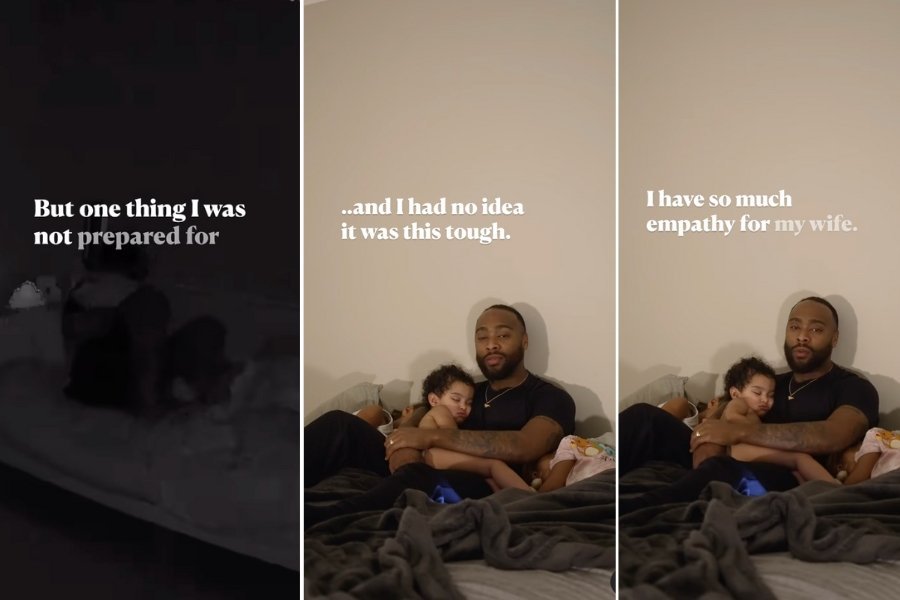
That’s why one dad’s confession after getting a taste of solo parenting has gotten a huge reaction. Cedric Thompson, Jr., a former NFL player and dad of three daughters, shared a video explaining that he didn’t really understand the mental load his wife was carrying until she went to visit family in the Philippines for eight days, leaving him home alone with the kids.
“I’ve been a single dad for 8 days because my wife is in the Philippines and I had no idea it was this tough,” he said with a sleeping child cradled in his arms. He explained that he was prepared for the cleaning, the transporting kids back and forth, the unexpected sickness, the feeding, and the sleeping. “But one thing I was not prepared for was the mental load,” he said. “I had no idea it felt like this. To think about things that need to be done that haven’t been done or things that I need to plan to do is so draining that I don’t even have the energy to take care of myself at all.”
This is why dads need to step into moms’ shoes once in a while
“And now that I understand this, I have so much empathy for my wife,” he said, “and I truly understand what she means by this ‘mental load’ and how draining it is. This has really opened my eyes and made me ask myself, what more can I be doing? What has been going on that I haven’t been seeing and it’s right in front of me? How can I step up the way that my wife needs me to instead of doing things that I think are helping?”
“I know I can’t always take the mental load away, but I can definitely make it lighter.”
There’s a significant difference between assisting and managing, and when you’re the sole parent for a while, you’re forced to take on the management role. Eight days isn’t very long, but it’s enough to get a taste of being the one who has to think about all the things all day. It’s a lot. As Thompson wrote in the caption, “The endless planning, remembering, and organizing is exhausting in ways I never understood before. The most profound lessons come when we walk in someone else’s shoes, even if just for a little while.”
Some people asked what he’s been doing this whole time when his wife is home, but it seems some of those folks might be missing the point. This is an involved dad and husband, not a slouch. But even those who want to and try to share the load equally don’t always know how to help with the mental load of the default parent because it’s mostly internal. And trying to explain it and figuring out how to ask for help with some of it just adds more work, not to mention we don’t even always know ourselves what we need help with. Stepping into the shoes of the default parent is really the best way to get a feel for what might be helpful without adding more to their plate.
The “mental load” is invisible, so it’s nice to have it seen and validated
Some commenters weighed in with thoughts and tips for lightening the mental load:
“How do men not understand their wife’s workload and bandwidth while literally sleeping next to her and living in the same house? Does she really have to leave the country for him to understand her contributions? Men have to do better.”Pro tip: when your wife asks you what she should make for dinner, she’s trying to share the mental load with you. So just give her a straightforward answer.”
“I love this…it’s called validation, empathy, and love Thank you for sharing this. The realization and verbalization of it makes the load lighter. Sometimes mental heaviness is worse than the physical.”
“Really appreciate this post and how you explained yourself. The ‘mental load’ is that never-ending list running through our minds every single minute of the day. It’s the constant inner monologue of everything that needs to get done, the overwhelming pressure of how to get it all done, and the invisible timeline that gives you anxiety when you don’t meet it—even though you set those standards yourself.
It’s the feeling of failing if you don’t check every box. Walking into a room and forgetting why you’re there, only to lose your mind later when you finally remember—but now you’ve got ten other tasks at hand. It’s the frustration when you realize that everything you just cleaned is already dirty again.
Sometimes, it’s not even about what men do or don’t do; it’s the weight of our own thoughts that get to us. But when someone helps lighten that load, even just a little, it means everything.”
“I love this. But to answer your question, the way you take the mental load away is you pretend you have to do it alone even when she comes back. Because that’s the reason she has mental load. Because she feels like she has to do most of it alone, even if you’re always there to “help”. That’s why I hate the word help. It implies that this is all her job. You’re doing well but keep digging deeper I do appreciate this post.”
What exactly does the parental “mental load” entail? Here’s a partial list.
And yes, there is a need to go deeper. As one commenter pointed out, “You are operating the day to day under a structure she put in place,” so a lot of the mental work was already done before she even left. And parenting is a marathon, not a sprint, so getting familiar with a specific list of “mental load” items that non-default parents might not think about can be helpful. Someone offered this helpful—if utterly daunting—list of some of those items:
“Planning teacher gifts for the holidays and the end of school. – getting that parent’s contact info for that play date. – researching, budgeting, and scheduling summer activities and when to sign up for them the January/Feb prior. – finding that in network pediatric ophthalmologist for an eye appt. Research that new dentist, schedule your kids vaccines, review the medical records, schedule that well child visit. – researching, scheduling, and budgeting the school and extracurricular schedule in the summer for the fall and in October for the winter/spring. – making time to be the family historian (researching, budgeting, and scheduling a family photographer 2 times a year, researching how to pick/buy outfits for the whole family, selecting and printing any prints, creating and ordering a photo book, organizing photo files, and physically organizing keepsake storage).
Teaching your kids about their heritage with activities. Research your family tree. – be the memory maker and plan fun activities for the family. Book those theater tickets, schedule that museum trip, plan that day trip to hike that waterfall, plan that vacation, schedule 3 farm trips a year, prep for activities leading up to the holidays. – 4 times a year audit your household belongings. What do you need to sell? What do you need to donate? What remaining needs a better storage system? Research the products that will help you stay organized and buy them. follow home organizers on social media. – Check your kids shoes. How are they fitting? Research and order/consign new clothing. – trim your kids nails once a week and cut their hair as needed (or schedule their hair appt). – plan your kids birthday party 2 months in advance, research activities, food, party favors, and decor ideas. create the invites and send them out 5 weeks in advance. 2 weeks in advance order the cupcakes, decor, party outfit, and gift wrapping.
Check in with guests food allergies, rsvps, and buy the gifts. 1 week in advance wrap the gifts, assemble the party favors, and take some cute photos of the birthday kid in their special outfit. Pack a bin of supplies you’ll need for the day of the party (scissors, wire and cutters, tape, paper goods, trash bags, matches, etc). – buy those tickets to your kids concert. – keep that first aid kit stocked up. – keep up weekly with school/teacher correspondence and volunteer at your kids school. – back to school shopping. – holiday planning.
Buy Halloween costumes at the end of September, plan a pumpkin farm day trip. Schedule any Halloween parties. The weekend before carve pumpkins. Take pictures day of. Buy nutcracker tix in October/ November, plan gifts, budget, and order. Research decor ideas, get desired supplies, and make them in Nov. meal plan and coordinate with family for thanksgiving. Set up decor and buy gifts, Christmas outfits, and wrapping supplies Black Friday. Wrap gifts, take kids out separately to pick out presents for their siblings. Research and schedule holiday outings as a family. Take pictures. Design, order, and send cards. Meal plan. Coordinate with the relatives.
Buy valentines cards for your kids class at the end of Jan. – talk to your kids about safety and abuse prevention 2-6 times a year in addition to “as needed”. – read the latest parenting books, listen to parenting podcasts, follow parenting accounts on social media. – plan kids craft projects. – take your kids to the library and keep up with the borrowed books. rsvp, order, and wrap a birthday gift for all the kid birthday parties. Write a nice note in a card about the child. – write thank you notes after birthdays, end of school, end of activities, after the holidays, and as needed.”
There you go. Not even an exhaustive list, but a solid start. Thanks to Ced for the reminder that the more we start putting ourselves in other people’s shoes as parents and partners, the better off the whole family will be.
The decision to have, or not have, children is complex and deeply personal. There are countless factors to consider, including finances, lifestyle, and your individual values.
Many people who’ve weighed all the options find themselves pretty certain they don’t want to have children. But one stubborn societal myth sticks in their craw and gives some of them pause: the idea that people without children will inevitably die alone.
It’s dark, heavy, and a little difficult to think about. It also happens to be completely false—at least, according to someone who works with death up close every single day.
Viral post resurfaces
A viral Reddit post on the topic was recently resurfaced by popular childfree influencer and organizer Zoë Noble, who shared it on Instagram.
“For two decades I have been a professional who works with older adults. People in their 60s, 70s, 80s, 90s, even over 100,” Noble reads from the post.
The original poster, a senior living and hospice care worker, wrote about how narcissistic parents who are estranged from their children are often alone in their dying days. But the post also piqued the curiosity—and fears—of the childfree community.
“Multiple times in this post, child free adults have expressed their fear that this is their future: dying alone because they have no children,” Noble reads. “Speaking from two decades of caring for older adults, I have worked with many child free adults who spent the final years, months, and days of their life surrounded by a loving and caring community. … Having a loving community around you who cares about you is more importantthan whether you have kids or not.”
“I’ve served many child free people who were doted on by a number of significant people in their life,” Noble continues. “They received excellent care and had devoted advocates. They were doing better than folks down the hall who did have children, 5 or 6 kids even. I promise.”
The post’s message is both a powerful myth-buster and a source of comfort for many.
Contrary to popular belief, most people who choose not to have children of their own free will do not come to regret it later in life.
“The takeaway from all this isn’t that having kids is good or bad–it’s that there is no one way to live a happy and fulfilled life,” The Guardian‘s Arwa Mahdawi writes of these research findings. “Parenthood isn’t for everyone and it should always be a choice.”
“Cold regret”
People without children are more likely to experience what Noble calls a fleeting feeling of “cold regret.”
“They might sometimes fantasise about how their life would have turned out if they’d had children, and the special moments they’re missing out on – while still knowing they made the right choice for themselves and their life,” she writes.
Some may be sure of their decision but still have a gnawing fear in the back of their minds about their final days. More commonly, “you’ll die alone” is used as a threat or warning to childfree people about remorse that rarely comes.
The social media post received nearly one million views, and Noble runs a large community of childfree adults who were eager to weigh in.
“I am a death doula and hospice volunteer and have seen first hand that having children does NOT guarantee having people around when you die. The absolute most important thing is the community that someone has built around them. … Family relationships are a bit more complicated and fraught with complex issues that don’t always guarantee presence.”
“I am a hospice nurse and I second this 100%! Some people I’ve cared for that didn’t have children had a more loving and supportive group of people around them toward end of life than people with kids. Community and friendship matters.”
The message even resonated with parents—a reminder that a lifelong, loving relationship with our children is far from guaranteed if we’re not willing to put in the effort.
“Beautifully said. I do have children, and I still couldn’t agree more with your sentiments. It’s all about investing in your relationships and your community. Sadly, many people are disconnected from their own children.. due to not investing in a relationship with them.”
Crucially, a tight-knit, loving community that will show up for you in your final days is not something people—childfree or otherwise—stumble into. It has to be intentionally built over time.
“The difference is not whether you have children. The difference is whether you have a community of people who care about you and will show up for you,” Noble reads from the Reddit post. “The way to build this community is to show up for them, consistently, for the next few years and as long as you are able. Invest in people and relationships. Grow bonds of companionship and trust. It doesn’t matter who; only that you like and trust each other.”
It’s good advice for anyone who may be afraid of dying alone, whether you have no children or a whole gaggle of them. It’s also the kind of reassuring embrace some people need to make the decision they know in their hearts is right for them.
Almost every long term relationship suffers from a rut eventually. That goes especially for married partners who become parents and have the added responsibility of raising kids. Maintaining a connection is hard enough in this busy, fast-paced world. Top it off with making sure kids are awake, dressed, entertained, well fed, oh yeah, and alive…and you best believe all you have energy for at the end of the day is sitting on the couch barely making it through one episode of your favorite show on Netflix.
And yet, we know how important it is to maintain a connection with our spouses. Many of us just don’t know how to make that happen while juggling a million other things. According to one mom, a “three-hour night” could be just the thing to tick off multiple boxes on the to-do list while rekindling romance at the same time. Talk about the ultimate marriage hack.
The three-hour night was something that Rachel Higgins and her husband began incorporating into their lives back in early 2024. And so far, “it’s been so fun and such…a game changer for how our evenings go,” she says in a clip posted to TikTok.
Before using the three-hour night, the evening would look a bit like this: their daughter would go to bed, they would lounge on the couch, scroll through social media, then fall asleep. Sound familiar?
But with a three-hour night, Higgins and her husband divvy up the time before bed into three sections, each for a different focus. In the first hour, starting around 7 p.m., is what Higgins calls “productive time,” during which the couple sees to any household chores that might need to be done.
if you’re stuck in a rut with your evenings try this! i saw someone do something similar to this a while ago but can’t remember who! #marriage#1sttimeparents#newyearsgoals
“So, start with like a quick cleanup of the kitchen or just like things that accumulated throughout the day, and then we try to do something that either … has been being put off or cleaning the bathroom or like organizing the pantry or hall closet or something like, super random like sharpening the knives. Anything that’s productive for the household,” she explains.
Next, the second hour is geared towards re-establishing a physical or emotional connection in their marriage. The phones go away, and they focus only on enjoying one another.
“So, that could be things like showering together or ‘having fun’ together, playing a game together, or just like anything that’s gonna get you guys talking and connecting or like debriefing from the day or just like talking about what you’re doing and like the plans for tomorrow or like how work’s going or whatever. So, anything that’s gonna connect and strengthen and build your marriage,” Higgins says.
Lastly, the final hour of the night is dedicated to anything Higgins and her husband individually want to do, any sort of personal recharge activity. Since this is a judgment-free time, Higgins states that “If you just want to lie on the couch and scroll your phone and watch TikToks or whatever, like watch YouTube videos,” it’s totally acceptable.
But can you really do this every night?
Higgins’ novel approach definitely interested viewers, who chimed in with their own questions. One major concern was how the heck this could be done every night. But even Higgins admits that she and her husband don’t succeed at having a three-hour night every night—they usually try for about 3-4 times a week. And honestly, even once a week could still probably be beneficial in building intimacy.
“Such a good idea. Good for us empty nesters too! The phone scrolling is outta control!” one commenter wrote. “This is really cool. The housework is equal. The emotional connection is equal and the self care is equal. No room for resentment,” another added. “We don’t have kids yet but I love this and want to do it because the nights slip away so fast!!” a commenter added.
Others wondered how to have a three-hour night when things randomly popped up in their schedule, like when kids won’t magically go to sleep promptly at 7pm. Higgins shares that in these cases, they tend to just shorten each phase. The point being: these can and probably should be customizable, even fun, rather than yet another rigid chore.
Making your relationship a priority
Plus, a three-hour night (or whatever your version of a three-hour night may be) is a great way to remind yourself just how high a priority your relationship has in your life, no matter what else is going on at the time. Odds are you’ll probably find you do have more time for it than you previously thought.
This article originally appeared two years ago. It has been updated.
Babies can’t talk. This isn’t something that needs to be studied and researched, it’s a pretty common fact of human existence. The reasons babies cry is because they can’t talk to tell us what they need, at least that’s what the general understanding has been for centuries. Not only their brains, but their bodies lack the development and coordination needed to form complete words and sentences.
But what if some babies could talk and we simply haven’t been exposed to them because the world is so big? Thanks to social media, the world has gotten a whole lot smaller when it comes to being able to take a peek into other people’s lives. This means we get to be exposed to things that may otherwise gone unseen.
Wait, did that baby just talk?
Mekeia, a mom of two, uploaded a video of her then 3-month-old son talking. Not the cute baby babble that we like to call talking, but repeating actual short sentences.
Mekeia was recording her daughter playing with the baby when they captured the moment on video.
The little girl holds the baby’s face and says, “say I am two months,” before Mekeia corrects her, “say I am three months,” the little girl pipes back up. Clearly the baby was trying to join in the conversation with what was expected to be baby babble when the mom instructed the older child to let the baby have a chance to “talk.” It was then that the baby shocked everyone by sounding like he repeated the same phrase.
The two are visibly and audibly shocked not wanting to believe the baby actually repeats what the other child says. Mekeia is on the phone with a friend when the entire thing happens. Presumably thinking this is a fluke, the mom attempts to put the phone up to the baby’s mouth. When he just babbles, she tells the baby, “say hey Bam.” Nothing. Just more babble and drool.
This was no fluke
Just when you think your ears were playing tricks on you, the baby does it again when the mom tells him to say, “hey Quintin.” Clearly the baby still sounds like a baby but you can clearly hear him repeating the sound and cadence of the words so much so that it sounds like he’s fully saying the words. His older sister is overwhelmed with emotion and begins to cry while Mekeia seems to be so shocked that she begins to laugh while the person on the phone is just stunned into confusion.
People in the comments were eager to jump in with exclaiming the baby is a genius with one person writing, “he is a baby genius start showing him math problems.”
Another person jokes, “next thing he’s writing emails and making appointments.”
“Talking so clear would scare me sooo bad he’s so intelligent,” someone writes.
There’s actually a name for this
Others explain the phenomenon with a condition called echolalia.
“Echolalia is a normal part of child development. As children learn to talk and understand words, they imitate, copy or echo the sounds and words they hear. Over time, a child usually learns to talk by connecting new words together to make unique little phrases or sentences,” according to Speech and Language Advisor Claire Smith when interviewed by the BBC.
Sometimes this phenomenon rears its head extraordinarily early. Mekeia’s daughter was just three months old in the video above. Another popular video from a few years ago shows an 8-week-old infant from the UK very clearly saying the word “Hello” in response to his parents. A 7-week-old from Ireland was shown doing the same in 2015.
What’s really interesting is when kids start to actually understand and utilize language intentionally at an extremely early age. A boy named Michael Kevin Kearney was said to be talking by around 4-months-old, even asking his parents “What’s for dinner?” He went on to become a certified child prodigy, received a masters degree in biochemistry at just 14, and pursued a doctorate in chemistry at Middle Tennessee State University.
Most babies who repeat words shockingly early are not little geniuses in the making, just good mimics. Much of the time, they’re not able to consistently repeat the feat once the clip goes viral on social media.
But you can’t blame the parents, and social media users, for getting excited. It’s adorable and fascinating to watch in action!
This article originally appeared two years ago. It has been updated.
When the holidays roll around, it’s time for families to decide where they will meet to celebrate. For the most part, parents with younger kids dread packing their bags and traveling to a family member’s house where things aren’t set up for young children. You fumble around setting up the pack ‘n plays, can’t find your bottle brush, and freak out because the electrical sockets aren’t child-proof.
However, many grandparents aren’t keen on enduring the mental and physical strain of traveling at an older age. So, who’s right? Grandma Jan, founder of Grandma Camp and a TikTok influencer who shares fun ideas for grandparents and grandkids, argued that parents should pack up their kids and visit Grandma.
“Okay, so, here’s the debate: families say, ‘Grandma, why don’t you come visit us?’ But let’s be honest, Grandma’s house is where the traditions are, the cookies are, and all of the toys are,” Grandma Jan begins. “But if grandma is driving, flying, hauling all the gifts, and packing up her car to come see you, maybe it’s time to flip the script. When did it become normal for Grandma to pack up all her stuff and come see you? Should the kids pile into the car, bring all their toys, and just go visit grandma? Bring all that love and chaos to her?”
So she asked her followers: “Should grandmas be the one on the road or should families pick everything up and drive to her?” Just about everyone in the comments said that grandparents should have to travel to see their grandchildren.
“Nope. I want Christmas morning in pajamas with my family. I want my traditions. My parents and in-laws (the grandparents) got all of this how they wanted. It’s my turn now,” Maggie wrote. “Gramma is retired and now has a shit ton of time. Kids and parents have a very finite amount of time off in the holidays that they do not want to spend on the road,” Mrs. Wright added.
Some grandparents also checked in to disagree with Grandma Jan. “Why would I put that on my kids and grandkids? It’s so hard traveling with kids, not to mention expensive to fly for more than one person,” Populustultus wrote. “What a weird way to think about that. Why wouldn’t you help your kids create magic in their home? Signed a grandma,” LifestylebyKat added.
The response inspired Grandma Jan to release a follow-up video clarifying her opinion. She admits she came up with the idea after seeing older people having a hard time getting through the airport. “[I saw] older grandparents struggling their way through airports carrying their own heavy bags while managing a walker or a plane or a wheelchair, struggling through all on their own with no one to assist,” Grandma Jan said. “And as an occupational therapist, that actually broke my heart. For younger, healthier grandparents, travel can be fun, but for the older generation, it can be quite a struggle.”
Ultimately, Grandma Jan didn’t intend to put anyone out; she just wanted to have a conversation about what’s best for families as a whole. “And Grandma Camp by Grandma Jan is about having those conversations, not making rules. And at the end of the day, it’s about connection, not distance,” she concluded her video.
This article originally appeared last year. It has been updated.