Father of 3 shares how he finally understood wife’s ‘mental load’ when she left him alone for 8 days

“I had no idea it felt like this.”

mental load, parenting, motherhood, fatherhood, marriage
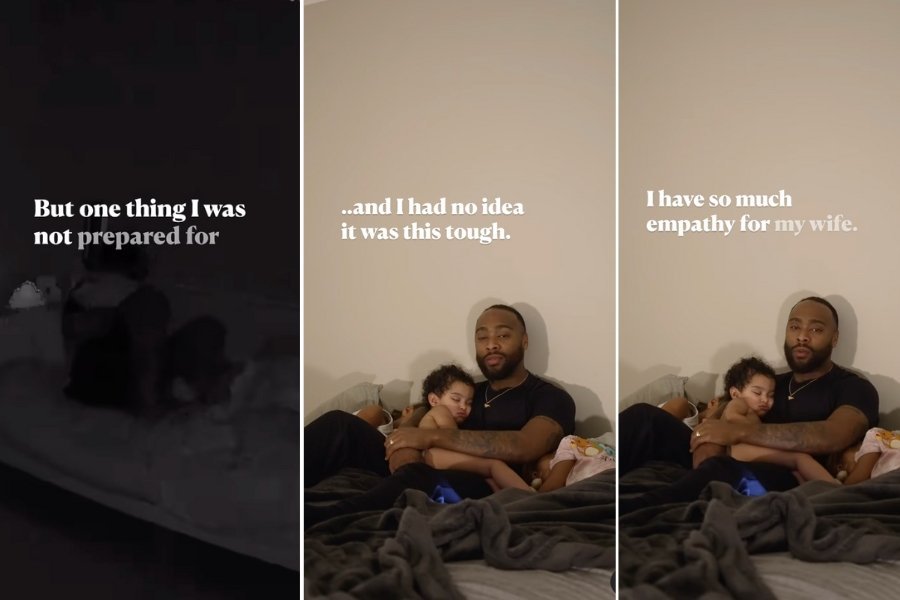
Photo credit: @ced/Instagram (used with permission)A dad with his young son filming a TikTok video.

Parents today share responsibilities more equally than in past generations, but studies show childcare still falls disproportionately on women’s shoulders. Some families choose one parent to take on the lion’s share of child-rearing and/or domestic duties, and if that works, great. Other couples work similar hours and have to figure out how to equally split home duties, but however the household is structured, mothers most often tend to be the “default parent” and household manager.

That means it’s mostly moms who are constantly thinking about managing the million little details of parenting. The big things like feeding, bathing, transporting, teaching life lessons, and such are fairly easy to share equitably. But the invisible work: keeping track of routine doctor and dentist appointments, communicating with teachers and caregivers, keeping extended family updated, figuring out what clothes to keep and get rid of as kids outgrow them, keeping the family calendar up-to-date, and more. That’s all part of the “mental load” of parenting that moms tend to carry, often without their partners even being aware they’re doing it.

That’s why one dad’s confession after getting a taste of solo parenting has gotten a huge reaction. Cedric Thompson, Jr., a former NFL player and dad of three daughters, shared a video explaining that he didn’t really understand the mental load his wife was carrying until she went to visit family in the Philippines for eight days, leaving him home alone with the kids.

“I’ve been a single dad for 8 days because my wife is in the Philippines and I had no idea it was this tough,” he said with a sleeping child cradled in his arms. He explained that he was prepared for the cleaning, the transporting kids back and forth, the unexpected sickness, the feeding, and the sleeping. “But one thing I was not prepared for was the mental load,” he said. “I had no idea it felt like this. To think about things that need to be done that haven’t been done or things that I need to plan to do is so draining that I don’t even have the energy to take care of myself at all.”

This is why dads need to step into moms’ shoes once in a while

“And now that I understand this, I have so much empathy for my wife,” he said, “and I truly understand what she means by this ‘mental load’ and how draining it is. This has really opened my eyes and made me ask myself, what more can I be doing? What has been going on that I haven’t been seeing and it’s right in front of me? How can I step up the way that my wife needs me to instead of doing things that I think are helping?”

“I know I can’t always take the mental load away, but I can definitely make it lighter.”

There’s a significant difference between assisting and managing, and when you’re the sole parent for a while, you’re forced to take on the management role. Eight days isn’t very long, but it’s enough to get a taste of being the one who has to think about all the things all day. It’s a lot. As Thompson wrote in the caption, “The endless planning, remembering, and organizing is exhausting in ways I never understood before. The most profound lessons come when we walk in someone else’s shoes, even if just for a little while.”

Some people asked what he’s been doing this whole time when his wife is home, but it seems some of those folks might be missing the point. This is an involved dad and husband, not a slouch. But even those who want to and try to share the load equally don’t always know how to help with the mental load of the default parent because it’s mostly internal. And trying to explain it and figuring out how to ask for help with some of it just adds more work, not to mention we don’t even always know ourselves what we need help with. Stepping into the shoes of the default parent is really the best way to get a feel for what might be helpful without adding more to their plate.

The “mental load” is invisible, so it’s nice to have it seen and validated

Some commenters weighed in with thoughts and tips for lightening the mental load:

“How do men not understand their wife’s workload and bandwidth while literally sleeping next to her and living in the same house? Does she really have to leave the country for him to understand her contributions? Men have to do better.”Pro tip: when your wife asks you what she should make for dinner, she’s trying to share the mental load with you. So just give her a straightforward answer.”

“I love this…it’s called validation, empathy, and love Thank you for sharing this. The realization and verbalization of it makes the load lighter. Sometimes mental heaviness is worse than the physical.”

“Really appreciate this post and how you explained yourself. The ‘mental load’ is that never-ending list running through our minds every single minute of the day. It’s the constant inner monologue of everything that needs to get done, the overwhelming pressure of how to get it all done, and the invisible timeline that gives you anxiety when you don’t meet it—even though you set those standards yourself.

It’s the feeling of failing if you don’t check every box. Walking into a room and forgetting why you’re there, only to lose your mind later when you finally remember—but now you’ve got ten other tasks at hand. It’s the frustration when you realize that everything you just cleaned is already dirty again.

Sometimes, it’s not even about what men do or don’t do; it’s the weight of our own thoughts that get to us. But when someone helps lighten that load, even just a little, it means everything.”

“I love this. But to answer your question, the way you take the mental load away is you pretend you have to do it alone even when she comes back. Because that’s the reason she has mental load. Because she feels like she has to do most of it alone, even if you’re always there to “help”. That’s why I hate the word help. It implies that this is all her job. You’re doing well but keep digging deeper I do appreciate this post.”

What exactly does the parental “mental load” entail? Here’s a partial list.

And yes, there is a need to go deeper. As one commenter pointed out, “You are operating the day to day under a structure she put in place,” so a lot of the mental work was already done before she even left. And parenting is a marathon, not a sprint, so getting familiar with a specific list of “mental load” items that non-default parents might not think about can be helpful. Someone offered this helpful—if utterly daunting—list of some of those items:

Planning teacher gifts for the holidays and the end of school. – getting that parent’s contact info for that play date. – researching, budgeting, and scheduling summer activities and when to sign up for them the January/Feb prior. – finding that in network pediatric ophthalmologist for an eye appt. Research that new dentist, schedule your kids vaccines, review the medical records, schedule that well child visit. – researching, scheduling, and budgeting the school and extracurricular schedule in the summer for the fall and in October for the winter/spring. – making time to be the family historian (researching, budgeting, and scheduling a family photographer 2 times a year, researching how to pick/buy outfits for the whole family, selecting and printing any prints, creating and ordering a photo book, organizing photo files, and physically organizing keepsake storage).

Teaching your kids about their heritage with activities. Research your family tree. – be the memory maker and plan fun activities for the family. Book those theater tickets, schedule that museum trip, plan that day trip to hike that waterfall, plan that vacation, schedule 3 farm trips a year, prep for activities leading up to the holidays. – 4 times a year audit your household belongings. What do you need to sell? What do you need to donate? What remaining needs a better storage system? Research the products that will help you stay organized and buy them. follow home organizers on social media. – Check your kids shoes. How are they fitting? Research and order/consign new clothing. – trim your kids nails once a week and cut their hair as needed (or schedule their hair appt). – plan your kids birthday party 2 months in advance, research activities, food, party favors, and decor ideas. create the invites and send them out 5 weeks in advance. 2 weeks in advance order the cupcakes, decor, party outfit, and gift wrapping.

Check in with guests food allergies, rsvps, and buy the gifts. 1 week in advance wrap the gifts, assemble the party favors, and take some cute photos of the birthday kid in their special outfit. Pack a bin of supplies you’ll need for the day of the party (scissors, wire and cutters, tape, paper goods, trash bags, matches, etc). – buy those tickets to your kids concert. – keep that first aid kit stocked up. – keep up weekly with school/teacher correspondence and volunteer at your kids school. – back to school shopping. – holiday planning.

Buy Halloween costumes at the end of September, plan a pumpkin farm day trip. Schedule any Halloween parties. The weekend before carve pumpkins. Take pictures day of. Buy nutcracker tix in October/ November, plan gifts, budget, and order. Research decor ideas, get desired supplies, and make them in Nov. meal plan and coordinate with family for thanksgiving. Set up decor and buy gifts, Christmas outfits, and wrapping supplies Black Friday. Wrap gifts, take kids out separately to pick out presents for their siblings. Research and schedule holiday outings as a family. Take pictures. Design, order, and send cards. Meal plan. Coordinate with the relatives.

Buy valentines cards for your kids class at the end of Jan. – talk to your kids about safety and abuse prevention 2-6 times a year in addition to “as needed”. – read the latest parenting books, listen to parenting podcasts, follow parenting accounts on social media. – plan kids craft projects. – take your kids to the library and keep up with the borrowed books. rsvp, order, and wrap a birthday gift for all the kid birthday parties. Write a nice note in a card about the child. – write thank you notes after birthdays, end of school, end of activities, after the holidays, and as needed.”

There you go. Not even an exhaustive list, but a solid start. Thanks to Ced for the reminder that the more we start putting ourselves in other people’s shoes as parents and partners, the better off the whole family will be.

You can follow Ced on Instagram here.

This article originally appeared two years ago. It has been updated.

  • ‘Devoted granny’ says it’s grandparents’ job to build relationships with their grandkids, not parents
    Photo credit: CanvaA grandmother with her grandchild.

    There has been a growing discussion over the last couple of years, mostly initiated by Millennial parents, that their Baby Boomer parents aren’t there for their children. It’s believed that the absentee Boomer grandparent phenomenon stems from the generation’s financial success. In retirement, Boomers have more options to travel and pursue their interests than earlier generations did, which often chose to spend more time with family.

    A common excuse among some grandparents is that they “did their time” as parents and don’t want to spend their golden years raising the next generation. Others will blame their children for refusing to foster a relationship between grandparents and grandchildren.

    However, TikTok user Helen Devoted Granny, a grandmother in Devon, England, is going viral for being brutally honest: “I think it’s always the grandparents’ responsibility.”

    Helen’s TikTok page expresses the joy of being a devoted grandparent while questioning those who aren’t there for their grandchildren.

    @hels5071

    Who’s responsibility is it? I think it’s firmly the grandparents responsibility. Being a devoted granny is an absolute privilege and one I cherish #mumsoftiktok #grandparentsoftiktok #familymatters #familydynamics #generationaltrauma

    ♬ original sound – Helen Devoted Granny

    Who is responsible for the grandparent-grandchild relationship?

    “I think it’s always the grandparents’ responsibility,” Helen said in a video. “And as a devoted granny, I’ll explain why I think it’s the grandparents responsibility to always reach out, to be the one saying, ‘Well, can we help with this? Can we come and visit? Can we take them there? Is there anything you’d like me to do? Do you need some support this week? Do you need some support next week? These are my days off.’ Blah, blah, blah.”

    She added, “That’s what I do. I’m a devoted granny, and I feel very strongly about this. And I don’t think kids should be the ones. Your children shouldn’t be the ones who need to facilitate that relationship. It’s up to the grandparents to do that.”

    grandma, grandparents, grandchild, family,
    Grandmother and grandson. Photo credit: Canva

    Helen also has some strong words for grandparents who don’t want to raise kids anymore because they believe that “it’s their time” now.

    “I think if grandparents are coming back with things like, ‘Well, it’s our time now, it’s our time now.’ No, it’s not,” Helen said. “It’s your time to help your kids because it’s really difficult when your children are small. The help that you give them is so needed, and it’s so appreciated that, honestly, it’s your time to be with your grandchildren and to help in every way you can.”

    The folks in the comments overwhelmingly agreed

    Commenters applauded Helen, many of whom were upset that their parents never put any effort into building a relationship with their children.

    “I recently read the following: ‘Active grandparents never want to stop being parents, while uninvolved grandparents never really wanted to be parents in the first place.’ This statement struck a chord,” Azucar wrote.

    “I agree. No support or effort = no relationship,” Naarah added.

    Family time. Photo credit: Canva

    Kermy said that it’s all about priorities, which are easy to see: “If Grandparents can work out how to order expensive gadgets online, buy new cars and book holidays, they are more than capable of picking up the phone and contacting the grandkids themselves.”

    Helen’s TikTok is a clear example of a truth in life: when people care about something, they take initiative. They don’t wait for other people to give them permission. In the end, no matter what side you take in the discussion, her message is clear: relationships don’t build themselves. When it comes to family, those who show up and take initiative are always going to be the ones who matter most. 

  • 5 ways people with perpetually tidy homes see things differently than the rest of us
    Photo credit: CanvaTidy people have a different way of looking at things.
    ,

    5 ways people with perpetually tidy homes see things differently than the rest of us

    Messy people have more things than places. Neat people have more places than things.

    Confession: I am not a neat freak, but I’ve always aspired to be one. I love neat and tidy spaces and envy those who have a natural knack for keeping their homes perpetually guest-ready. Because I live in a normal-messy home, I appreciate it when people say “No one’s house is tidy all the time!” but I also know it’s not true. There are people with always-tidy houses. I personally know multiple people whose homes never, ever devolve into cluttered chaos, whose kitchen sinks are always free of dishes, whose tables are never cluttered with stuff and whose master bedrooms look like hotel rooms.

    Knowing that it is possible, I’ve spent years observing my naturally neat friends and family to understand what gives them the seemingly superhuman ability to keep their homes clean 24/7. As one might assume, some of it comes down to a fastidiousness and rigid adherence to routines that some of us simply do not possess. Some of it has to do with how often people are home and how much their home actually gets used. However, those things aside, I’ve figured out a handful of “secrets” in the form of minor habits and mindsets that we messier folks who yearn to be neater can glean from the naturally tidy.

    Messy people think of ‘cleaning up’ as a separate task

    Neat people see it as an inherent part of every activity.

    Though it’s largely unconscious, we all have ways of thinking through completing any activity, from the first step to the last step. Take eating, for example. For a naturally messier person, “eating” starts with preparing the food and ends with swallowing your last bite. Cleaning up is not an inherent part of the eating process—it’s seen as something separate, an activity that has its own beginning and end, its own time frame, its own energy expenditure, etc.

    For a naturally neat person, however, eating means preparing the food, eating the food, and then cleaning up whatever mess you made. That’s the whole cycle of eating. When you see cleaning up as part of the eating process, eating doesn’t “end” until the dishes are finished and the kitchen is clean. Without cleaning up, the eating activity is simply incomplete.

    For some people, this sounds like a “duh” revelation. For some of us, it’s a life-changing mindset shift.

    Messy folks tend to overestimate how much time cleanup takes

    Neat people don’t

    Struggling to accurately estimate how much time a task will take is called “time blindness,” and it’s a common ADHD trait. But even those of us without ADHD can misjudge how long a task will take and form habits around our erroneous assumptions or perceptions.

    For instance, I used to put off unloading the dishwasher because it seemed like a huge chore. All those dishes having to go to all those different cabinets—surely that was something that took a significant chunk of time to do. My brain had it labeled as a “big task” and therefore something I needed to carve out time for.

    Then I timed myself doing it one day. Not rushing at all, just casually unloading a full dishwasher. It took less than 3 minutes, which was a fraction of the amount of time my brain had assigned to the task. Did I feel silly having subconsciously made a mountain out of a molehill? Yes. Did finding out it only took 3 minutes change how I viewed that chore and make it so I didn’t procrastinate it anymore? Also yes.

    For someone who is a little messy, in the future, they can budget time for the entire task. It probably takes around an hour and 10 minutes to cook a meal for a family and eat it. Loading the dishwasher only takes about 10 minutes at most, so budget an hour and 20 minutes instead of an hour and ten.

    Neat people don’t put off small cleaning/tidying tasks that they know only take a minute or two. Messy people can utilize timers to help them figure out what those are, because surprisingly, most tasks don’t take as long as you think they will.

    Messy people think of cleaning as all or nothing

    Neat people utilize tiny time chunks for mini maintenance

    A messy person will pop something in the microwave for two minutes and then zone out or stare at it while it cooks. A neat person will pop something in the microwave and then use those two minutes to wipe down the counter, unload the dishwasher, or sweep the kitchen floor. They’ll fold laundry while watching a show and go put it away during a commercial break. They utilize small snippets of time to do little cleaning tasks, which all add up to maintaining a neat and tidy space without having to take big chunks of time to organize or clean.

    Think of it as two minutes here and there, when there is nothing else to do, instead of taking up the entire morning on Saturday, when you could be out having fun.

    Messier folks tend to overlook little messes here and there, so they build up until suddenly there’s an overwhelming mess to deal with. It helps to think of cleaning and tidying not as one big chore that is either done or not done, but rather as a conglomeration of tiny tasks that can be done any time you have a minute or two. Eventually, using tiny time chunks to mini-clean becomes habitual.

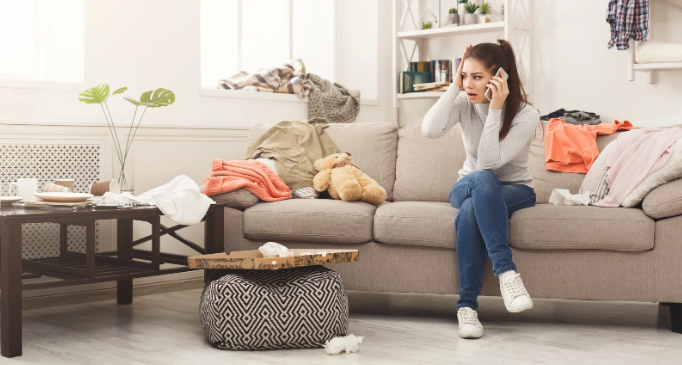
    woman, phone, shock, mess, messy room, cleanliness,
    Woman in a messy room talking on the phone. Photo credit: Canva

    Mess makers set things down

    Neat people put things back

    “Clean up as you go” is a mantra to internalize if you aspire to have a perpetually neat home. If a neat person is baking, they will take out an ingredient, measure what they need, then put that ingredient back where they got it. They do this every time, so when the baked good gets put in the oven, all that’s left to do is clean the dishes they used in prep (which is, of course, seen as an inherent part of the baking task). And this isn’t just in the kitchen. They do the same thing with their toiletries in the bathroom, their clothes when choosing an outfit, etc. Everything gets put back rather than put down, preventing a mess from the get go.

    A woman upset about her messy house. Photo credit: Canva

    If a messy person is baking, they’ll take out an ingredient, measure what they need, and then set the ingredient down on the counter. Once the baked good gets put in the oven, there’s then a whole counter full of ingredients and dish mess to clean up. And because “cleaning up” is seen as a separate task, there’s a gearing up of energy that’s required as well as a separate time commitment, which makes procrastination more likely.

    The key here is to recognize that putting things back where you got them really doesn’t take any more time than setting them down but saves tons of time and work later.

    Messy people have more things than places

    Neat people have more places than things

    “A place for everything and everything in its place” is a mantra that neat people live by religiously and messy folks may not even realize is possible. If a neat person doesn’t have a place for something, they find one or make one by getting rid of something else. If a messy person doesn’t have a place for something, it sits on a table or countertop or entryway or some other placeholder for an indeterminate amount of time, often moving from surface to surface before eventually being shoved in a drawer or closet to be dealt with later.

    Part of living like a neat person is being honest with yourself about the space you have and embracing inflow and outflow of things that enables you to live comfortably in that space. Messy people almost always have too much stuff for their space and therefore not enough places to put things. (This is true no matter how large or small your home is, sorry to say.) Neat people keep things pared down so that everything can have its own place. Regular purging of excess stuff and not holding onto things “just in case” is a huge key to staying neat and tidy.

    I can’t say that I perfectly implement all of these things all the time, but I can say that being aware of these mindsets and habits and attempting to live more like my “neat freak” loved ones has made a big difference in my home and how I feel about living in it.

    This article originally appeared two years ago. It has been updated.

  • Dad follows his daughter during her 5 a.m. jog for the sweetest reasons
    Photo credit: CanvaRunning in the dark raises safety concerns.

    A woman going out on an early morning run is showing everyone what being a good father looks like. Social media fitness influencer Orey shared a TikTok praising her father’s protection and motivation to achieve her goals.

    “I have whatever the opposite of daddy issues are because my dad drives behind me during my 5 A.M. runs to make sure that I’m safe,” said Orey in the video’s caption. In the video, Orey gives her dad a fist bump through the open driver’s seat window before running off into the dark streets as her dad monitors her from his car.

    Why early morning runs can be dangerous for women

    Most outdoor joggers prefer to get their run in early in the morning to avoid traffic and pedestrians that would clog up city streets. It’s also a more comfortable time to run for people who live in warmer climates that get significantly hotter during the day, such as in Los Angeles where Orey resides. Unfortunately, though, such runs aren’t always safe.

    Running outdoors when it’s dark can be risky, especially for women. There have been several news stories over the years about primarily female runners being harassed or assaulted while alone on the streets or in a park. While there should be a conversation on how to permanently ensure the safety of the public while they exercise, it’s currently necessary to actively find ways to protect yourself. Or, in Orey’s case, reflect upon how special it is that someone steps up for you.

    What other people shared in the comments

    The commenters on Orey’s TikTok shared similar stories from their parents:

    “My dad finds parking in the Bronx for me and moves his car when I come home. ”

    “I didn’t have my dad, but my mom would follow me to work when I would have to be there at 5 A.M. to open and stay until another employee showed up.”

    “My dad would walk to the beach a block from our house at 2 A.M. after his night shift to check on me on my night ‘walk’ and walk me home…I was in my 30s. ”

    Orey has built a following on TikTok by sharing relatable and accessible videos of her fitness journey, especially with running:

    @oreyfit

    Replying to @Monique Miller some running tips 🩷 #fyp #run #running #runningmotivation #runningtips

    ♬ original sound – orey 🤍


    Parents often protect their children through limitations, even when they’re grown. They might say, “Don’t do that at night,” or “That’s too dangerous of a commute,” or “You could get hurt; best to forget about it.” While well-intentioned, that approach can create a boundary in the relationship and a lack of trust in an offspring’s ability to be independent. If Orey’s dad had that mentality, it could create resentment from Orey and he would still be worried for her if she decided to run before dawn.

    Why participation beats protection

    Instead, Orey’s dad did something great parents do—he participated. It’s special when anyone inconveniences themselves to support their loved one’s goals. If he was going to feel restless knowing that his daughter was going to run at 5 a.m., might as well go along with her, right?

    Supportive and participatory phrases might sound like, “Let me drive you there and back,” “Let’s make a plan together in case the worst happens,” or “Can I do it with you?” This approach not only creates peace of mind for the parent but also strengthens the bond with the child as a wonderful side benefit. And it isn’t just applicable for parents and their kids, but also between spouses, partners, and friends, too. You not only help keep them safe as they pursue their goals but are actively there when they achieve them.

    It’s an unfortunate reality that safety is never 100% guaranteed, but providing protection in tandem with support creates something special between loved ones. That alone is worth an early alarm each morning.

    This article originally appeared two years ago. It has been updated.
  • Mom blasted for not wanting to go to her kid’s parent-teacher conference. Is she in the wrong?
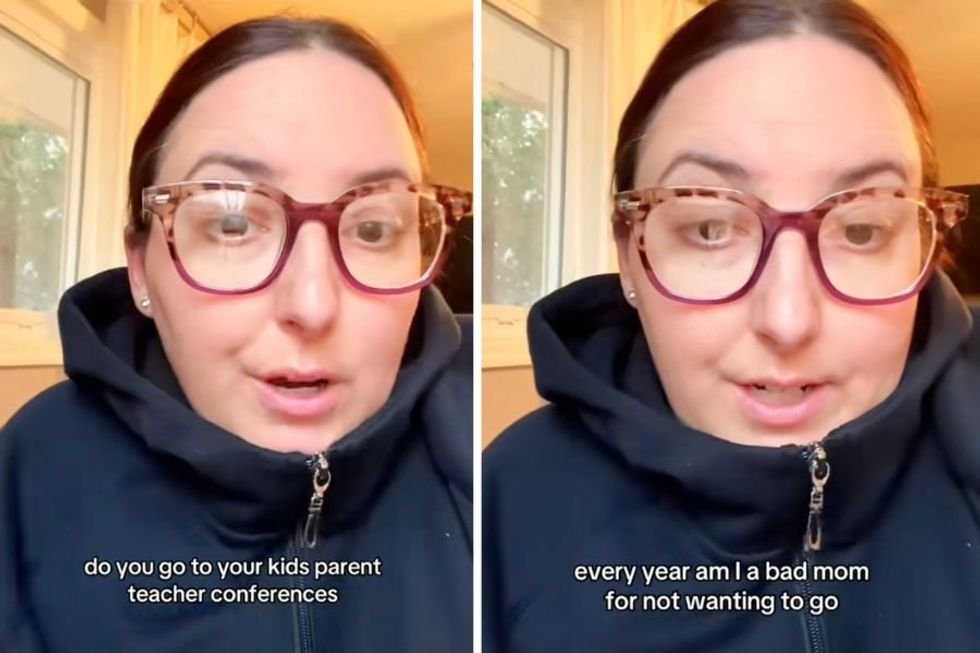
    Photo credit: @mamasreadingjournal/TikTok"Am I a bad mom for not wanting to go?"

    Parent-teacher conferences are considered a crucial tool in a child’s education and development. They help both parents and teachers get on the same page about a student’s progress, strengths, and areas where improvement is needed. What’s more, it helps parent maintain a participating role in this aspect of their child’s life, making them hopefully feel supported and cared for.

    That said, with all the mandatory activities that parents today have to manage on top of their work and other household responsibilities…not to mention all the various ways parents are constantly inundated with information from schools…it’s understandable why some parents might question whether or not these one-on-ones are actually necessary. Or at the very least…if it could be sent in an email.

    The video that started the controversy

    For mom Tatiana (@mamasreadingjournal), the dread of having to go to her kid’s parentteacher conference was so strong that she posted a TikTok video asking if other moms and dads felt the same way. “Do you go to your kid’s parent-teacher conferences every year? Am I a bad mom for not wanting to go? Like I’m gonna go, but I really don’t wanna go, you know?” she asked in the clip, just before quipping, “sorry if his teacher finds this, it’s not you, I swear, it’s me, I’m lazy.”

    Considering Tatiana is already in communication with her kid’s teacher through an app, she also couldn’t help but wonder why “this can’t be an email?” A very, very relatable thought for anyone in the 21st century. Tatiana’s confession was met with…a lot of concern. Clearly, people do, in fact, feel pretty strongly about this topic. And a common point brought up was how a child might feel if their parent doesn’t show an interest in their education in this particular way.

    The comments did not hold back

    “Your child is worth the effort, showing up to things like this is showing up for them,” one person wrote.

    Another asked, “I guess the question is why aren’t you interested in learning from your child’s teacher about how their learning journey is going, if they’re a good friend to their classmates, etc? I see how it can be an inconvenience but being a parent means being involved in their life at school as well.”

    A few teachers also weighed in, who admitted that even they didn’t exactly love parent-teacher conferences. Still, one advised, “always go. As a teacher it builds the connection we have with the parent, helps communication to overall support the child.”

    Another teacher was a little more blunt, saying, “Girl, we don’t want to go! But you create so much work for us if you don’t go. We gotta document so many attempts of trying to get you in. Also, your kid wants you to go. I see HS kids sad that their parents don’t care to go. It’s important I swear.”

    The conversation didn’t stop there

    There was even a heated sidebar debate as to which parent, if only one, should be attending said parent-teacher conference: the stay-at-home-parent (SAHP), or the parent who works. Some argued that the SAHP should be the one to go as part of their at-home responsibilities. Others argued that SAHPs are the ones in regular correspondence with teachers, and therefore it’s the other parent that needs to get caught up.

    But all moral judgments aside, this mom wasn’t necessarily saying she planned on skipping out. She was merely sharing a feeling that quite honestly a lot of folks can probably relate to. Even the most involved parent on the planet could get overwhelmed with the ever increasing amount of random school events that seem more or less mandatory. That goes double for parents who already have demanding schedules or social anxiety, which has to describe at least 99.9% of parents, right? It more so sounds like she was looking for commiseration than anything else.

    To that point, Tatiana did make a follow-up video sharing that she “did not know” that not attending a parent-teacher conference results in more work for the teacher. She assumed it meant they’d “get to go home earlier if I didn’t go.” Honestly, fair assumption.

    She also clarified that she did in fact go to the conference, and had always planned to go. However, she tells Upworthy that “outta my 15 minute slot we talked about my kid’s actual performance for maybe two minutes. Even my husband was shocked how much we chitchatted vs discussing actual grades and progress.”

    But regardless, while she still feels that there’s “too much weight” put on this particular event, she will “go every year with bells on.”

    “A mom who’s willing to accept feedback and adjust their attitude. We love to see it,” one astute viewer said.

    This goes to show a few things. One, it’s a reminder of how so many aspects of education could stand for a revamp to fit with modern times. Two, productive conversations really can lead to better understanding. And three, parenting comes with going to a lot of things that you’d really rather not go to. Be it a parent-teacher conference or a Peppa Pig pop-up.

    Not to mention, it can almost always be an email instead.

    This article originally appeared two years ago. It has been updated.

  • Mom turns texts from teenage son into an emo ballad, and it has no right to be this good
    Photo credit: mandimoonda/InstagramParents are turning their teens' angsty text messages into catchy pop-punk songs.
    ,

    Mom turns texts from teenage son into an emo ballad, and it has no right to be this good

    Parents are wondering if they all have the same kid after hearing this.

    Kids say a lot of hilarious things. It starts when they’re little and are just learning how to talk and string sentences together, and the unintentional comedy continues all the way into the overdramatic and angsty teen years.

    As parents, we often wish we could remember these little nuggets of gold forever. Now, a new trend is turning teens’ most emotional and unhinged words into unforgettable earworms.

    One mom turns texts into unbelievably catchy pop-punk song

    Mandi Mansour, a hairstylist from San Diego, recently posted a Reel on Instagram of herself rocking out in the car while singing along to a song of her own creation.

    The lyrics? Her own teenager’s frantic and melodramatic text messages.

    It’s amazing to watch how messages like “Can I get Canes or Taco Bell? I know you said no, but I’m starving,” and “Can I have ten bucks? … Can I have seven dollars?” become such a catchy and convincing song. Of course, old early-2000s emo is the only musical style perfectly suited to capture the frantic angst, and the final product is honestly a banger. (The vocal run during “seven dollars” is absolutely priceless.)

    A great detail from the video is how Mansour is driving and singing the lyrics without even looking at the screen. She’s clearly listened to her personalized song on repeat dozens of times and can’t seem to get enough of it.

    Video is part of a trend making clever use of an AI music app

    Mansour’s video isn’t the only one like it, not even close. These “emo songs” have become a huge viral trend over the last couple of weeks, with parents using the AI music app Suno (and similar ones) to turn these “lyrics” into full-blown songs, usually in the pop-punk genre.

    It’s hard to say exactly where the trend originated, but Marcus Leshock, a reporter for WGN-TV, was one of the early prominent participants. Hundreds of thousands of parents followed suit shortly after.

    Trend has parents asking: “Do we have the same kid?”

    No matter how many clips you watch, all texts from the teenagers seem to fall into two buckets: wanting food and asking for money.

    The series is an amazing glimpse inside the mind of the modern American Gen Z or Gen Alpha kid. It’s all Starbucks, açaí bowls, Raising Cane’s chicken—all fast food, really—e-bikes, and, of course, the classic requests for cash.

    This is one of the first times we have such thoroughly documented evidence of how teens and preteens really think. About 85% of 11- to 13-year-olds have a cell phone capable of texting, with many getting their first phone under the age of 10.

    Simply put, we’re in the frontier days of kids being able to text directly with their parents at all times. And the results are definitely something these moms and dads will want to remember when their kids are grown and self-sufficient.

    Thanks to these infectious and unforgettable choruses, they most certainly will.

    Turning texts into emo songs is really the best kind of AI trend. It draws humor from real-life experiences that connect all of us (well, all of us with moody teens), and uses a little assist from the technology to make it memorable and fun.

    No one’s trying to top the Billboard charts here, but the commonalities between the songs really go to show that none of us are in it alone. Raising a teenager is tough, exhausting work—but it’s bringing parents all over social media a lot of comfort to know the challenges they’re dealing with are extremely common.

    And those big feelings and dramatic outbursts just so happen to be perfect fodder for the type of songs many of us grew up loving.

  • Adult plane passenger praised for denying window seat to stranger’s child having a tantrum
    Photo credit: Photo by Mohamed Abdelghaffar 'We do not negotiate with tantrumists.'

    Flying can test anyone’s patience, but Reddit user Safe_Ad_9314 may take the cake for having all their buttons pushed. They shared how a recent flight turned into a surprising lesson in setting boundaries, explaining that they had reserved a window seat, which was an intentional choice aimed at making their journey just a bit more enjoyable. But as soon as they settled in, a family boarded and a conflict began brewing.

    After several attempts to calm her, the father turned to u/Safe_Ad_9314 and asked if they’d give up their seat for the child, adding, “She’s just a kid.” The OP gently stood their ground, explaining that the window seat was not a random perk, but something they had deliberately arranged, and even paid extra for.

    Outbursts from children on airplanes can be extremely disruptive, sometimes even causing flights to be delayed.

    The tantrum that sparked the conversation

    The family’s six-year-old daughter quickly grew upset that she didn’t have the coveted window view. Her frustration was clear:

    “I want the window! I want the window!”
    — the child

    Eventually, the mother distracted the child with a tablet, and the flight continued. When everyone deboarded at their destination, the mother shot a lingering remark at u/Safe_Ad_9314:

    “Some people just have no heart.”
    — the mother

    That stung. It’s never easy to feel judged, especially when you’ve tried to be polite. Unsure if they’d done the right thing, u/Safe_Ad_9314 turned to the trusty Reddit subforum r/AITAH for feedback, asking, “AITA for not giving up my window seat on a plane to a kid just because she threw a tantrum?”

    The response was overwhelmingly supportive, reframing the encounter into a conversation about how we teach children empathy, respect, and understanding of life’s little disappointments.

    Boundaries matter – especially in public

    Do we cave at the first sign of a tantrum, or do we help kids learn that not every wish can be granted? The community weighed in:

    “You teach your kids how society works and that not everything is at their disposal all the time.”
    u/hierosx

    People pointed out that giving in to every demand might soothe tears in the moment, but can set unrealistic expectations for the future. If having a window seat was so important, some said, parents could plan ahead and book one. After all, this wasn’t about denying a child joy, but about showing them how to handle disappointment gracefully.

    Why tantrums don’t work

    Many commenters stood behind the idea that it’s kinder in the long run to help children learn healthy boundaries:

    “I learned when my kids were toddlers that the best policy was ‘we do not negotiate with tantrumists.’”
    u/BeBearAwareOK


    Setting clear limits doesn’t mean being cruel. It means showing kids that while it’s okay to feel upset, not every feeling must be instantly gratified.

    Nobody owes you their seat

    At the core, many commenters reminded readers that random strangers aren’t responsible for resolving someone else’s poor planning or appeasing a meltdown:

    “It’s not your responsibility to accommodate someone else’s poor planning or their child’s tantrum.”
    u/experiment_ad_4

    Others emphasized that saying “no” isn’t heartless—sometimes it’s a necessary act of kindness to the child, who learns that people have their own boundaries and can’t always bend.

    “I am a mum of three. Kids get explained that they can’t have that seat as it’s already occupied, end of it.”
    u/Sure_Freedom3

    Instead of feeling guilty, u/Safe_Ad_9314 received a gentle reminder that upholding personal boundaries is part of living in a shared world. When we calmly stand our ground, we help create an environment where everyone learns that respect and empathy go both ways—even at 30,000 feet.

    In the end, that’s what makes these moments matter. When we model healthy limits, we’re not just keeping a seat—we’re showing kids that there’s a bigger picture out there, one where kindness and fairness guide us all.

    This article originally appeared two years ago. It has been updated.
  • Doctors thought the smaller twin was struggling in the womb. She was perfectly fine. She had been saving her sister.
    Photo credit: CanvaA pair of newborn twins in the hospital.
    ,

    Doctors thought the smaller twin was struggling in the womb. She was perfectly fine. She had been saving her sister.

    A young mom refused to choose between her daughters. The smaller one made sure she didn’t have to.

    At 21 weeks pregnant with twins, Leah McBride got news that no expectant mother wants to hear. Her daughters had twin-to-twin transfusion syndrome, a condition where blood flow between twins becomes dangerously imbalanced. One baby becomes the donor, passing nutrients to the other, while the other receives everything. The size difference between her girls had already reached 48 percent.

    Doctors advised her to terminate the smaller twin, Poppy, to give her other daughter, Winnie, a better chance. They were worried Poppy would have a heart attack from giving away so many nutrients, and that Winnie might have a stroke.

    Leah refused to choose.

    Doctors were concerned about the smaller twin

    She sought a second opinion at Memorial Hermann Hospital in Houston, where doctors recommended surgery to correct the blood flow imbalance. It worked. But at 27 weeks, her water broke, and the situation became urgent again. Doctors used steroids to try to delay delivery, knowing that earlier was riskier. “We needed to buy as much time as possible because 28 weeks was still too early to deliver them safely,” Leah said.

    At 31 weeks, Poppy’s heart rate began dropping and wouldn’t stabilize. Doctors had no choice but to deliver both girls. Poppy and Winnie were born on May 24, 2019.

    The twist that surprised everyone

    What happened next surprised everyone. Poppy, the smaller twin at 1lb 11oz and the one whose monitor had been sounding alarms, was born perfectly healthy. Nothing was wrong with her heart.

    It was Winnie who was in trouble. She weighed 3lb 8oz but had underdeveloped lungs and was rushed to the intensive care unit. At 14 days old, she needed brain surgery to relieve a buildup of fluid. She came through it.

    A lifesaver of a sibling

    Leah said the doctors told her plainly: “I think your tiny twin saved her sister’s life.” Poppy’s heart rate had been fluctuating on the monitors, triggering the early delivery. But there was nothing wrong with Poppy. The medical team’s belief is that she was sending distress signals because Winnie wouldn’t have survived much longer in the womb.

    “Poppy’s heart rate had been all over the place, so they had to deliver,” Leah told reporters, “but when she was born, she was completely fine.”

    The girls, now 6, are thriving. Winnie was reading books from memory by age 3. Poppy is still smaller than her twin, but according to Leah, she still keeps a close eye on her sister. When Leah tried to move their beds apart, they weren’t having it.

    “They are so close,” Leah said. “It’s sweet.”

  • Woman with unfortunate initials warning parents to think things through before naming their kids
    Photo credit: CanvaWoman holding her nose looking in the refrigerator.
    ,

    Woman with unfortunate initials warning parents to think things through before naming their kids

    “When you’re deciding what to name your kids, look at what their initials are going to be.”

    A lot of thought goes into choosing a baby’s name. Will other kids have the same name when they start kindergarten? Is the name too dull? Is the name too original? Will the name lead to bullying? Will the name look good on a job application? Could you run for president with this name?

    Popular TikToker Emily Windham, 23, from Birmingham, Alabama, is adding another question that parents should ask themselves: What will their initials be? Windham has gone viral for her video in which she reveals how disheartening it is when she has to write her initials, especially when they appear multiple times on a document. To put it simply, they are pretty yucky.

    “When you’re deciding what to name your kids, look at what their initials are going to be,” she says at the beginning of her video. “Every time I have to initial a document, I have to write ‘EW.’ All these little initial lines just say EW EW EW EW.” The situation is frustrating for Emily because her parents considered naming her Alexia, which would have been AW, which is sweet. “That’s so cute,” she said.


    The post inspired other people with unfortunate initials to comment; some of them are much harder to live with than EW.

    “Yea… mine is XL,” Xitlali wrote.

    “Mine is ‘BLT’ because it was my dad’s favorite sandwich. Mom didn’t notice until it was too late I don’t even like blts,” Bryony Tally Art wrote.

    “Mine is ‘PP’ elementary and middle school was a blast,” Pais wrote.

    “I knew a girl in school whose name was Amy, and her initials were also AMY, and I’ll never forget because that’s so baller,” Charlie wrote.

    “My son’s initials are BRB,” Ashleigh wrote.

    “My initials are EGG,” El-Glory wrote.

    “My initials spell EMO and I think that’s awesome,” Elle wrote.

    “Mine is OG… now I’m getting married and it’ll be OJ. Can’t decide if I like an original gangster or Orange Juice more,” Olivia wrote.

    “Mine is ME, and when I sign out on duties at work, someone goes, ‘Can someone please stop signing ME and sign your initials?’ I’m like, those are my initials,” a TikToker named Madison wrote.

    @thesam_show

    sorry if i talk about this problem too much but it is HAPPENING AGAIN!!

    ♬ original sound – Sam Showalter

    Emily’s story is similar to that of Samantha Hart, a woman who went viral on TikTok in 2023 because her name doesn’t exactly work well with modern email conventions. Clearly, her parents hadn’t thought that her name would cause any trouble in the late ’90s when email was a new thing. So, she made a video warning parents to think of their children’s future email addresses before selecting a name.

    “My name is Samantha Hart,” the 27-year-old said. “Most companies use the email designation of first initial, last name, meaning my email would be shart.” A shart is an accidental release when one assumes they only have gas, which is not exactly how one wants to be known in professional circles. Imagine sending an email to someone at another company and their name comes up as SHart. YOu might even think that someone is pranking you.

    “At every single workplace, I have received an email from HR the week before I start letting me know that my name does not exactly fit the company email structure as they would intend and [asked] would I mind if they gave me a different structure for my email,” Hart said. That’s kind of the HR people to help Samantha save a bit of face when starting a new job, so the thing she’s most known for, before meeting anyone, is her questionable email address.

    Sadly, Hart will probably have to deal with this whenever she gets a new job. Hopefully, she enjoys doing long stretches with her employers.

    This article originally appeared two years ago. It has been updated.

Culture

Hero principal crowned prom king after he was shot tackling school shooting suspect

Communication

‘No convincing’: Teacher praised for getting to the heart of ‘no means no’ lesson

Education

Teacher reveals the ‘really obvious’ reason teens no longer read. It’s not just the phones.

Finance

UPS driver has a blunt take on America’s economy after delivering Christmas packages