
HOA told a guy exactly how to mow his own lawn. He found an epic loophole they didn't see coming.
The HOA said straight lines. He heard "challenge accepted."
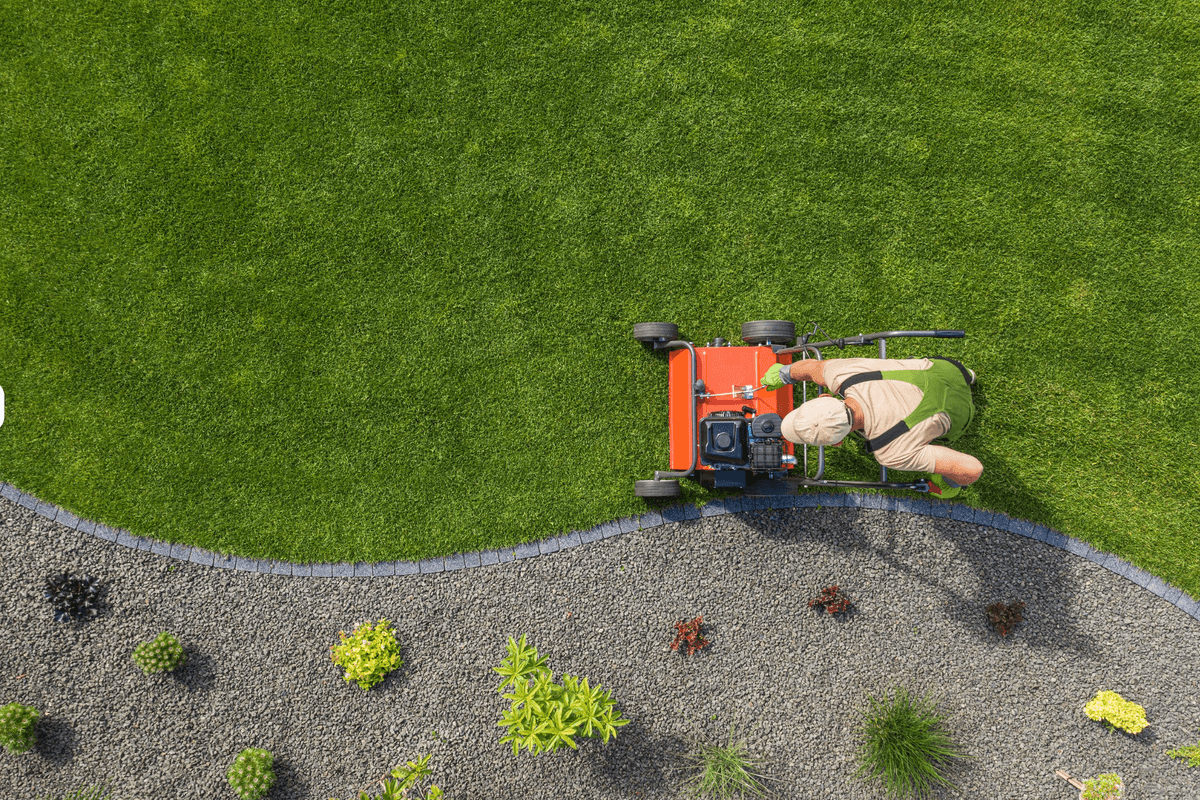
Aerial view of man mowing his lawn
There is a particular kind of frustration that comes with being told how to mow your own lawn. Not whether the grass is too long, not whether the edges need trimming, but the specific direction your lawnmower needs to travel. For the man behind the TikTok account @rootedlawnco, that was apparently the line.
His HOA had instructed him to mow only in straight lines. So he did. Sort of.
In a video that has been bouncing around TikTok with the caption "Take that HOA," he methodically mows his lawn in long, flowing, perfectly symmetrical waves. The result is gorgeous: a sea of alternating light and dark grass bands that roll across the yard like something off a golf course or a baseball field. He even varies the cut depth on alternating passes to give it a color shift, which makes the whole thing pop even more from a distance. The text overlay on the video reads, "When HOA tells you only straight lines." His face, for what it's worth, is extremely unbothered.
@rootedlawnco Take that HOA!! #mowing #stripes #hoa #lawncare #mowing
In a follow-up video, he shared an aerial shot of the lawn covered in sand: "POV: You can't go to the beach, so you bring the waves to you."
@rootedlawnco Surfs up 🤙🏽 What do you think of the wavey stripes? Pretty sure @Chase has these trade marked by now. #stripes #waves #lawnstripes #beforeandafter #reelmower #allettmowers #greengrass🌱 #dronevideo
The comments landed exactly where you'd expect. "Tell them you have astigmatism and this is straight," wrote @nowherenothin. @spiderlover74 added, "No way they're trying to control the direction you mow your lawn." One commenter, @caffeinatedpossum, offered a legal-ish read on the situation: "HOAs have legal rights to control the aesthetic of your grass, but there's no legal standard for them to control cutting patterns as the cutting pattern is semantic." (That's one interpretation, though HOA rules vary widely by state and governing documents, so your mileage may vary on that one.)
The broader frustration behind the video is real and well documented. A survey conducted by Rocket Mortgage found that 57% of HOA homeowners dislike having one, and more than 3 in 10 feel their HOA has too much power. A separate YouGov poll found that most Americans actually oppose HOA rules specifically around landscaping, with more people against those restrictions than in favor of them. And yet, 38% of HOA residents think their HOA is too restrictive, with rules about yard signs, fences, and landscaping among the most contested.
It's worth saying that HOAs were not invented to tell people which direction to push their lawnmower. The idea was originally to maintain shared spaces and protect property values. But there's a gap between that intention and the reality of a board with the authority to regulate the pattern of someone's grass, and that gap is where videos like this one get millions of views.
In yet another video, he openly disregards the HOA's rules against using sand to level his yard: "POV: When the HOA says no sand, but you did it anyway..."
@rootedlawnco Yep, the HOA will be all over me for this one! Got a bumpy lawn? Check out my 4 part mini series on You Tube and learn all you need to know in under 10 minutes. Mowing is super enjoyable but mowing a smooth lawn is literally the best thing! I need to do this to my back lawn pretty badly. Maybe this Fall I will. #level #leveling #bumpy #Lawn #diy #lawntips #compost #sand #topsoil #smooth #HOA
There is something deeply satisfying about a response that is simultaneously fully compliant and completely defiant. He did not fight the rule. He did not post an angry letter or file a complaint. He just made something beautiful out of the constraint, posted it to TikTok, and let the rest of us enjoy it.
The lawn looks incredible, for the record.
You can follow @rootedlawnco on TikTok for more content on home decor and lifestyle.