Hospice nurse shares clue she uses to know if someone is dying 6 months before it happens
"Allow the body to be the guide."

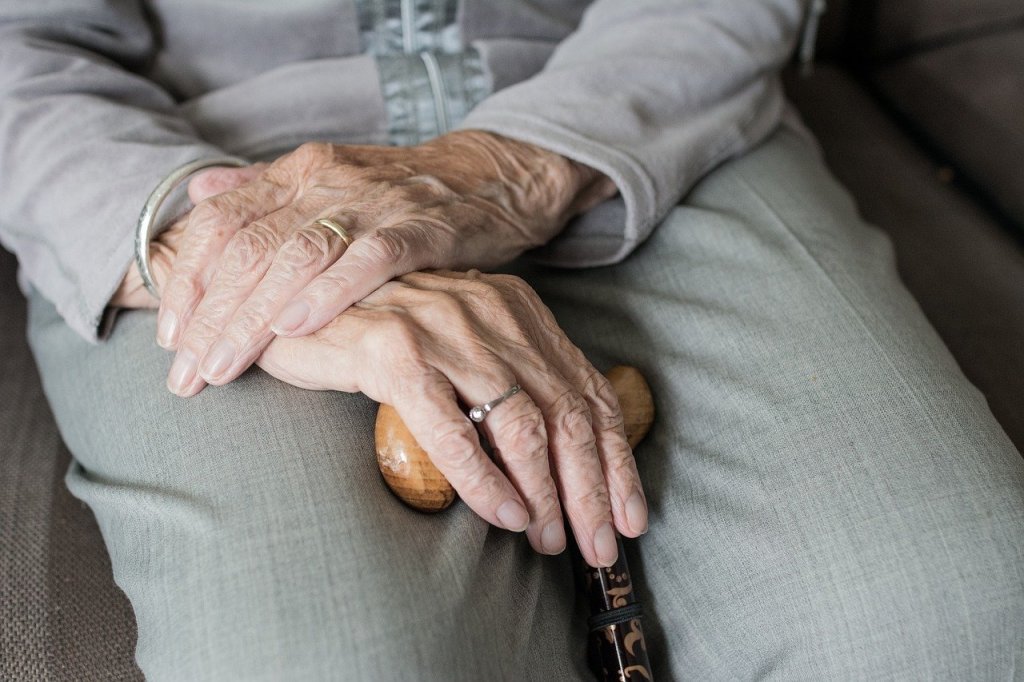
An old woman holding a cane.
Death is the last great mystery that all of us face. We don’t know when we will go or can really be sure what comes next. So there’s understandably a lot of fear and uncertainty that most of us feel around death, whether we’re thinking about ourselves or a loved one. That’s why Julie McFadden's work is so important. As a palliative care nurse in the Los Angeles area, who has seen over a hundred people die, her TikTok videos shed light on the process to make us all a bit more comfortable with the inevitable.
McFadden is also the author of the bestseller, “Nothing to Fear.” The nurse’s experience helping people in their final stages has given her a unique perspective on the process. In a recent video, she shared how she can see the first symptoms that someone is going to die a natural death about 6 months before they finally do.
Interestingly, she can determine that someone only has half a year left to live when most of us have no idea they have entered the final stages of life.
@hospicenursejulie Replying to @Mariah educating yourself about scary topics will help decrease fear. ✨Nothing to Fear ✨- my book- out june 11th #hospicenursejulie #hospicenurse #caregiversoftiktok #medicaltiktok #learnontiktok #nothingtofearbook
What are the symptoms of dying at the 6-month mark?
McFadden adds that people who are dying are usually placed in hospice care when the symptoms begin to appear around the 6-month mark.
"You will have very generalized symptoms. Those symptoms will usually be, one, you will be less social. So you'll be more introverted than extroverted," McFadden said. "Two, you will be sleeping a lot more. And three, you will be eating and drinking a lot less. Literally, everyone on hospice, I see this happen to."

What are the symptoms of dying at the 3-month mark?
You are going to notice more debility,” McFadden continues. “They will be staying in their house most of the time. It's going to be difficult getting up and just going to the bathroom. Again, sleeping a lot more and eating and drinking a lot less.”
What are the symptoms of dying at the 1-month mark?
Something usually begins to happen in the final month of someone’s life. They start to believe they are in contact with others they have lost. It’s like they are there to make the dying person feel comfortable with their final transition.
"Usually around the one month mark is when people will start seeing 'the unseen', they have the visioning. They'll be seeing dead relatives, dead loved ones, dead pets, old friends who have died,” McFadden said. “Again, not everyone — but many, many people will start seeing these things at around one month."

Angela Morrow, a registered nurse at Verywell Health, agrees that people in the final stage of life often hear from those who have passed before them. Morrow says we should refrain from correcting the patients when they share their stories of talking to people and pets who have died. "You might feel frustrated because you can't know for sure whether they're hallucinating, having a spiritual experience, or just getting confused. The uncertainty can be unsettling, but it's part of the process," Morrow writes.
At the end of the video, McFadden says that the most important factors palliative care nurses look at to determine the stage of death are eating, drinking and sleeping. “Most people, a few weeks out from death, will be sleeping more than they are awake. And they will be barely eating and barely drinking,” McFadden said.

In the end, hospice nurses “allow the body to be the guide” as they help their patients transition from life to death.
McFadden’s work has brought a lot of peace to her followers as they go through trying times. "My mom is in hospice right now and she’s currently, I think, hours or days from death. YourTikToks have helped me out tremendously," Deb wrote. "My grandma passed away in February, and she experienced all of this. this page brings me peace knowing everything she went through was natural," Jaida added.
"Thanks, Julie. I volunteer in a hospice end-of-life facility, and this helps educate the families. Your posts are wonderful," Grandma Nita wrote.
One of the things that makes death so scary is the number of unknowns surrounding the process. That’s why it’s so important that McFadden shares her stories of helping people to the next side. She shows that death is a natural process and that hospice nurses are here to help make the transition as peaceful as possible.
This article originally appeared last year.

- 83-year-old hospice patient's last wish was for a tattoo and it's a great lesson for everyone ›
- Hospice nurse who's seen a hundred people die shares the one regret her patients always have ›
- Hospice Nurse Julie shares video of what dying looks like - Upworthy ›
- Hospice nurses share their patients' most shocking death bed confessions, and it's eye-opening - Upworthy ›
- Woman shares the one heartwarming request she got while volunteering at a nursing home - Upworthy ›
- Hospice nurse shares one comforting sign that someone is going to die within 4 weeks - Upworthy ›
- Hospice nurse reveals the exact time most people die and the reasons why are fascinating - Upworthy ›
- Man unexpectedly dies during brain scan. What scientists saw should give everyone comfort. - Upworthy ›
- 'Either way you've been there before.' Mom has beautiful way to explain death to her kids. - Upworthy ›
- Hospice worker reveals people's new biggest deathbed regret - Upworthy ›
- A man died suddenly during a brain scan. What scientists saw was beautifully comforting. - Upworthy ›


Student smiling in a classroom, working on a laptop.
Students focused and ready to learn in the classroom.
Fish find shelter for spawning in the nooks and crannies of wood.
Many of these streams are now unreachable by road, which is why helicopters are used.
Tribal leaders gathered by the Little Naches River for a ceremony and prayer.

Communications expert shares the perfect way to gracefully shut down rude comments
Taking the high ground never felt so good.
A woman is insulted at her job.
It came out of nowhere. A coworker made a rude comment that caught you off guard. The hair on the back of your neck stands up, and you want to put them in their place, but you have to stay tactful because you're in a professional setting. Plus, you don't want to stoop to their level.
In situations like these, it helps to have a comeback ready so you can stand up for yourself while making making sure they don't disrespect you again.
Vince Xu, who goes by Lawyer Vince on TikTok, is a personal injury attorney based in Torrance, California, where he shares the communication tips he's learned with his followers. Xu says there are three questions you can ask someone who is being rude that will put them in their place and give you the high ground:
Question 1: "Sorry, can you say that again?"
"This will either make them have to awkwardly say the disrespectful remark one more time, or it'll actually help them clarify what they said and retract their statement," Xu shares.
Question 2: "Did you mean that to be hurtful?"
The next step is to determine if they will repeat the disrespectful comment. "This calls out their disrespect and allows you to learn whether they're trying to be disrespectful or if there's a misunderstanding," Xu continues.
Question 3: "Are you okay?"
"What this does, is actually put you on higher ground, and it's showing empathy for the other person," Xu adds. "It's showing that you care about them genuinely, and this is gonna diffuse any type of disrespect or negative energy coming from them."
The interesting thing about Xu's three-step strategy is that by gracefully handling the situation, it puts you in a better position than before the insult. The rude coworker is likely to feel diminished after owning up to what they said, and you get to show them confidence and strength, as well as empathy. This will go a lot further than insulting them back and making the situation even worse.
Xu's technique is similar to that of Amy Gallo, a Harvard University communications expert. She says that you should call out what they just said, but make sure it comes out of their mouth. "You might even ask the person to simply repeat what they said, which may prompt them to think through what they meant and how their words might sound to others," she writes in the Harvard Business Review.
More of Gallo's suggested comebacks:
“Did I hear you correctly? I think you said…”
“What was your intention when you said…?”
“What specifically did you mean by that? I'm not sure I understood.”
“Could you say more about what you mean by that?”
Ultimately, Xu and Gallo's advice is invaluable because it allows you to overcome a negative comment without stooping to the other person's level. Instead, it elevates you above them without having to resort to name-calling or admitting they got on your nerves. That's the mark of someone confident and composed, even when others are trying to take them down.