upworthy
Add Upworthy to your Google News feed.
Google News Button
Animals & Wildlife

Horse ranch raises $17K to rescue two mustangs from abuse—thanks to a viral Facebook post

Clare Staples and her Skydog Sanctuary have saved hundreds of wild mustangs and burros, bringing them back to a freedom they deserve

horse, ranch, barn, Skydog Sanctuary, Facebook
Photos courtesy of Meta Community Voices
True

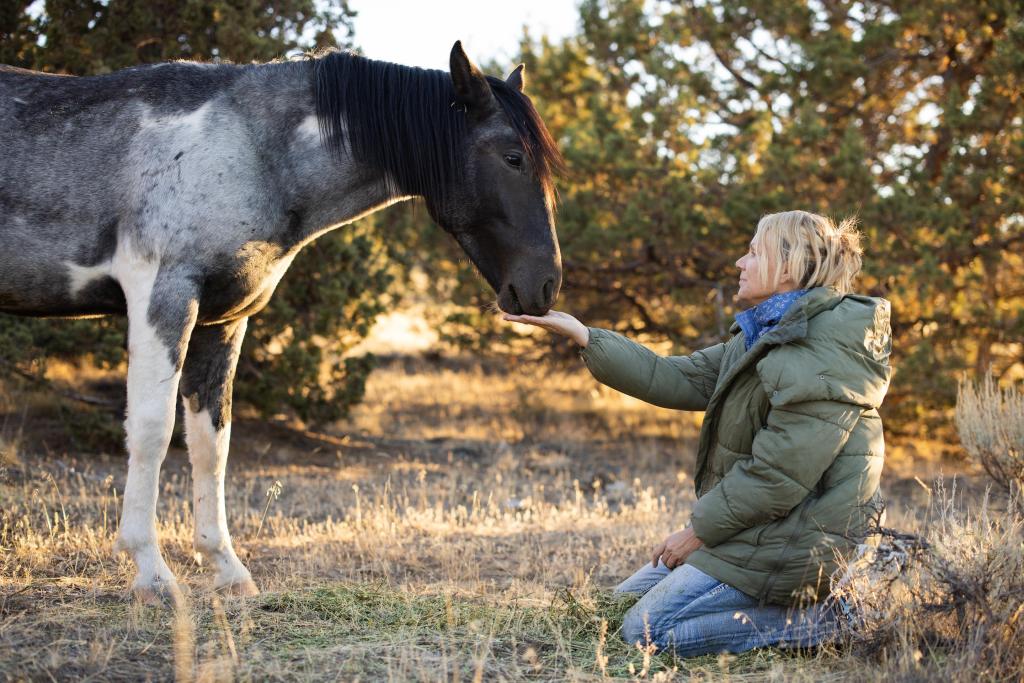
Horses often invoke feelings of passion, freedom, and graceful power. And though they might not get the title of “Man’s Best Friend,” horses share a special bond with humans.

Just ask Clare Staples, founder of mustang and burro rescue organization Skydog Sanctuary who recently raised a whopping $17K to help two horses —simply by writing a heartfelt post on Facebook.

“I grew up in England where there is a huge culture of horse loving people,” she told Upworthy. “When I was growing up I lived in a sort of imaginary land where I rode everywhere on an imaginary horse, which is a bit crazy, but my love of horses was born at such an early age. I'd be going on long car rides with my family and swiveling my head to look in every horse trailer or every field to see if I could see a horse.”


Growing up, horses became Staples’ “happy place.” In particular, she loved watching American TV shows like “Bonanza” and “Little House on the Prairie”, along with other westerns where “you would see a band of wild mustangs gallop through and steal the mares.”

Considering the image as a “romantic symbol of the American West,” Staples was shocked and sad to later discover that the American mustang’s reality was much less glamorous. As she explained, mustangs who run free on public lands get rounded up by the Bureau of Land Management, making more room for mining and livestock interests. “It makes the American government a lot of money and wild horses don't.” These captured horses and burros receive a Bureau of Land Management “BLM” brand, then get sent to kill pens or get auctioned off.

Staples became determined to offer her hooved friends a place of refuge, so she founded Skydog Sanctuary—a 9,000 acre ranch near Bend, Oregon where wild mustangs and burros can live out their lives peacefully in their natural habitat. The sanctuary also has an 11 acre location in California. In addition to rewilding equines, Skydog aims to raise awareness about the plight they face, in order to bring about change.
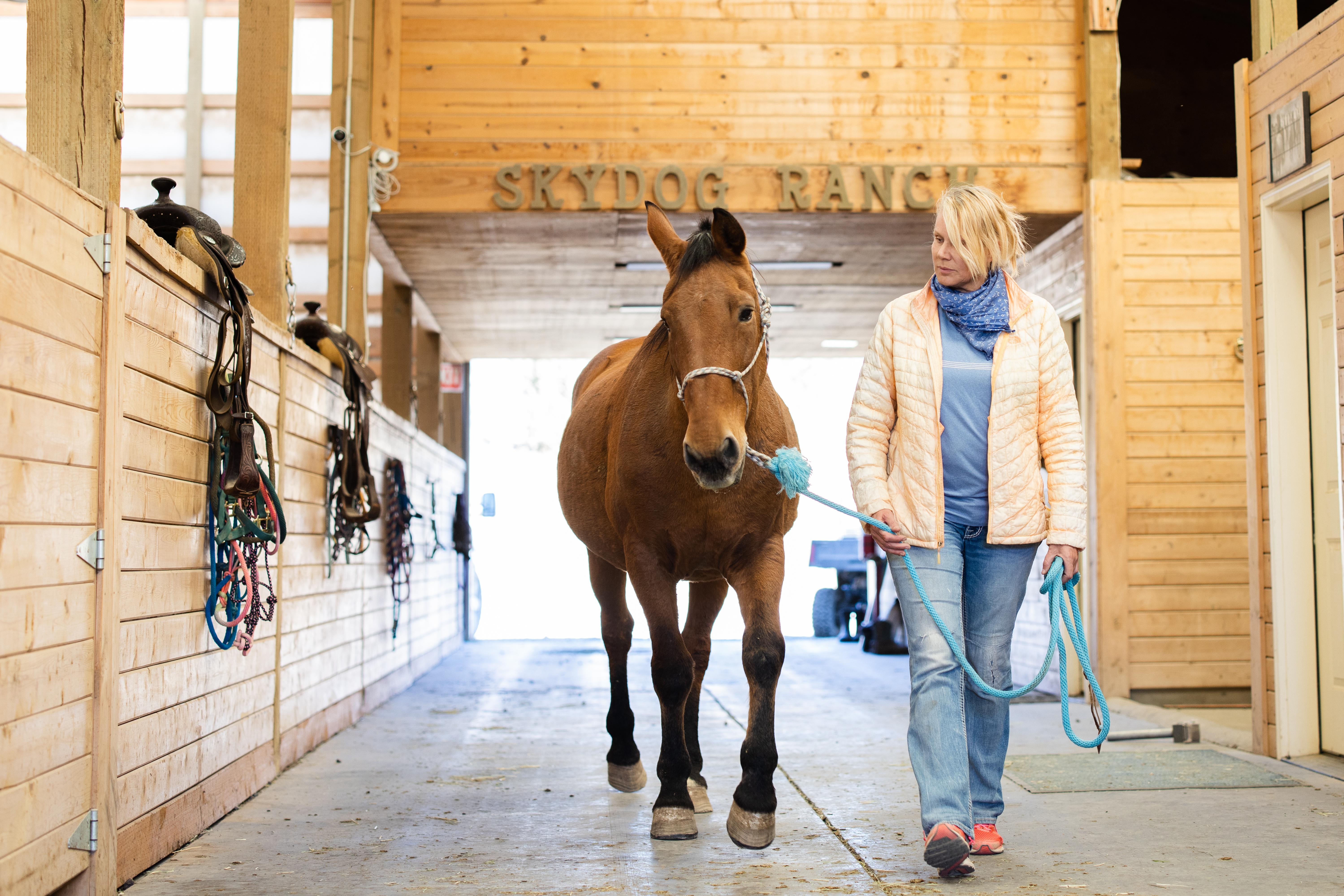
horse, ranch, barn, Skydog Sanctuary, Facebook

Earlier this year, two young mustangs caught Staples’ eye, as they bore an uncanny resemblance to one of her own horses from Skydog. Sure enough, by looking up their BLM IDs, Staples confirmed they were related. She then posted a Facebook fundraiser to get the siblings reunited.

Within only two weeks, people rallied enough support to reunite the two mustangs—now named Rising Sun and Presley, in homage to Elvis—with their native family.


With around 220 horses and 50 burros to look after, and no grant money, Staples relies heavily on her ever-growing social media community. Luckily, Facebook doesn’t take a percentage of their fundraisers, which gives people all the more incentive to donate, since they know exactly where their money is going. Plus, the platform has expanded Skydog’s reach tenfold—with nearly half a million followers, and fundraiser videos racking up nearly 20 million views.

Staples is especially excited for Giving Tuesday, when Meta, Facebook’s parent company, matches funds up to a total of $8 million dollars. “It means a lot to our followers to know if they donate $10 we're actually getting $20. Every year we just break records for ourselves. It's a really fun day. I feel like Facebook are our partners, because they've helped us grow and then [GivingTuesday] is a real day where we can celebrate them too.”

Connecting with people who care and want to help, combined with the power of social media, gives Skydog the resources needed to rescue horses from the very worst of situations. And for Staples and her followers, “seeing them come back to life and watching them heal on this land is just the most beautiful thing. Rewilding them and giving them their freedom and space back is one of the most extraordinary experiences. It never gets old.”

guitar, learning a skill, neuroscience, music, exposure, passive exposure, gardening

A woman learning how to play guitar.

Learning a new skill, such as playing an instrument, gardening, or picking up a new language, takes a lot of time and practice, whether that means scale training, learning about native plants, or using flashcards to memorize new words. To improve through practice, you have to perform the task repeatedly and receive feedback so you know whether you’re doing it correctly. Is my pitch correct? Did my geraniums bloom? Is my pronunciation understandable?

However, a new study by researchers at the Institute of Neuroscience at the University of Oregon shows that you can speed up these processes by adding a third element to practice and feedback: passive exposure. The good news is that passive exposure requires minimal effort and is enjoyable.


"Active learning of a... task requires both expending effort to perform the task and having access to feedback about task performance," the study authors explained. "Passive exposure to sensory stimuli, on the other hand, is relatively effortless and does not require feedback about performance."


woman reading, woman book, young woman, studying, new skills A woman reading a book.via Canva/Photos

How to pick up new skills faster?

So, if you’re learning to play the blues on guitar, listen to plenty of Howlin’ Wolf or Robert Johnson throughout the day. If you’re learning to cook, keep the Food Network on TV in the background to absorb some great culinary advice. Learning to garden? Take the time to notice the flora and fauna in your neighborhood or make frequent trips to your local botanical garden.

If you’re learning a new language, watch plenty of TV and films in the language you are learning. The scientists add that auditory learning is especially helpful, so listen to plenty of audiobooks or podcasts on the subject you’re learning about.

But, of course, you also have to be actively learning the skill as well by practicing your guitar for the recommended hours each day or by taking a class in languages. Passive exposure won't do the work for you, but it's a fantastic way to pick up things more quickly. Further, passive exposure keeps the new skill you're learning top-of-mind, so you're probably more likely to actively practice it.

What is passive exposure?

Researchers discovered the tremendous benefits of passive exposure after studying a group of mice. They trained them to find water by using various sounds to give positive or negative feedback, like playing a game of “hot or cold.” Some mice were passively exposed to these sounds when they weren't looking for water. Those who received this additional passive exposure and those who received active training learned to find the water reward more quickly.
gardening, woman gardening, gardening shears, leaning gardening, weeds A woman tending to her garden.via Canva/Photos


“Our results suggest that, in mice and in humans, a given performance threshold can be achieved with relatively less effort by combining low-effort passive exposure with active training,” James Murray, a neuroscientist who led the study, told University of Oregon News. “This insight could be helpful for humans learning an instrument or a second language, though more work will be needed to better understand how this applies to more complex tasks and how to optimize training schedules that combine passive exposure with active training.”

The one drawback to this study was that it was conducted on mice, not humans. However, recent studies on humans have found similar results, such as in sports. If you visualize yourself excelling at the sport or mentally rehearse a practice routine, it can positively affect your actual performance. Showing, once again, that when it comes to picking up a new skill, exposure is key.

The great news about the story is that, in addition to giving people a new way to approach learning, it’s an excuse for us to enjoy the things we love even more. If you enjoy listening to blues music so much that you decided to learn for yourself, it’s another reason to make it an even more significant part of your life.

- YouTube www.youtube.com

This article originally appeared last year.

library book, children's book, harry the dirty dog, overdue library book, chantilly regional library

A man returned a library book his parents had checked out for him in 1989, when he was 5 years old.

Most of us have returned an overdue library book or two in our lifetimes, but probably not one that went several decades past its due date. Books that have been missing from the library for that long are usually destroyed or long lost, fated to never make their way back home.

That was not the case for a copy of Harry the Dirty Dog that was returned to the Chantilly Regional Library in Virginia on Thanksgiving weekend 2025. The children's book had been checked out 36 years earlier by the parents of Dimitris Economou, who was five years old at the time. The Fairfax County Public Library shared a photo of the book and the handwritten note that accompanied it on their Facebook page.


The note read:

library book, children's book, harry the dirty dog, overdue library book, chantilly regional library The Fairfax County Public Library shared this photo on its Facebook page. www.facebook.com

“This book was checked out Nov. 6, 1989 by my parents who were diplomats based in DC at the time. They are now retired in Greece and I found this book on their shelves. It traveled the world and was well taken care of as you can see. And now it can find its way home.”
The library also wrote, "Thank you to Dimitris' parents for taking such good care of our book and to Dimitris for helping the book find its way back to our shelves."

According to Northern Virginia Magazine, Economou found the children's book on his parents' shelf when he took it down to read to his own son.

“I was reading it to my son, who is now seven years old,” Economou said, “As we got to the end, I realized it was a library book. … The moment I saw it, I felt like I had to return it. ...It just felt like the right thing to do.”

children's literature, kids books, library, public library, books, reading Some children's books never get old. Photo credit: Canva

It's never too late to return a library book

Economou's family had taken the book with them through many moves all around the world, from Syria to the Netherlands, to Japan, and finally ending up in Athens, Greece. So basically, Harry the Dirty Dog had a three-decade-long globetrotting adventure with the family until Economou discovered it.

Why return it after that much time? As Economou said, it was simply the right thing to do.

“People really care about library books, and most people really care about getting them back. And this kind of proves it, that they really cared about getting the book back to us,” library branch manager Ingrid Bowers told the Washington Post.

As far as fines for such an overdue book, Economou didn't need to worry. Chantilly Regional Library is a fine-free library, so Harry the Dirty Dog just got reshelved for other kids to enjoy.

library, librarian, public library, overdue books, books Librarians are the best.Photo credit: Canva

The timeless joy and wonder of the public library system

Public libraries are undeniably one of the greatest ideas human beings have ever come up with and one that we should never take for granted. Everything about libraries is a testament to humanity's faith in itself. The belief that people should have free access to knowledge, information, ideas, art, and entertainment is beautiful. Librarians trained to help you find whatever you are looking for are a gift. In many places, libraries now offer other useful items to borrow, such as power tools, kitchen appliances, gardening supplies, language classes, and museum passes. Libraries recognize needs and fill them, asking nothing in return except for people to bring things back.

Perhaps that's why Economou returning a book after 36 years felt like the right thing to do and makes us feel good in turn. Libraries trust us, collectively, to uphold our part of the agreement, which isn't a lot to ask when their part is so much greater. In exchange for getting to take home almost any book we can think of (plus whatever else they offer), we're supposed to bring them back. Even if it's been 36 years.

Popular

I showed my Gen Z kids 'Dead Poets Society' and their angry reactions to it floored me

"Inspiring" apparently means different things to Gen X and Gen Z.

Robin Williams in Dead Poets Society, gen x and gen z differences

Robin Williams played inspiring English teacher John Keating in "Dead Poets Society."

As a Gen X parent of Gen Z teens and young adults, I'm used to cringing at things from 80s and 90s movies that haven't aged well. However, a beloved film from my youth that I thought they'd love, "Dead Poets Society," sparked some unexpectedly negative responses in my kids, shining a spotlight on generational differences I didn't even know existed.

I probably watched "Dead Poets Society" a dozen or more times as a teen and young adult, always finding it aesthetically beautiful, tragically sad, and profoundly inspiring. That film was one of the reasons I decided to become an English teacher, inspired as I was by Robin Williams' portrayal of the passionately unconventional English teacher, John Keating.


The way Mr. Keating shared his love of beauty and poetry with a class of high school boys at a stuffy prep school, encouraging them to "seize the day" and "suck all the marrow out of life," hit me right in my idealistic youthful heart. And when those boys stood up on their desks for him at the end of the film, defying the headmaster who held their futures in his hands? What a moving moment of triumph and support.

My Gen Z kids, however, saw the ending differently. They did love the feel of the film, which I expected with its warm, cozy, comforting vibe (at least up until the last 20 minutes or so). They loved Mr. Keating, because how can you not? But when the movie ended, I was taken aback hearing "That was terrible!" and "Why would you traumatize me like that?" before they also admitted, "But it was so gooood!"

- YouTube youtu.be

The traumatize part I actually get—I'd forgotten just how incredibly heavy the film gets all of a sudden. (A caveat I feel the need to add here: Gen Z uses the word "traumatize" not in a clinical sense but as an exaggerative term for being hit unexpectedly by something sad or disturbing. They know they weren't literally traumatized by the movie.)

But in discussing it further, I discovered three main generational differences that impacted my kids' "Dead Poets Society" viewing experience and what they took away from it.

1) Gen Z sees inspiring change through a systemic lens, not an individual one

The first thing my 20-year-old said when the credits rolled was, "What? That's terrible! Nothing changed! He got fired and the school is still run by a bunch of stodgy old white men forcing everyone to conform!" My immediate response was, "Yeah, but he changed those boys' individual lives, didn't he? He helped broaden their minds and see the world differently."

 o captain my captain, dead poets society Individual impact isn't as inspiring to Gen Z as it was to Gen X. Giphy

I realized that Gen X youth valued individuals going against the old, outdated system and doing their own thing, whereas Gen Z values the dismantling of the system itself. For Gen X, Mr. Keating and the boys taking a stand was inspiring, but the fact that it didn't actually change anything outside of their own individual experiences stuck like a needle in my Gen Z kids' craw.

2) Gen Z isn't accustomed to being blindsided by tragic storylines with no warning

To be fair, I did tell them there was "a sad part" before the movie started. But I'd forgotten how deeply devastating the last part of the movie was, so my daughter's "Why would you do that to me?!" was somewhat warranted. "I thought maybe a dog would die or something!" she said. No one really expected one of the main characters to die by suicide and the beloved teacher protagonist to be blamed for his death, but I'd somehow minimized the tragedy of it all in my memory so my "sad part" warning was a little insufficient.

But also to be fair, Gen X youth never got any such warnings—we were just blindsided by tragic plot twists all the time. As kids, we cheered on Atreyu trying to save his horse from the swamp in "The Neverending Story" only to watch him drown. Adults showed us "Watership Down" thinking it would be a cute little animated film about bunnies. We were slapped in the face by the tragic child death in "My Girl," which was marketed as a sweet coming of age movie.

Gen Z was raised in the era of trigger warnings and trauma-informed practices, while Gen X kids watched a teacher die on live TV in our classrooms with zero follow-up on how we were processing it. Those differences became apparent real quick at the end of this movie.


3) Gen Z fixates on boundary-crossing behavior that Gen X either overlooked or saw as more nuanced

The other reaction I wasn't expecting was the utter disdain my girls showed for Knox Overstreet, the sweet-but-over-eager character who fell for the football player's cheerleader girlfriend. His boundary-crossing attempts to woo her were always cringe, but for Gen X, cringe behavior in the name of love was generally either overlooked, tolerated, or sometimes even celebrated. (Standing on a girl's lawn in the middle of the night holding a full-volume stereo over your head was peak romance for Gen X, remember.) For Gen Z, the only thing worse than cringe is predatory behavior, which Knox's obsessiveness and pushiness could arguably be seen as. My own young Gen X lens saw Knox and said, "That's a bit much, dude. Take it down a notch or three." My Gen Z daughters' lens said, "That guy's a total creepo. She needs to run far the other way."

run, red flag behavior Gen Z is much more black and white about behaviors than previous generations. Giphy Red Flag Run GIF by BuzzFeed

On one hand, I was proud of them for recognizing red flag behaviors and calling them out. On the other hand, I saw how little room there is for nuance in their perceptions, which was…interesting.

To be clear, I don't think my Gen Z kids' reactions to "Dead Poets Society" are wrong; they're just different than mine were at their age. We're usually on the same page when it comes to these kinds of analyses, so seeing them have a drastically different reaction to something I loved at their age was really something. Now I'm wondering what other favorite movies from my youth I should show them to see if they view those differently as well—hopefully without "traumatizing" them too much with the experience.

This article originally appeared in January.

Humor

People share 32 words they purposefully mispronounce to get a laugh out of others

"I used to call my dog 'furface' but I pronounced it like Versace."

funny mispronounced words, mispronounced words, mispronouncing words, funny words, words that make you laugh, laughing

A woman laughing.

One of the most amusing things about the English language is wordplay. Also known as a play on words, it involves experimenting with sounds, spellings, and meanings for the sake of wit and humor. And there are few things funnier than deliberately mispronouncing English words.

Merriam-Webster notes that English is especially ripe for wordplay because its origins are an amalgam of different languages. "It's essentially a product of Anglo-Saxon aka Old English, Latin, Old Norse, and Anglo-French," it explains.


With so many dialectal influences, English has plenty of opportunities for funny pronunciations. On Reddit, people shared 32 words they deliberately mispronounce because it makes them (and others) chuckle.

- YouTube www.youtube.com

"I used to call my dog 'furface' but I pronounced it like Versace. She always smiled." - copingcabana

"I call people casseroles instead of *ssholes." - SentimentalTaterTot

"My wife is a pharmacist, I always say drug names incorrectly to annoy her. Omee prazolee, like it's an Italian dish." - Whitchit1, marsh283

"Baby because of Moira Rose [Schitt's Creek]. RIP." - Darius2112

"Porpoise instead of purpose. My Dad said it once and I will say it forever. It's fun and silly. People usually ignore it 🤷🏼♀️" - fortheloveofgodno

"Diabeetus, RIP Wilford Brimley." - Phoenix_Rising42069

- YouTube www.youtube.com

"A-A-Ron [Key & Peele]." - TwoDrinkDave

"Quesadilla - Kay suh dil uh - mainly Napoleon Dynamite." - anix421

"AirPods, I call them Air-buds because it triggers my grandkids." - Pristine_Explorer265

"Canadian here, I say 'aboot' when I'm around Americans." - Saucefire

"Fragile, as fra-gee-lay. Thanks to A Christmas Story." - goldimom

"Ess-cap-ayyyyy! Funny, it's spelled just like the word escape?" - InfinitiveIdeals

"Scissors. Pronounced skizzers." - NarrativeScorpion

"I pronounce the K in Knife. Sharp tools deserve sharp consonants, none of this silent letter nonsense." - captain_slackbeard

"Epitome -> epi-tome. Because I learned that word by reading and now because it annoys certain family members." - Ace_W

@dadlifejason

Bruh. I cant shake this no matter how hard i try. This is how it looks!!! #duet #funny #bruh

"I said Hermione (as in Granger) as her-me-own for ages before I realized." - rebekha

"Beeth-oven and So-crates. Be excellent to each other!" - NotSayingAliensBut

"I do the opposite and do testicles and molecules like they are the names of Ancient Greek heroes/philosophers." - TheOtterDecider

"Saxamaphone and trampopoline. Because Homer [Simpson]." - mr_dbini

- YouTube www.youtube.com

"I put the em-FAH-sis on the wrong syl-AH-bull [View from the Top]." - diogenes_shadow

"I like to say milestone such that it rhymes with minestrone. I also like to say ziggurat instead of cigarette. I just think it's funny, no other reason." - Tenocticatl

"Champagne. 🍾 Cham-pag-nee. Because it's Bugs Bunny style." - Necessary-Eye5319

"Trés-passing. 'There's only two of us, it doesn't say no dos-passing'." - DivineUnconvention

"Microwave as me crow wawv eh because funny. Nigella Lawson is shaking in her boots right now!" - Bubbly_Skin_8069, TheDriverEarist

"Hors d'oeuvres. Whores Dee Vours." - stedun

"Washedyoursister sauce [Worcestershire sauce]." - Mr_McGigglepants

"I used to mispronounce Persephone as Purse a phone to annoy my father. He was a fan of Greek mythology and even gave me a middle name based on one of the stories. Enough reason to want to annoy him." - metalmick

steve jobs, steve jobs advice, santa clara, apple, technology advice

Steve Jobs speaks to the Santa Clara Valley Historical Association.

Steve Jobs was one of the greatest minds of our time because he could anticipate what people would love before they even knew it themselves. By blending art and technology, he helped create era-defining products like the iPhone, iPod, iPad, and Macintosh computer. He also helped guide Pixar to change how we see movies.

Jobs once described the epiphany that led him to embrace out-of-the-box thinking in a 1994 interview with the Santa Clara Valley Historical Association. The message was simple: you're just as smart as the people who created the parameters of the modern world, so break them and see what you can create.


- YouTube youtu.be

The realization that changed his life

In the interview, Jobs revealed:

"When you grow up, you tend to get told that the world is the way it is and your life is just to live your life inside the world, try not to bash into the walls too much, try to have a nice family, have fun, save a little money. That's a very limited life. Life can be much broader, once you discover one simple fact, and that is that everything around you that you call life was made up by people that were no smarter than you. And you can change it, you can influence it, you can build your own things that other people can use. Once you learn that, you'll never be the same again."

"The minute that you understand that you can poke life and actually something will, you know if you push in, something will pop out the other side, that you can change it, you can mold it," Jobs continued. "That's maybe the most important thing. It's to shake off this erroneous notion that life is there and you're just gonna live in it, versus embrace it, change it, improve it, make your mark upon it."

steve jobs, iphone, jobs apple, apple iphone luanch, steve jobs conference, stete jobs speech, Steve Jobs holds an iPhone 4 at the 2010 Worldwide Developers Conference.Photo via Matthew Yohe/Wikimedia Commons

His advice applies to everyone

Jobs's realization is empowering because he argues that the people who came before us were no more special than we are today, and that we shouldn't live our lives constrained by their limitations. Traditions from years ago may no longer serve us, and pathways to success that once worked may not be as fruitful today. Nobody knows how to live your life but you.

He added that the average person has the intelligence to make big, significant changes that can improve the lives of many. In fact, with all the information and technology available today, individuals have far more tools than those who originally created the parameters by which we live.

steve jobs, iphone, jobs apple, apple ipad luanch, steve jobs conference, stete jobs speech, Steve Jobs introducing the iPad in San Francisco on January 27, 2010.Photo via Matt Buchanan/Wikimedia Commons

"I think that's very important, and however you learn that, once you learn it, you'll want to change life and make it better, cause it's kind of messed up, in a lot of ways," Jobs said. "Once you learn that, you'll never be the same again."

The beautiful thing about this realization is that Jobs wasn't trying to gatekeep being a changemaker but instead invited everyone to the party. His breakthrough was an admission that the world is never finished; it is only a rough draft that we can either keep perfecting or throw away and start something completely different.

Look around, what do you think we can improve that no one else has considered? That's how you start thinking like Steve Jobs, and after we lost him in 2011, it's clear we could use more people who see the world the way he did.