

upworthy
Add Upworthy to your Google News feed.
Google News Button
Family

The Gen X 'stay at home mom' crisis is real, but what's the solution?

Some moms in their 40s feel like they were lied to about what their "resume gap" would mean.

mom with school-aged daughter

40-something moms who stayed home to be with their kids are finding themselves in uncharted waters.

A few generations ago, parents had pretty clearly defined roles with the dad generally being the breadwinner and the mom being the homemaker and stay-at-home mother. Then, in 1848, the women's rights movement in the United States began with a powerful second wave coming in the 1960s and 70s, empowering women in the workplace, ushering in the era of two working parents, and producing an entire generation of "latchkey kids."

Now those Gen X latchkey kids are parenting Gen Z, with the pendulum of working motherhood having swung somewhat to the middle. We were raised to believe we could be anything we dreamed of being and that we didn't have to choose between being a mom and having a career. Gen X also became mothers during the heyday of parenting self-help books that impressed upon us the importance of attachment and hands-on childrearing, as well as the era of super-scheduled kids, whose activities alone require a full-time manager.

As a result, those of us in our 40s have raised our kids straddling two worlds—one where women can have all of the career success we desire and one where we can choose to be stay-at-home moms who run seemingly effortless households. At first, we were told we could have it all, but when the impossibility of that became clear, we were told, "Well, you can have it all, just not at the same time." But as many moms are finding as their kids start leaving the nest, even that isn't the full truth.

in 2023, a Facebook post by Karen Johnson, aka The 21st Century SAHM (short for "stay-at-home mom") nailed the reality many stay-at-home moms in their 40s are facing as they find themselves floundering with the glaring gap in their resumes.


"This is for all the moms in their 40s who put their careers on hold to do the SAHM thing because you knew you couldn't do both—career you loved and motherhood—and do both WELL, so you picked, saying to yourself, 'This is just for now and we'll see,'" Johnson wrote. "But now it's 15 years later and so much has changed in your career field that you know you can't go back. So really, when you 'took a break' all those years ago, you gave it up."

Johnson explained that yes, moms know they should be grateful for the time they've had with their kids. Most are. That's not the issue. Whether a woman chose to be a stay-at-home mom because she really wanted to or because childcare costs didn't work in the financial equation of the family, the transition out of it feels like completely uncharted waters.

"Okay, so you're looking for a 'career' with part-time hours and a 100% flexible schedule because you're still Mom-on-duty but you do have *just* enough hours during the day to reflect on the fact that you *do* have a college degree (maybe even 2) and although being a mom is the greatest and most important job in the world, you *might* actually want something more to your life than folding laundry and running hangry children to 900 events and remembering that they're all due for dental cleanings," she wrote.

Yup. The "default parent" role is real and weighted heavily toward moms as it is. For stay-at-home moms, it's 100% expected, and that doesn't suddenly end when it's time to start thinking about joining the workforce again.

And, of course, moms barely have time to try to figure all of this out.
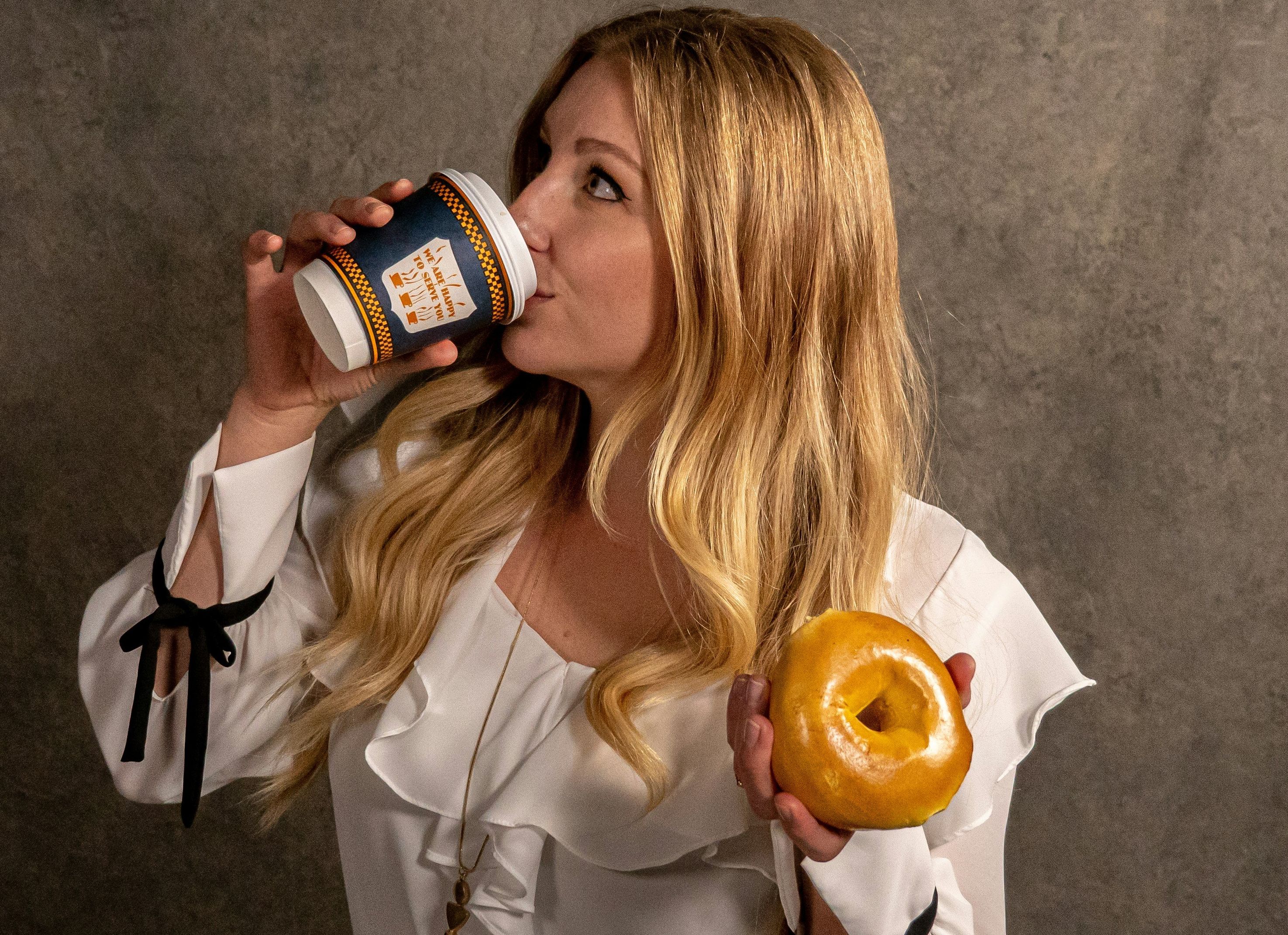
woman in white long sleeve shirt holding brown and white labeled can

A working mom is the ultimate multitasker.

Photo by Memento Media on Unsplash

So, as Johnson says, "But for now, you cram yourself into the only pair of jeans you have right now that fit and find a t-shirt on the floor that isn't clean but isn't dirty and will pass for the 4 hours of mom-taxiing you're about to do and you tell yourself, 'I'll figure it out another day. Right now, I gotta get the kids to practice.'" Oof.

Johnson's entire post is worth a read, as it resonates with so many women at this stage of life. But just as telling are the comments from women who not only see themselves in Johnson's description but who feel like they were sold a bill of goods early in their motherhood. So many of us were led to believe that the skills and experiences of managing a family would be valued in the workplace simply because they should be and that the gap in their resume wouldn't matter.

"This hits hard. I am right there too. And all those volunteer hours & leadership positions people said would look good on my resume when I once again applied for jobs? Those people all lied. It means squat," wrote one person.

"Thank you! You spoke my heart. 42 this year, resigned from teaching almost 12 years ago, and never been more confused about my personal future, or exhausted in my present," shared another.

"I’ve never related to a post more in my life! THANK YOU. Your words perfectly summarize the loneliest, most important job in the world and how that perspective shifts in your 40s. It is confusingly beautiful," wrote another.

Some moms have chosen to see their post-stay-at-home era as a fresh start to learn something new, which might lend some inspiration to others.

woman carrying baby with two ladies beside her smiling

Beginnings are often rough, but that's okay.

Photo by Alexander Grey on Unsplash

There is hope in the comments, too.

"I went back for my master’s degree at 47 years old. I’m now 50 in a new career I love and my husband is doing just fine pulling his weight with after school/carpool/dinner. Happy for the years I stayed home, happy with this new season too," shared one person.

"Yuuuup. I decided to go back to grad school at 45. It’s insane but every term I complete I’m like - omg I’m doing it! So don’t let sweaty out of shape bodies and carpool fatigue stop you. I take naps and write grad school papers and have meltdowns where I cry from the frustration of it all - but dammit I’m doing it!" wrote another.

One mom who is past this stage also offered some words of encouragement:

"So incredibly well written. I feel all these things and did throughout my 40s. Now I'm in my early '50s and I'm so glad I was able to stay home with my kids, but the guilt! The guilt of not using my education, the judgment of people who don't understand why someone would stay home with their kids, the social engineering... We just eat each other alive sometimes don't we? I wouldn't trade it for anything, but it is a very lonely road and one you always question. I can tell you that all three of my kids were so grateful to have a full-time parent. I might not have always been the best, but they were glad to always have someone to talk to if they needed it. It's hard to fill other people's buckets when your bucket isn't full, but the rewards do come back when the kids tell you thank you for everything that you've done. ❤️"

Being a mom is hard, period. Working moms have it hard, stay-at-home moms have it hard, moms who have managed to keep one foot in the career door and one foot in the home have it hard. There's a lot that society could do to support moms more no matter what path they choose (or find themselves on—it's not always a conscious choice), from providing paid maternity leave to greater flexibility with work schedules to retirement plans that account for time away from the workplace. Perhaps that would at least make the many choices moms have today feel more like freedom and less like choosing between a rock and a hard place.


This article originally appeared two years ago.

Animals & Wildlife

Woman says we are 'severely underreacting' to octopuses, then proves she's not wrong

"However impressed or fascinated you are by octopuses, it's honestly probably not enough."

octopus, octopuses, wildlife, ocean life, marine life

Octopuses are just wildly interesting creatures.

What creatures have eight legs, nine brains, and dozens of fun and fascinating facts about them? Octopuses, of course. (Wait, is octopuses or octopi? Octopodes, perhaps?)

However interesting we think our suction-cupped, cephalopodic friends are, we're probably selling them short. That's the contention of Sarah, a comedic content creator on TikTok who's been sharing everything she's learned about octopuses, because they're far more bizarre than we might think.


"However impressed or fascinated you are by octopuses, it's honestly probably not enough," she says. "We are severely underreacting to octopuses collectively."

Once you see her video, it's clear she's not wrong.

@sarahmakesmelaugh

Octopuses are fascinating and I DO want to hold a tiny guy if possible just putting that out in to the universe 😬🐙#creatorsearchinsights #octopus #weirdanimals #animalfacts #didyouknow

With a hilariously understated sense of humor, Sarah shares facts like the idea that octopuses don't have tentacles, as many of us have been led to believe, but arms instead. Tentacles have suckers only at the end, while an octopus's arms have them from top to bottom.

"They decorate their front yards with shells and other shiny things they find in the ocean," Sarah says, adding, "I wonder if they judge other octopuses for how they decorate their front yard. Like, is there an octopus HOA?"

Sarah points out that The Beatles' song "Octopus's Garden" was inspired by this delightful fact.

Many of us know that octopuses are smart, but we may not know that they have a brain in each arm in addition to the brain in their heads, which is shaped like a donut. They can solve mazes and complete tricky tasks. And if their beak can fit through a hole, so can their whole body.

"So a fully grown giant Pacific octopus, which can literally be 30 feet long, can fit through a hole the size of a lemon," says Sarah. "And I don't care for that, particularly. I would never say that to an octopus's face because, evidently, they can recognize us, which I find unsettling. Note to self: Do not be mean to an octopus."

Because each arm has its own brain, it can operate independently, complete with its own sensory system.

Octopus, octopus arms, ocean life, marine life, octopus brains Each of those arms has its own brain?Photo credit: Canva

"I feel like they're smarter than us," Sarah says. "Are we confident they're not smarter than us? For instance, they will prank their prey. You know the joke where like old men will tap you on one shoulder, but surprise, they're at the other shoulder? Octopus do that. If they're hunting a shrimp, they'll tap it on the faraway shoulder so the shrimp runs directly into them. Like, 'gotcha!' I don't want octopus to do gotcha."

On a positive note, Sarah shows some examples of exquisitely colorful octopuses, though some of the most "fancy and beautiful" ones are also highly venomous.

That may have been the end of Sarah's video, but she wasn't finished. There's a part two that features blanket octopuses, the female superheroes of the sea. And that's not even the wildest part:

@sarahmakesmelaugh

Replying to @LalainID did yall know about the blanket octopus and didn’t tell me? Except those of you who did thank you 😂 #octopus #animalfacts #science #learnontiktok #learnwithme


A male blanket octopus is basically an inch tall and the female can grow to over six feet. The males can fit inside the pupil of the female's eye. What?! Basically, their only job is to produce sperm, which just raises way too many questions.

Sarah also talks about the mimic octopus, which she calls "the Jafar of the ocean" because it's basically a sorcerer (and one of them genuinely looks like Jafar from Aladdin).

That wasn't all. Even after the second video, she still wasn't done. Part three was every bit as fascinating, terrifying, wonderful, and chuckle-worthy as the first two (and also slightly NSFW in the most PG way possible):

@sarahmakesmelaugh

More Octopus species, this could go on forever y’all 😂 #octopus #weirdanimals #learnwithme #funfacts #creatorsearchinsights

The blob octopus? Who even knew? The eighth-arm situation is too much. Sarah was 100% right. We are, collectively, not reacting to octopuses nearly as strongly as we should be.

You can follow Sarah (@SarahMakesMeLaugh) on TikTok.

Learning

Sleuths debunk 5 supposedly healthy things that are actually terrible ideas

"Detoxes / cleanses are great for clearing out your wallet."

healthy food; healthy options; unhealthy food; fasting; juicing; supplements

Sleuths debunk 5 supposedly healthy things that are actually terrible. 5 things to do instead.

A lot of people reach for convenient items advertised as healthy when they're short on time. The rise of health and fitness influencers has also contributed to the proliferation of confusing information about what is considered healthy, and what actually is. It's no wonder people sometimes make unhealthy choices, believing they're doing right by their body.

Some people took it upon themselves to parse out the gimmicks from the multi-million dollar health and fitness industry. Their revelations may surprise you. If you've fallen for the hype of an item or product that turned out to be a dud, it's not your fault. Some things are heavily marketed as healthy, while others are things we've grown up believing were healthy. In a world that can feel oversaturated with information, it can be difficult to have time to research everything.


Suddenly, everyone's drinking green juice or swearing by a new protein bar. Since the bars promise to taste like raw cookie dough without the risk of salmonella, you throw a few boxes in your grocery cart, hoping for the best. After all, it claims to provide all of the vitamins for the day, and you don't have time to cook.

healthy food; healthy options; unhealthy food; fasting; juicing; supplements Homemade granola bars with chocolate chips – perfect for a delicious snack!Photo credit: Canva

Instead of wondering, here are some things people think are healthy, but actually aren't, and what you can replace them with instead:

1. Cereal, granola, and protein bars

Cereal bars are quick to grab when you're running late. The same goes for granola and protein bars. Some people even use them as a meal replacement, but they're not as healthy as people like to believe. If you flip over the package, you'll be met with a high sugar content and very little actual protein in many cases. One person in the Ask Reddit thread is aghast, "We all need to be taught how to read nutrition labels. I was and am still absolutely shocked by the amount of sugar and sodium that are in most packaged foods, throw serving size in there, and it's totally bananas."

Try this instead:

If the goal is to make a healthier morning selection while still packing in a little extra protein, eating whole fruits with a side of peanut butter will fill you up. Whole vegetables, cheese cubes, or mixed nuts are also easy to grab but are full of needed vitamins and healthy fats, minus the high sugar content. Good RX reminds people, "Eggs aren’t just a morning treat. Make a batch of hard-boiled eggs to have on hand as a high-protein snack. One hard-boiled egg contains over 6 g of protein."

healthy food; healthy options; unhealthy food; fasting; juicing; supplements Refresh with a healthy green juice boost.Photo credit: Canva

2. Detoxes

There's a detox for everything. One person shares in a Reddit thread about things people think are healthy, but aren't, because detoxes don't work in the area you're expecting. They write, "Detoxes / cleanses are great for clearing out your wallet." According to the National Institutes of Health (NIH), some detoxes contain laxatives that may cause acute diarrhea, which can lead to dehydration and malabsorption. The organization also explains that, "Some juices used in 'detoxes' and 'cleanses' that haven’t been pasteurized or treated in other ways to kill harmful bacteria can make people sick." Others may result in kidney stones for some users due to the high amount of oxalate found in leafy green foods, often used for green detox juices.

Try this instead:

Instead of taking your chances on a detoxing cleanse, Alix Leestma, RDN, CSOWM, senior dietitian at MultiCare Center for Weight Loss & Wellness, tells MultiCare Vitals that staying properly hydrated and eating a balanced diet will allow your body to detox properly. People's liver and kidneys are designed to detox your body naturally. “When dehydrated, our blood is more concentrated," Leestma says, "But when adequately hydrated, you’ll have the same amount of toxins in the blood but in smaller concentrations, which is easier on the kidneys to filter through.”

healthy food; healthy options; unhealthy food; fasting; juicing; supplements Making fresh orange juice in the kitchen. 🍊Photo credit: Canva

3. Juicing/fasting

Juicing is a way people are fasting while still feeling like they're getting in their nutrients. One person voiced concerns that juicing alone wasn't effective in maintaining the nutrients of the fruit, so it's best to eat the whole fruit. Northwestern University recently did a study exploring the effects of juicing. The results were surprising.

"The juice-only group showed the most significant increase in bacteria associated with inflammation and gut permeability, while the plant-based whole food group saw more favorable microbial changes. The juice plus food group had some bacterial shifts but less severe than the juice-only group. These findings suggest that juicing without fiber may disrupt the microbiome, potentially leading to long-term health consequences," Northwestern writes. Senior author Dr. Melinda Ring, director of the Osher Center for Integrative Health at Northwestern University Feinberg School of Medicine and a Northwestern Medicine physician, says, “Most people think of juicing as a healthy cleanse, but this study offers a reality check."

Try this instead:

“If you love juicing, consider blending instead to keep the fiber intact, or pair juices with whole foods to balance the impact on your microbiome,” Ring explains. You can also eat the fruit whole to ensure you're getting the fiber needed if blending it doesn't sound as appetizing as juicing.

healthy food; healthy options; unhealthy food; fasting; juicing; supplements Be careful with supplements.Photo credit: Canva

4. High doses of supplements

There's a supplement for everything, and some people take as many as they can in an effort to fill in the gaps of their diet. But excess supplements can cause issues, one person reveals: "I got a kidney stone this way. Wasn't fun." According to Healthline, water-soluble vitamins are more benign, even when taken in higher doses, because the excess is excreted in the urine. Fat-soluble vitamins found in some supplements can cause dangerous toxicity levels that cause irreversible damage.

Katie Mohan, a 57-year-old woman, was close to needing a liver transplant after beginning a regimen of a turmeric supplement. A report of an increase in liver damage due to supplement use on NBC prompted her to seek medical care. She was hospitalized for six days. Dr. Dina Halegoua-De Marzio, a hepatologist at Jefferson Health in Philadelphia, tells NBC, “Natural does not mean safe. When you cook with turmeric, that could be really safe. But some of the supplements now are 2,000 mg-plus, which is a very high dose of turmeric." According to the World Health Organization, a daily dose should be no more than 0-3mg per kilogram (2.2 pounds) of body weight. Which means, even a man weighing 200 pounds should only take less than 300mg of turmeric a day.

Try this instead:

Get the appropriate nutrients through a balanced diet and stick to one multivitamin daily, instead of several different supplements. Adding more nutrient-dense foods can also aid in boosting the vitamins you're hoping to make up for with supplements, according to the Navy and Marine Corps Public Health Center.

debate, political debate, disagreement, agreement, consensus,

People debating at a city council meeting.

One of the most challenging things to do as a communicator is to convince someone you disagree with to listen to you. You’re fighting against a host of psychological phenomena that prevent people from changing their minds or listening to those with whom they disagree. Persuasion is incredibly difficult because we’ve evolved to cling to our views no matter what.

One of the most pronounced psychological blockages is the backfire effect, which states that when people are confronted with information that challenges their opinion, even if it is indisputable, they will hold onto their views even more strongly than before.


So, what are we to do in a world where there is so much misinformation and zombie lies flying around? Dr. Alison Wood Brooks, a professor at Harvard Business School who studies conversation and emotion, shares the key to having a constructive dialogue with people we disagree with is: Don’t invalidate them.

stressed couple, couple's therapy, therapist, upset woman, upset man, Couple arguing during therapy.via Canva/Photos

The moment we invalidate someone by saying, “I disagree,” we’ve killed our chance at persuading them. Dr. Books believes that changing people’s beliefs is important, but it only happens over time. So, it's pointless to disagree at the onset of the conversation. “The only way that we change our beliefs is usually across many conversations and we're around someone we like talking to and respect and have admiration for. And then over time, we sort of bend to the gentle pressure of their differing viewpoint,” she told Bartlett.

Dr. Brooks shared her strategy in a recent appearance on the Diary of a CEO podcast with Steven Bartlett.

- YouTube www.youtube.com

Three steps to disagreeing with someone without invalidating them

1. You don’t need to be certain

“Even if you're right, like it's not about being right or wrong in that moment. The goal here is to keep the conversation in an emotional place where it can continue. So, you can continue to engage. And that's what these researchers find in this receptiveness recipe,” Dr. Books said. The receptiveness recipe is a research project by Harvard and the University of British Columbia that created a formula for the most effective way to disagree with someone.

2. Hedge your claims

“I think often people think of these types of things as weakness because it's like our instinct is to try to win and be right. And instead, what I'm saying is no, hedge your claims. Show that you're uncertain about stuff. Validate their feelings. Divide yourself into disagreeing parts because you're not certain about anything, in order to keep the conversation going, so that you have any shred of hope of persuading them over the longer term.”

If they say the sky is purple:

“That’s interesting. I'd love to hear more.”

“As a painter, who knows a bit about color, that is so intriguing.”

The key is to make it an emotionally safe dialogue and show you’re interested in what they have to say. In turn, they'll be more receptive to your thoughts.

argument, debate, coworkers, art, questions, why Two coworkers debate each other.via Canva/Photos

3. Hold back your disagreement

“I wrote this chapter in my book called 'Do Not Disagree.' It's an intentionally provocative chapter because people think, ‘What do you mean, never disagree with anybody?’ But I mean, don't make the first thing you say 'I disagree,'" Bartlett adds.

“That's right. It can come later,” Dr. Books added. “It can come later, but first has to come like ‘Oh, it's so intriguing that you said that. I'm so fascinated, and it makes sense that you might feel that way. I wonder if…’ and then you can go on instead of ‘I disagree.’”

Ultimately, the key is understanding that changing someone’s mind takes time and is nearly impossible if we shut down the conversation by invalidating them. By delaying the instant gratification of saying, “You’re wrong! I got you, here are the facts,” you can create a space where they are more open to listening to what you have to say. You've validated their beliefs, so they'll be more likely to consider yours.

90s, Gen X, QVC, Hello Dolly, vintage dolls, porcelain dolls
Photo Credit: QVC, @80svintagevisions, Instagram

Two porcelain dolls being sold on QVC in 1991.

One of the most wonderful attributes of a QVC host is their ability to sell the heck out of anything. In 1991, this was the job of one such woman tasked with selling two porcelain dolls from the “Hello Dolly” collection by Albert E. Price. (A few online sleuths pegged her as Judy Crowell, though Upworthy spoke with her and she didn't recall.)

Whoever she was, this was quite a feat as these weren’t just any dolls. They were wide-eyed, cleft-chinned little siblings named Jaime and Jason. And they were certainly unique. Described as 16 inches and porcelain, the “brother/sister team” were selling for $50 each. (On screen, there’s a note that they retailed at $82 apiece.)


A clip of the set being hawked on QVC is making the rounds on social media, and it has many people genuinely intrigued. In the @Totally80sroom clip, we see two almost puppet-looking dolls, a boy and a girl, each clad in overalls with golden blonde hair. Jason is wearing a red hat, while Jaime has white bows in her hair. But it’s their expressions that truly stand out: both might be described by some as “frightened-looking” thanks to their intense, unique stares.

The camera zooms in on Jaime, who seems as if she’s side-eyeing the host with a tiny tear in one eye. The host asks, “Do they remind you of your two little ones? Or do they remind you of you and your brother when you were this age? Up to no good! Being put on restriction!”

She then laughs and tells a delightful story from her childhood. “Who was it… Jeff said to me, ‘Restriction? Who gets put on restriction? You get grounded!’” She lets out a hearty laugh. “Well, I was put on restriction! In first grade. And I remember my restriction was I couldn’t leave my own front yard. So I used to go up to the border. My border, where the grass—our grass—met the neighbor’s grass, and stand right on the edge. And say, ‘Nope! I can’t come over! I’m on restriction.’ So by the time the spanking was over, and all the sadness is gone from your eyes, then it became kind of a game.”

She pauses as if she's just remembering that she has a job to do. “And that’s probably what will happen to these two too. Fifty dollars for Jaime. And fifty dollars for Jason. It is your choice of porcelain dolls from Hello Dolly.”

dolls, clowns, porcelain, QVC, vintage dolls A white porcelain doll with a tear stain. Photo by Monique Layzell on Unsplash

The comments are fabulous. One points out the obvious. “They’re cute until you wake up in the middle of the night because of a noise and they’re sitting there staring at you!” Another has a similar thought. “They’ve looked like they’ve seen some stuff they weren’t supposed to.”

This person focuses on the excellent professionalism of the QVC host: “This hostess deserves an Academy Award for filling time talking about those horrendous dolls.”

These wouldn’t be the first dolls to raise some eyebrows. If TV and movies were an indication of the toys that kids had back in the '80s and '90s, it would seem we were all surrounded by clowns and Chucky dolls. While yes, we did have a few such things, they became more of a symbol of fear in media than in real life.

In a piece for Collider, feature writer Jenna Rae Isley discusses the 1982 Spielberg-written classic Poltergeist, in which a child’s toy clown becomes a nightmare for the audience. “In reality, a clown doll is just a clown doll. But in our imaginations and in Poltergeist, a clown doll is a sinister, watchful force, lurking ominously in the corner of our rooms, keeping us perpetually on edge until it ultimately makes its move.”

The very scary clown scene from the film Poltergeist. www.youtube.com, Moyer Movies

But according to research conducted by Scientific American staff, there are actual reasons that people across many cultures are afraid of clowns. After sending out a questionnaire with various clown-based scenarios, more people answered that they had coulrophobia due to ‘negative portrayals of clowns in popular culture’ rather than actual ‘frightening experiences with clowns.’” In other words, movie makers and artists determined them to be scary…and so they became scary. (Though according to the same research, some are truly afraid of the unsettling makeup, even that of Ronald McDonald.)

It’s worth noting that most people, at least according to this survey, are afraid of clowns because they’re masked. “In fact, the strongest factor we identified was hidden emotional signals, suggesting that for many people, a fear of clowns stems from not being able to see their facial expressions due to their make-up. We cannot see their ‘true’ faces and therefore cannot understand their emotional intent.”

To that point, Jaime and Jason do not seem to be hiding their true intent. They just seem scared…perhaps because they saw a clown.

feel good story, music, rock music, lost and found, musicians
Photo credit: Marcus Pollard on Facebook

Marcus Pollard is reviving a 77-year-old warehouse worker's lost rock music.

In the 1960s, Norman Roth and his band, The Glass Cage, were Canadian indie rockers who played small local shows and built enough of a following to land gigs in bigger cities. When Roth was 18, the band recorded a live performance that was never officially released and was eventually lost after they broke up shortly afterward. Now, thanks to a four-dollar thrift store purchase, the band's music is reaching a wider audience—58 years later.

In 2016, veteran rock music promoter Marcus Pollard bought an unlabeled vinyl record at a thrift store on a whim, despite the album being physically damaged. He fell in love with the six songs recorded on it and spent the next two years trying to track down any band members connected to the record.


"I searched in vain for two years trying to get any clue as to who was on the record, but to no avail," Pollard wrote on Facebook. "Then, in a last ditch effort I posted a clip on the Canadian Artists Records Appreciation FB page and... I got a hit!"

Pollard eventually received a reply that read, "Hey, that's my record!" from Roth, now 77 and working as a warehouse manager. Roth was floored that his band's long-lost recording had resurfaced, and he was able to listen to songs he hadn't heard in more than 50 years.

- YouTube youtube.com

After reuniting Roth with his lost music, Pollard went a step further. After consulting with the other band members, he set out to bring The Glass Cage's music back to life after remaining dormant for generations. Pollard spent the next eight years using his industry connections and expertise to officially release the album. Working with a team of professionals, he refurbished the damaged record, digitally remastered the songs, designed elaborate packaging, and developed a booklet detailing the band's impact on the Vancouver indie rock scene of the 1960s before they broke up.

The finished vinyl album, titled Where Did the Sunshine Go?, is scheduled for release on February 24, 2026.

"I feel like everyone has done something in their life that was dismissed," Pollard told CTV News. "And I wanted them to feel like what they created was actually important."

While Roth and his former bandmates are excited about the album's release, they aren't trying to relive their youth or chase the rock star dreams they once had. They're just happy that others will now have access to their music and are enjoying the ride.

"I'm not looking for accolades or super stardom—that's long gone," Roth told CTV News. "It's just saying to the world, 'I was here.' And I hope they enjoy it."

If you'd like to hear Roth's music, you can stream tracks by The Glass Cage on Bandcamp and purchase the vinyl when it's released.