
upworthy
Add Upworthy to your Google News feed.
Google News Button
Google Nest

When childhood photos remind us of our most precious relationships

When childhood photos remind us of our most precious relationships
Gretchen Kelly (left), Annie Reneau (right)
True

When I was a kid, we had an entire living room shelf full of photo albums to pore through when we wanted to relive family memories. Now, several decades later, we flip through digital albums, instead. But the feelings that family photographs invoke are still the same. Every photo tells a story, and some photos hold tales and truths that are particularly dear to our hearts.

I was visiting with my friend Paula recently when she pulled up a sweet old photo of our sons together.
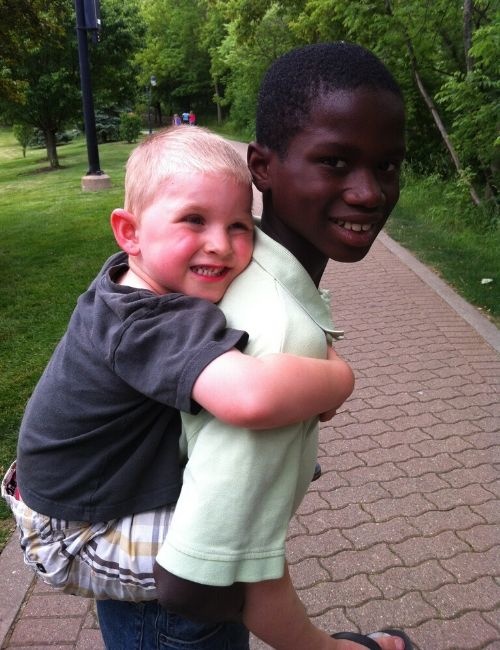

Paula Fitzgibbons

Paula and I met in a parenting group 15 years ago. Our oldest daughters were nearly identical in age and we both had newborn babies, so we started planning regular play dates together.

Soon those play dates became a lifeline to our own sanity, and our friendship blossomed. We got together several times a week for years, essentially raising our kids together. Paula didn't have any family living nearby — no grandparents to gush over her children, no cousins to bond with — so our family became their extended family.

"I entered parenting without having been parented well myself," says Paula, adding that our marathon playdates gave us a chance to parent in a community. "Sometimes I'd even call and say, 'I can't parent today. How about if I do all the cooking and you do all the parenting?' So we did. In that way, I learned how to be the parent I never had."

While our girls were same-aged peers, our sons were seven years apart. Paula says that her son Sevvy had always wanted a brother, and when my Isaac was born, it was like Sevvy's wish was fulfilled. Indeed, our boys grew an incredibly sweet bond, less like friendship and more like brotherhood. Isaac followed Sevvy around like a puppy, and Sevvy doted on Isaac with a mixture of mentorship and protectiveness.

Life happened and we eventually ended up moving to different parts of the country. Our boys are now 18 and 11, but we still get together and reminisce about how those formative years meant so much to both of our families. This photo encapsulates the joy and care that defined our families' relationship.

Annie Reneau

Gretchen Kelly also has a precious sibling photo, but hers holds beautiful, bittersweet memories of her beloved baby brother, Todd.

At 16, Todd was diagnosed with Ewing's Sarcoma, a rare type of bone tumor that generally hits people at a young age. He was eight years younger than Gretchen and 11 years younger than their older sister. "He was the baby of the family and spoiled rotten by all of us," Gretchen says. He passed away in 1999 at age 18.

"There's a photo of he and I that tugs at my heart because he has his arm casually draped over my shoulder and it perfectly captures our relationship and dynamic," says Gretchen.

Gretchen Kelly

"I don't remember what he said when we took this picture, but I know he said something to make me laugh while he stayed casual and cool for the photo. That was his way. He could keep a straight face and make you laugh in spite of yourself. And he could ALWAYS make you laugh."

"This is the picture that always leaves a lump in my throat," she adds. "It makes me smile—it is exactly how we were together. He was the baby brother who I adored, but at times, as he matured, it was as if he was the older sibling. Protective and wise beyond his years. But mischievous. Always mischievous."

Gretchen keeps another photo of Todd on her "inspiration wall" in her office, this one during his cancer journey.

Gretchen Kelly

"Obviously cancer was already taking something from him at this point," she Gretchen. "But not his smile. He somehow made all of us laugh and smile even when we were terrified of everything he was going through. I keep this picture on the wall in my office. His smile is what I will always cling to, his determination to not let cancer steal his joy or his humor. This serves as a reminder of determination and grit. When things get hard, as they tend to do, I look at this picture and he reminds me we can do hard things, and sometimes we can smile through it."

Photos aren't just snippets of our lives — they are images of joy and love, of family and community that can move us and inspire us. But these days our photos frequently get lost in the digital deluge of modern life. They end up archived on a hard drive somewhere or buried deep in social media.

Google Nest is trying to make it easier to keep treasured photos front and center with the Google Nest Hub — a device that serves as a digital photo frame and personal assistant. You can choose any album from Google Photos, such as "Family" or "Favorites," and the Nest Hub will display them on rotation. The Live Albums feature takes the work out of updating the photos by letting you create an album that automatically adds photos of the people who matter to you most. You can share a Live Album with anyone you want, just like any other album in Google Photos. The Nest Hub even adjusts to the lighting in the room so your photos look less like images on a screen and more like real photos.

Here's to the snapshots that remind us of our loved ones at all stages of life. They truly are among our most precious belongings.

Google is providing Nest Hubs to USO families to help them feel closer this holiday season. Join us in supporting the USO at uso.org/googlenest.

From Your Site Articles
Related Articles Around the Web
time off requests, pto, sick leave, gen z manager, manager positions, asking for time off

This Manager thinks PTO is for vacation, not "life changing events."

What does it take to be a good boss? You can answer this a million different ways—by being a clear communicator, earning employee trust, providing constructive feedback, and fostering a positive and supportive work environment while also being open to feedback and recognizing your team's contributions—but really, it all seems to stem from respecting your employees as fellow human beings.

Part of that means acknowledging that these employees have lives that are, frankly, more important to them than the job, and not penalizing them for it. One manager, and Gen Zer no less, seems to fully understand this basic principle, and folks are applauding her for it.


Elizabeth Beggs, who manages a five-person team for a packaging distribution company in Virginia, recently made a TikTok sharing which time-off requests she “rejects. ”You’ll see why “rejects” is in quotes shortly.

One example: when a female rep notified Beggs that she was likely having a miscarriage. After the team member asked how she can file for time off to see to the issue, Beggs immediately responded, “Girl, go to the doctor! We’re not submitting time off for that!”

In Beggs’ mind, PTO is for “vacation,” not medical emergencies. What a concept.

@bunchesofbeggs

Edited to clarify- 1. My team is all salary. 2. These examples are not all recent or from my current position. 3. My team works hard and hits thier KPIs above and beyond. Time off is meant to recharge and be used how you need it, not to handle life changing events #mangers #corporate #genzmanagers #sales #vetstocorporate #veterans

Beggs went on to explain a couple more situations, like when one employee—a parent—was “up all night” with their sick kid. And her last one wasn’t even negative—she had an employee who wanted to work a half-day to do something nice for their anniversary.

“Seriously, if any of these triggered anyone, then you need to evaluate how you run your team as a manager,” she concluded.

By and large, the response to Beggs’ management style has been overwhelmingly positive, and people seem to find it completely refreshing.

“You are not a manager, you’re a LEADER,” one person wrote.

@bunchesofbeggs

Everything you do should be to better your team, not to make your life easier #leadership #ownership #corporatelife #veteran #military

Another said, “The better you treat your employees, the more loyal they will be and the better work they will put out. Most people do not understand how management works.”

A few noted how this attitude seems to be more present among younger leaders. One person commented, "millennial manager here. My team members are human first, employees second. Like just go do what you want but get the work done too.”

Another joked that “Boomer managers could NEVER.”

Beggs would later clarify this doesn’t mean she doesn't have clear productivity expectations for her team (who work on salary). Perhaps if she had a team member not making their KPIs (key performance indicators), there would be an additional conversation surrounding time off, but there is still an inherent respect as a fellow human being. Which, to her, means treating bona fide time off as a way to “recharge and be used how you need it, not to handle life changing events.”

@bunchesofbeggs

If you’re planning does not account for people being human- it’s bad planning #genzleaders #armyvet #militaryvet #genz #corporatelife #corporate #manager #timeoff

Younger generations might get labeled “lazy” or “entitled,” but they are also the ones fighting to change the status quo so that we all may be treated less like cogs in the machine, and more like actual human beings. Its leaders like Beggs who show that operating in new ways doesn't compromise productivity—it, in fact, enhances it. We might not be able to change the global standard overnight, but we certainly aren’t going to get to a better place without leaders who choose to serve their community rather than a bottom line.

This article originally appeared in March.

Community

Uber driver with Tourette's goes viral sharing her unforgettable interactions with riders

"Honesty, humor, and human connection can change the way the world sees Tourette’s."

uber driver, passenger, ride share, tourette syndrome

A woman drives an Uber. A passenger gets in.

Not all heroes wear capes, but some do drive Uber. Jeanna DiVietro is one such hero who has a big laugh, infectious positivity, and the ability to be so vulnerable that she puts many of her passengers at ease. In fact, some seem to become "unexpected friends" in just five minutes flat.

The thing is, DiVietro has Tourette Syndrome, which presents in tics, both physical and vocal. Rather than letting that be a barrier for her, she uses it as a way to educate others. With the rider's permission, of course, she films the interactions and shares them on social media to reach a larger audience.


And she's simply delightful while doing it. In many videos, she has at least one passenger sitting in the front seat and explains to them that she has Tourette Syndrome. In one clip, there's a woman up front when one of DiVietro's tics causes her to scream. They both wind up laughing, with the passenger exclaiming, "This is the best Uber ride ever!" Our driver responds, "Oh yay, I'm so excited!" This is followed by the yelling of "Wh--e!" and again they both laugh. "You're not a wh--e," she assures the rider, who jokingly quips back, "I might be!"

Here's where DiVietro begins to educate. She shares, "I've always had a great attitude with Tourette Syndrome. I just want to help other people have a good attitude too. So that way they can accomplish things that they never thought they were ever able to accomplish. Look at me, I'm an Uber driver, traveling nationwide. I'm also a photographer." She then screams, "Click click b---h!" to which our understanding passenger laughs, "Did you get the picture? Was it my good side?"

The comments are completely understanding and supportive. This clip alone has nearly half a million likes and thousands of comments. One person suggests, "She needs a full-on SERIES!"

Another admits, " This is an Uber ride I would love! My husband says I'm not supposed to laugh, it's rude. Is it considered rude? Because this is hilarious." DiVietro puts her at ease, writing, "No it's not rude, because I too am laughing!"

One person even asks, "Wait are you the lady who picked up a passenger who also had Tourette's? That was the best video!" DiVietro answers, "Yes I am and thank you!"

It turns out the clip in question involved a man in Evansville whom she notes did not, in fact, have the disorder but was "playing along." But, she shares, she "was not offended one bit." They seemed to have an ultimate blast.

Another heartwarming clip shows DiVietro, having presumably explained that she has Tourette Syndrome to a young man, laughing uproariously when he mishears "Tourette's" it as "T-Rex." "I need to Google 'how do I help T-Rex?'" She then explains the correct word, which leads them to finding their inner dinosaurs and roaring a few times.

The passenger tells her that he's a rapper (CEO DEE) and she's incredibly supportive, immediately asking where she can listen to his music. Once again, the comment section doesn't disappoint. They link to his Instagram and share it with DiVietro.

Others in the comments focus on the dinosaur of it all. "This is so funny. The dinosaur impersonation took me out." Another notes that is seems to be a lovely plutonic connection "What do you get when you put a guy with the munchies and a female "t-rex" in the same car? A beautiful friendship."

Currently, there's a fan-funded documentary in the making. According to DiVietro's website, it will document her life in and out of Uber across the South and the Midwest. "This isn’t just a road trip. It’s a movement to show that honesty, humor, and human connection can change the way the world sees Tourette’s."

As exemplified by DiVietro's vocal tics, Tourette's is one type of tic disorder. According to their informational website Tourette.org, it's "a neurodevelopmental disorder that affects children, adolescents and adults. The condition is characterized by sudden, involuntary movements and/or sounds called tics. Tics can range from mild/inconsequential to moderate and severe, and are disabling in some cases."

Tourette Syndrome is explained. www.youtube.com, Tourette Association of America

DiVietro doesn't let this disorder define her. On the contrary, she uses it to sparkle and clearly make beautiful connections. The hope is that she is able to inspire others to do the same.

Education & Information

This surprising map reveals the real value of $100 in each state

Your purchasing power can swing by nearly 25 percent from state to state.

cheapest states, cost of living, finances, cost of living, $100

Map represents the value of 100 dollars across America.

As the cost of living in large cities continues to rise due to inflation, tariffs, and other economic factors, more and more people are realizing that the value of a dollar in the United States is a very relative concept. For decades, cost of living indices have sought to address and benchmark the inconsistencies in what money will buy, but they are often so specific they prevent a holistic picture or the ability to "browse" the data based on geographic location.

Each year, the Tax Foundation addresses many of these shortcomings using the most recent Bureau of Economic Analysis data to provide a familiar map of the United States overlaid with the relative value of what $100 is "worth" in each state. In recent years, they've further updated their data so that you can break down the value of your money across every single metro area in the United States. It's an incredibly valuable tool for the many people considering (or who have already acted and migrated from states like California to Florida), Texas and other states with friendly state taxes rates and more affordable housing options.


The map quantifies and presents the cost of living by geography in a brilliantly simple way. For instance, if you're looking for a beach lifestyle but don't want to pay California prices, try Florida, which is about as close to "average"—in terms of purchasing power, anyway—as any state in the Union. If you happen to earn (or luck) your way into Silicon Valley tax brackets, head to Hawaii, D.C., or New York. You'll burn through your money in no time. And in some of those places like Hawaii, there are quality of life measurements that often exceed raw purchasing power.

So, where does your dollar go the furthest in 2025? The financial planning site GoBankingRates.com compiled its own list of cash purchasing power across each state and found that in California, you get the least bang for your buck: only $87.42 in real purchasing power for every $100 of cash. The average person in California makes $96,344 annually, one of the higher income levels in the country. However, just living in California on average costs residents a staggering $86,408, leaving the average person with little flexibility for long-term financial planning projects like retirement, saving for a new home, or even buying a new car.

At the other end of the spectrum is Arkansas, where your dollar goes the furthest. In fact, that $100 bill burning a hole in your proverbial wallet is in fact worth more than its technical value, with a real value of $113.49. On top of that, the cost of living is only $37,067, less than half of that in California. Further, the average cost of a new home in Arkansas is $208,743, less than one-third of a new home in California. Not coincidentally, in 2023, Arkansas was the top destination for people moving to another state within the United States, followed by Texas.

family, moving, income, finances, $100 Family moving into a new home. Canva Photos.

How about Florida, which has received outsized attention in recent years for its overt efforts to draw residents from California and other states with higher costs of living? According to the most recent data, Florida is in fact much closer to California than Arkansas, coming in only in 40th place on the GoBankingRates rankings, with $100 in cash only being worth $96.55. However, the annual cost of living is still only slightly more than half of that in California, coming in at $53,505. And if you're looking to buy some real estate, the average home is valued at $404,924. That's still well outside the purchasing power of many Americans, but with built-in advantages such as warm weather and one of the top-ranked state education system in America, it's obvious why so many people, especially those with families, are choosing Florida over California in recent years.

florida, cost of living, finances, $100, education Driving Road Trip GIF by Rosen Hotels & Resorts Giphy

According to U.S. News and World Report's data analysis, California only has the nation's 23rd best education system and is ranked a paltry 37th overall in their state rankings. It's quite a contrast for a state that bills itself on the promise of opportunity, natural wonder, and positive lifestyle options. And with 2025's wildfires (as well as an annually-worsening wildfire season), the constant threat of earthquakes, and other factors, California clearly has challenges beyond economics if it wants to remain one of the more attractive states in the nation.

Of course, those numbers are always in flux, and political leaders in California have promised concrete reforms in order to address the state's high cost of living compared with the value of its social and emergency services. If you want proof of how quickly things can change, look at a similar analysis of the value of $100 in each state from 2015:

- YouTube youtu.be

However, those negative statistical trends aside, California continues to have an incredible pull on our collective imagination. Four hundred twenty-three thousand, one hundred ninety-four Americans left their state for California according to the most recent data in 2023, placing it in third behind our previously mentioned top two states, Arkansas and Texas.

So, it's clear there are a number of factors that determine the best place to live in America. When it comes to raw purchasing power, you cannot beat Arkansas. But there's so much else to consider: public resources like education and healthcare, job opportunities (you probably won't make nearly as much in Arkansas as you might in California) and other factors such as proximity to family, friends, and personal interests.

There's no doubt America is rapidly changing and that includes what people value the most when they decide where to live. In uncertain economic times, the face of America will likely change radically in the coming years with the political, economic, and social landscape shifting in meaningful ways.

This article originally appeared in August.

time, neil degrasse tyson, time flies, perception of time. clock, science,

A clock and Neil deGrasse Tyson.

When you’re a kid, time passes a lot more slowly than when you’re an adult. At the age of seven, summer seems to go on forever, and the wait from New Year’s Day to Christmas feels like a decade. As an adult, time seems to go faster and faster until one weekend you’re putting up your Christmas lights though you swear you just took ‘em down a month ago.

Why does time seem to speed up as we get older? Astrophysicist Neil deGrasse Tyson recently explained the phenomenon in a video posted to Instagram. He also offered tips on how to slow the passage of time as you age. DeGrasse Tyson is one of the most popular science communicators in the world and the host of 2014's Cosmos: A Spacetime Odyssey and 2020’s Cosmos: Possible Worlds.


Why does time appear to speed up as we get older?


“When you're young, everything is new. Your brain is constantly recording fresh memories, and the more memory your brain stores, the longer the experience feels. But then something changes. As you get older, routines take over. Your brain stops saving so much detail. It switches to autopilot because everything feels familiar and predictable,” deGrasse Tyson explains. “And when your brain stores fewer new memories, your perception of time compresses. That's why childhood feels long, and adulthood feels like a blur.”


Steve Taylor, PhD, author of many best-selling books including Time Expansion Experience, The Leap, and Spiritual ScienceThe Leap, and Spiritual Science, agrees with deGrasse Tyson.

“This is mainly because, as children, we have so many new experiences, and so process a massive amount of perceptual information,” Taylor writes at Psychology Today. “Children also have an unfiltered and intense perception of the world, which makes their surroundings appear more vivid. However, as we get older, we have progressively fewer new experiences. Equally importantly, our perception of the world becomes more automatic. We grow progressively desensitized to our surroundings. As a result, we gradually absorb less information, which means time passes more quickly. Time is less stretched with information.”

How do we make time slow down?

There’s something a little depressing about the idea that time speeds up as we age because we have fallen into predictable routines. The good news is that we can break this cycle by changing our habits and having new experiences. The more novel information we can process and the less routine our lives become, the slower time will move.

DeGrasse Tyson believes that with some change in our behaviors, we can get back to longer summers and Christmases that aren’t perpetually around the corner.

“You can actually slow time down again. Do something unfamiliar,” deGrasse Tysons says. "Travel somewhere new. Break a routine you've repeated for years. Learn a skill your brain hasn't mapped yet. Because the more new memories your brain forms, the slower time feels as it passes. So if life feels like it's accelerating, it's not your age. It's your brain, and you can reboot it.”

christmas, holidays, christmas gifts, nostalgia, 60s, 70s, 80s, 90s, tickle me elmo, easy bake oven, chatty cathy
Kevin Labianco/Flickr, Rochelle Lockridge/Flickr, Bradross63/Wikimedia Commons

Adults share the nostalgic "must-have" Christmas gifts from their youths.

Christmas as a kid was the absolute best: crafting your wish list with care; the anticipation as presents began to appear under the tree; the lights, the cookies. It was pure magic. Though the holidays are still special in their own way once you're grown, most of us would love a chance to feel like a little kid again on Christmas morning.

One small way adults are recapturing that nostalgia is by remembering the most in-demand, highly anticipated toys and games from their childhood—the ones every kid wanted for Christmas. The ones that had Mom and Dad standing outside Toys R Us at 5 a.m. The ones that prompted panicked reports on the evening news about toy shortages and checkout line mayhem.


Here are 11 of the hottest toys of all time that topped Christmas lists in the 50s, 60s, 70s, 80s, 90s, and even early 2000s.

1. Baby All Gone

This doll, released in 1991, was pure witchcraft for kids who saw the commercials on TV. You could make it drink milk or eat cherries which would then just...disappear.

"It is sweet how a simple toy like Baby All Gone can bring back warm memories, because those disappearing milk and cherries remind us of a time when childhood felt magical and full of small joys," one user wrote on X.

"I never understood where the cherries went. Did they go in the mouth or the spoon? Perplexed," added another.

All we know is that we wanted it.

2. Easy-Bake Oven

In 1963, the toy company Kenner changed the game when they released the Easy-Bake Oven and allowed kids to cook their own brownies and cakes with a small lightbulb. The original design came in turquoise and yellow, and sold out during its first holiday season. The demand was so high that the company tripled production for the next year.

Simply put, everyone wanted one.

"I remember the way the pastries tasted. Even to this day. And how disappointed I became when it took so long to bake. But the smell....I'm pretty sure I still remember how it smells," one user wrote on Reddit.

- YouTube www.youtube.com

3. Tickle Me Elmo

Perhaps the wildest Christmas toy craze of all time, Tickle Me Elmo was actually released in the summer of 1996. It didn't became a phenomenon until shortly after Thanksgiving, when a feature on Rosie O'Donnell and news reports of low stock prompted panicked parents to risk life and limb to get their hands on one.

By the end of Christmas that year, and after many injuries and in-store brawls, Tyco had sold over a million Tickle Me Elmos.

"That year only one kid in my class got one and they brought it to school to show everyone. Apparently they were extremely hard to find and their parents waited outside a store before they opened just to get one," a user wrote on Reddit.

christmas, holidays, christmas gifts, nostalgia, 60s, 70s, 80s, 90s, tickle me elmo, easy bake oven, chatty cathy Tickle Me Elmo changed Christmas as we know it in the 90s.Kevin Labianco/Flickr

4. Chatty Cathy

Long before Tickle Me Elmo hit the scene, and way before the term "Chatty Cathy" was used to refer to someone who couldn't stop talking, kids in the '50s and '60s were falling all over themselves to get a hold of this talking doll. Chatty Cathy was the original pull-string doll, coming pre-programmed with seven different talking phrases. This was big news at the time.

One Reddit user reports never giving up on her dream of owning a Chatty Cathy, and finally finding one at an antique mall many years later:

from Dolls


5. A rock tumbler

Rock tumblers, which could magically transform rocks you found in your backyard into shiny gems or egg-smooth pearls, became hugely popular in the 1960s. They were a staple of every toy catalog for decades, but parents were often wary because they could be expensive and loud (especially in the early days). A kid could dream, though.

"I never did get that dang rock tumbler. I circled it so many times in the JCPenney Christmas catalog (it was the 80s), that I remember the paper nearly being torn through," a Redditor wrote.

6. Barbie Dreamhouse / Malibu Barbie Beach House

Barbie was released in the late 1950s, but the craze really went to the next level in 1962 when the first Barbie Dreamhouse came out. The Museum of Arts and Design writes that Barbie's pad was different from anything else on the market at that time:

"While other dollhouses of the time featured baby rooms and kitchens, Barbie’s house was in a league of its own. It looked like a modern studio apartment in NYC—complete with sleek modernist furniture, a TV console, a record player, and even a bookshelf stocked with fiction and Encyclopedia Britannica, showcasing Barbie’s love for learning! Barbie’s walls proudly displayed college pennants, proving she was educated and ambitious. She even had a fabulous dressing area and closet—because we know Barbie is all about fashion."

It wasn't until decades later that Barbie decided to move to the beach in Malibu, getting a whole new playset as a result. One Redditor writes that the Beach House was their dream house, but sadly, it was not meant to be:

"[I always wanted] a Malibu Barbie Beach House. We were a military family and it wouldn't have made all the moves"

- YouTube www.youtube.com

7. Moon Shoes

There's not much to say about Moon Shoes. If you came of age at a time where you saw the commercial on TV, you know all you need to know about them. "Kid-powered anti-gravity" shoes? Sold! What kid wouldn't be obsessed?

Most of us were not lucky enough to get our hands on a pair of Moon Shoes, sadly. Whether it was the price tag or the high likelihood of injury, a lot of parents had to say No.

"Moon shoes. [Dang] did I want some moon shoes. Growing up we were really tight in money. Only necessary items with a few wants if we could afford it," one user writes.

- YouTube www.youtube.com

8. Power Wheels

Power Wheels are the ultimate "everyone wanted it, nobody got it," Christmas present. If you grew up in the '80s or '90s, you knew precisely one kid who had one, and they were the envy of everyone at school.

Released in 1984, the early models cost between $129 and $150 to start. That would be a whopping $375 in today's money—definitely steep for most families. But all '80s and '90s kids dreamed of cruising down the street in their very own mini Jeep.

from The1980s


9. Furbies

One of the few toy crazes that lived up to the Tickle Me Elmo madness of 1996, Furbies took the world by storm in 1998.

Where Tickle Me Elmo seemed to be mostly driven by news and product scarcity, a lot of kids really, genuinely wanted a Furbie—they could talk to you, after all, gradually transitioning from speaking their own gibberish language to speaking English. They could even communicate with each other.

There were even rumors that China and other countries were using Furbies to spy on Americans, and the NSA actually banned Furbies from its properties. Sadly, those stories kept a lot of eager kids from realizing their holiday dreams:

"I wanted one but I wasn't allowed one, my Mom believed the 'OMG DEY R SPYING DEVICES!!!!' stories that the news was pushing at the time," wrote on Redditor.

- YouTube www.youtube.com


10. Joe Namath Electric Football Game

Before there was Playstation and Xbox and John Madden football, there was Joe Namath. The vibrating, magnetic foosball-like game may not look like much by today's standards, but kids in the '60s got hours and hours of joy out of it.

"OK, old timer here," one Redditor wrote. "The must get present was the old 'electronic' football game where the big metal field vibrated the little players chaotically around the field."

"My parents bought one of these for me for Christmas in the early 70s. I was in 2nd grade at the time. By the time I hit junior high school, my friends and I played this all the time," a YouTube commenter added.


- YouTube www.youtube.com

11. Hi Heidi doll

Another hit from the '60s, Heidi's selling point was that she could wave and came in her own little pocketbook. Ah, simpler times!

One Redditor shares a harrowing story behind never getting her own Hi Heidi in the '60s:

"I wanted one soooo bad. My dad's company had a Christmas party when I was a kid, and they had a show in an auditorium with a glass display case. At the end of the show, they called up the kids in the order of their dads' importance (president, vp, management, workers) and we got to choose a gift from the case. When it was my turn, the only Hi Heidi dolls that were left were black ones, and they wouldn't let me, a little blonde girl, have one. I was so upset, and ended up with a hula hoop, instead. Never did get a Hi Heidi."

- YouTube www.youtube.com

We've barely scratched the surface of the hottest "must-have" Christmas gifts in history. Adults all over social media continue to go gaga over erector sets, tether race cars, Polly Pocket, Tamogatchi, Teddy Ruxpin, and more.

It's amazing how the commercials, catalog spreads, or TV jingles for these toys can take you right back to Christmas morning. It's fun to remember a time when our biggest dreams were to play, bake, or jump high in the sky with anti-gravity boots. Celebrating with our own kids or the children in our lives is one small way we can recapture a little bit of that magic year after year.