Comedian summarizes 'Romeo and Juliet' plot in Gen Z slang and it's seriously brilliant
This might just be the best Shakespeare plot summary ever.

Shakespeare slaps in Gen Z slang.
High schoolers have been studying Shakespeare plays for generations, grappling with the bard's language as they learn to appreciate his brilliance. The further we get away from Shakespearean English, though, the more challenging it is for young people to understand it, giving teachers the formidable task of helping their students relate to 400-year-old English.
What better way to prep them for it than to translate Shakespeare's storylines into their language?
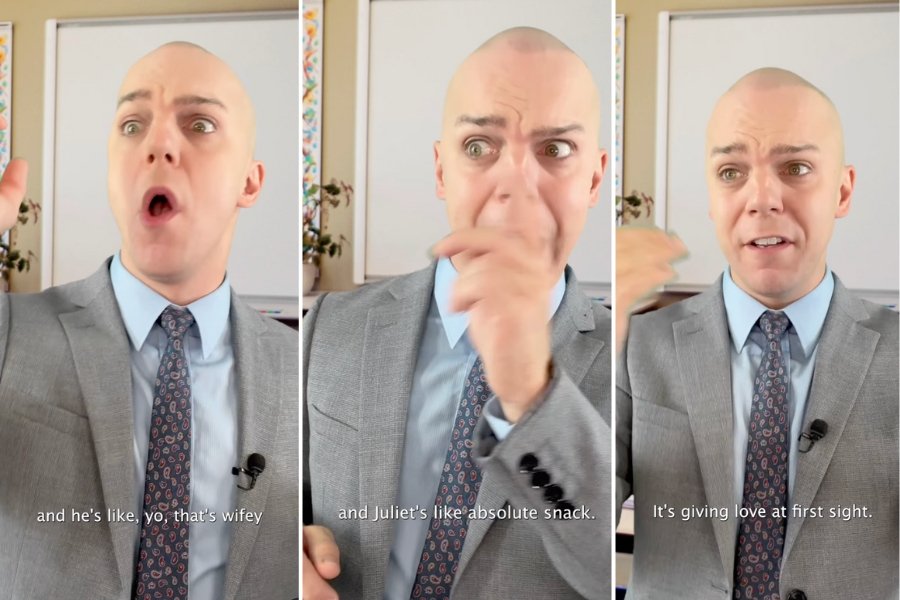
That's what comedian Richard Franks did by summarizing "Romeo and Juliet" entirely in Gen Z slang, and teachers are praising him for it. Watch him leave no crumbs:
From Juliet seeing Romeo as "an absolute snack" to the Capulets and the Montagues "beefing hard" to "it's giving bruh, just check your messages" when Romeo mistakenly believes Juliet's really dead, it's modern translation perfection.
It's meant to be comedy, but it has real educational value
English teachers in the comments were thrilled to find a fun, engaging way to introduce "Romeo and Juliet" to their students:
"As an English teacher, this is going into my lesson on R&J with Year 9 next week. 💥"
"I'm humiliating year 10 with this first thing Monday morning."
"This is brilliant. I had a professor who would sit on the edge of his desk and tell us all about The Canterbury Tales. Just the major highlights, some interesting background and then say go read it. They are such hilarious raunchy tales that everyone went off, struggled through the Middle English and read it. I was an English teacher and this is how you keep them engaged. Amazing."
"I have spent 40 years working with high school in college students, editing, papers, grading papers, and this honest goodness is the best explanation of Romeo and Juliet I have ever heard. I am laughing tears.😂😂"
"As someone who has majored in Shakespeare, this is downright hilarious 🤣"
A lesson in Shakespeare, but also a lesson in Gen Z slang
People are also loving Franks' skit as much for the Gen Z slang lesson as the other way around:
"This is beyond brilliant because it works two ways: kids can understand Shakespeare, and olds can understand kids. The level of your intelligence and comedic genius is off the charts!"
"You think you're teaching Gen Z Shakespeare. But really you're teaching Gen X modern slang. Thank you for your service."
"As a 52 year young Olds, I actually finally understood some of the new young slang taken in the context of the play recap!"
"YAAASSS!!! 😂 My knowledge of Shakespeare was translating the Gen Z lingo for me 😅"
"This is the best break down of Romeo and Juliet I've ever heard...And I'm Gen X 😂."
This is not Franks' first foray into translating Shakespeare into Gen Z. He also has a Macbeth breakdown that's equally brilliant:
Arguably, that one's even more impressive as "Macbeth" is a harder plot to follow in many ways than "Romeo and Juliet."
As one commenter wrote, "This is brilliant - and beyond the humor, it is a fascinating study of language. Shakespeare as written is not really anything close to any kind of modern English at all, and even many familiar words had different meanings or usages/connotations. But the story itself, if we can manage to understand it at its core, is tragic and brilliant. Language is constantly evolving—if he were alive today, I bet Shakespeare would get an enormous kick out of this.👏👏👏"
Shakespeare probably would have loved this
Several commenters shared that they thought Shakespeare would enjoy this, and considering the way he played with language, invented words and used slang himself in his writing, they may be right. Language is ever-evolving, but few people in history have had more of a direct impact on the English language than Shakespeare. As much as English has changed since the late 1500s, there are many words widely believed to be created or first used by Shakespeare that we use regularly today, including "lonely," "rant," "obscene," "gossip" and more.
So Gen Z's distortion or invention of words to communicate is right up Shakespeare's alley. The famous poet and playwright didn't just invent words but created phrases we use today as well. "Breaking the ice" and "heart of gold" are Shakespeare's babies, so Gen Z phrases like "main character energy" are basically giving Shakespeare vibes.
From an educational standpoint, Franks' videos are great for illustrating how ideas can be expressed in various ways, even when people speak the same language, in addition to helping hook young people into Shakespeare's stories by putting the plot into terms they relate to. What a fun jumping off point for a lesson on Shakespeare, all from the mind of a comedian. Shakespeare would surely be proud.
You can follow Richard Franks on Instagram for more comedy.

- Why you're way more familiar with William Shakespeare's work than you think. ›
- 35 Shakespearean insults to take down your enemies and crack up your friends ›
- Florida politician said Shakespeare never used pronouns 'in his plays' and got a fact check ›
- Gen Z has much higher financial goals than the rest of us - Upworthy ›
- Comedian summarizes 'A Christmas Carol' plot in Gen Z slang - Upworthy ›
- How social media is changing the way we speak - Upworthy ›
- High school teacher quizzes his students on 90s slang words and it was 'on fleek' - Upworthy ›
- History teacher brilliantly explains how 'Yankee Doodle' is America's first 'diss track remix' - Upworthy ›
- Gen Xers discuss nostalgic slang met with Gen Z stares - Upworthy ›
- Chinese teacher shares American names with funny Mandarin meanings - Upworthy ›
- 25-year-old manager explains why he loves that his Gen Z employees 'don't care anymore' - Upworthy ›
- Linguists explain why some slang words stick and some don't - Upworthy ›
- A tmesis is abso-freakin-lutely the coolest feature of the English language you don't know exists - Upworthy ›
- Millennials share the charmingly outdated generational slang that they still can't get enough of - Upworthy ›


A woman is getting angry at her coworker.via
A man with tape over his mouth.via
A husband is angry with his wife. via 
a man sitting at a desk with his head on his arms Photo by
Can a warm cup of tea help you sleep better? If you believe it, then yes. Photo by 
Three women sit on a blanket in the park. 
Two women engaging in a pleasant conversation inside a coffee shop
Two men engaging in a peaceful disagreement.
Resurfaced video of French skier's groin incident has people giving the announcer a gold medal
"The boys took a beating on that one."
Downhill skiing is a sport rife with injuries, but not usually this kind.
A good commentator can make all the difference when watching sports, even when an event goes smoothly. But it's when something goes wrong that great announcers rise to the top. There's no better example of a great announcer in a surprise moment than when French skier Yannick Bertrand took a gate to the groin in a 2007 super-G race.
Competitive skiers fly down runs at incredible speeds, often exceeding 60 mph. Hitting something hard at that speed would definitely hurt, but hitting something hard with a particularly sensitive part of your body would be excruciating. So when Bertrand slammed right into a gate family-jewels-first, his high-pitched scream was unsurprising. What was surprising was the perfect commentary that immediately followed.
This is a clip you really just have to see and hear to fully appreciate:
- YouTube youtu.be
It's unclear who the announcer is, even after multiple Google inquiries, which is unfortunate because that gentleman deserves a medal. The commentary gets better with each repeated viewing, with highlights like:
"The gate the groin for Yannick Bertrand, and you could hear it. And if you're a man, you could feel it."
"Oh, the Frenchman. Oh-ho, monsieurrrrrr."
"The boys took a beating on that one."
"That guy needs a hug."
"Those are the moments that change your life if you're a man, I tell you what."
"When you crash through a gate, when you do it at high rate of speed, it's gonna hurt and it's going to leave a mark in most cases. And in this particular case, not the area where you want to leave a mark."
Imagine watching a man take a hit to the privates at 60 mph and having to make impromptu commentary straddling the line between professionalism and acknowledging the universal reality of what just happened. There are certain things you can't say on network television that you might feel compelled to say. There's a visceral element to this scenario that could easily be taken too far in the commentary, and the inherent humor element could be seen as insensitive and offensive if not handled just right.
The announcer nailed it. 10/10. No notes.
The clip frequently resurfaces during the Winter Olympic Games, though the incident didn't happen during an Olympic event. Yannick Bertrand was competing at the FIS World Cup super-G race in Kvitfjell, Norway in 2007, when the unfortunate accident occurred. Bertrand had competed at the Turin Olympics the year before, however, coming in 24th in the downhill and super-G events.
As painful as the gate to the groin clearly as, Bertrand did not appear to suffer any damage that kept him from the sport. In fact, he continued competing in international downhill and super-G races until 2014.
According to a 2018 study, Alpine skiing is a notoriously dangerous sport with a reported injury rate of 36.7 per 100 World Cup athletes per season. Of course, it's the knees and not the coin purse that are the most common casualty of ski racing, which we saw clearly in U.S. skier Lindsey Vonn's harrowing experiences at the 2026 Olympics. Vonn was competing with a torn ACL and ended up being helicoptered off of the mountain after an ugly crash that did additional damage to her legs, requiring multiple surgeries (though what caused the crash was reportedly unrelated to her ACL tear). Still, she says she has no regrets.
As Bertrand's return to the slopes shows, the risk of injury doesn't stop those who live for the thrill of victory, even when the agony of defeat hits them right in the rocks.