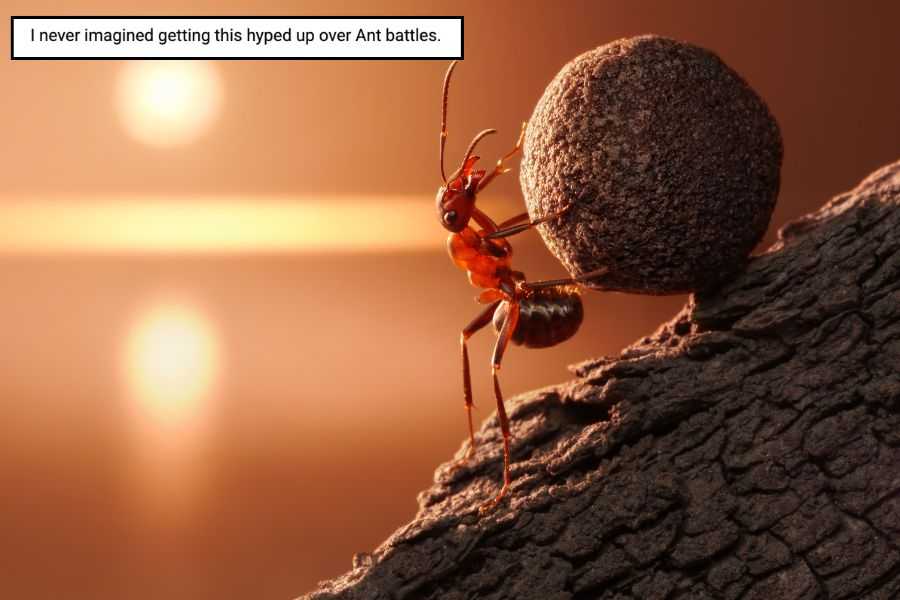
We often think of war as a strictly human phenomenon, but there are plenty of structured territorial battles that go on within the animal kingdom. Ants, in particular, engage in highly complex warfare, including “slave-making” (raiding other species’ nests to steal young) and large-scale territorial conflicts between colonies.
In fact, there is one ant battle that’s gone on for so long that experts think it might be the longest non-human conflict in the world.
As explained by a video posted by Michael McBride, creator of the “edutainment” social media channel @IdeaSoup, this ongoing conflict spans a whopping 600 miles of the California coast. The main antagonist, if you will, is a “super colony” of Argentine ants, which have a unique set of superpowers.
For one thing, Argentine ants ignore other nests of the same species. They also support several queens, rather than one. This allows them to create massive interconnected, cooperative colonies that span across continents.
In fact, they “co-colonized” alongside the Europeans during a “peak point” of colonization. ”The earliest record of the Argentine ant in the United States specifically is from around 1890, when ships carrying sugar from Argentina landed in New Orleans. They traversed 2,000 miles to reach the Golden State sometime around 1905, and have been waging war ever since. Some believe that the Argentine ant is the only non-human species capable of such widespread “globalization,” according to McBride. They are technically the largest society in the world.
The warfare that goes on between Argentine ants and other super colonies is “surprisingly complex,” said McBride, with defined frontlines on which 30 million ants die every year. And yet, the Argentine ants have the upper hand in their ability to unite. They might not have the size that some species possess, nor large mandibles, nor a stinger for weaponry, but they do have relentless aggression, overwhelming numbers, and extreme organization.
That, and their proclivity for chemical warfare. A major strategy Argentine ants implement is spraying toxic chemicals onto their enemies, which disorients the victim and marks them for other Argentine ants. A mob then surrounds the prey, pins them down, and dismembers them.
Showing that their greed knows no bounds, Argentine ants also rather easily take down spiders, flies, and other native insects. And when those resources are exhausted, they might find themselves in our own homes. Yes, these are the ants we might see lurking in our pet food bowls, kitchens, and dumpsters.

Gardens are a particularly precarious place for Argentine ants to dwell, because, get this, they are apparently capable of making negotiations with aphids. In exchange for the aphid’s sweet secretion (yuck), Argentine ants will kill off their predators.
However, while Argentine ants have won many, many battles in California, they might not yet win the war. Some of their factions have broken off and formed their own empires, resulting in civil war and compromising their most winning strategy.
That, and fire ants, which also came from South America by way of Alabama, are a formidable foe, both in aggression and the ability to super-colonize. They’re also larger in size and have venomous stingers. Basically, the war they waged in their homeland has now been moved to foreign lands. Who shall become the ultimate victor is still up to fate. Are you not entertained?!
In a small village in Pwani, a district on Tanzania’s coast, a massive dance party is coming to a close. For the past two hours, locals have paraded through the village streets, singing and beating ngombe drums; now, in a large clearing, a woman named Sheilla motions for everyone to sit facing a large projector screen. A film premiere is about to begin.
It’s an unusual way to kick off a film about gender bias, inequality, early marriage, and other barriers that prevent girls from accessing education in Tanzania. But in Pwani and beyond, local organizations supported by Malala Fund and funded by Pura are finding creative, culturally relevant ways like this one to capture people’s interest.
The film ends and Sheilla, the Communications and Partnership Lead for Media for Development and Advocacy (MEDEA), stands in front of the crowd once again, asking the audience to reflect: What did you think about the film? How did it relate to your own experience? What can we learn?
Sheilla explains that, once the community sees the film, “It brings out conversations within themselves, reflective conversations.” The resonance and immediate action create a ripple effect of change.
MEDEA Screening Audience in Tanzania. Captured by James Roh for Pura
Across Tanzania, gender-based violence often forces adolescent girls out of the classroom. This and other barriers — including child marriage, poverty, conflict, and discrimination — prevent girls from completing their education around the world.
Sheilla and her team are using film and radio programs to address the challenges girls face in their communities. MEDEA’s ultimate goal is to affirm education as a fundamental right for everyone, and to ensure that every member of a community understands how girls’ education contributes to a stronger whole and how to be an ally for their sisters, daughters, granddaughters, friends, nieces, and girlfriends.
Sheilla’s story is one of many that inspired Heart on Fire, a new fragrance from the Pura x Malala Fund Collection that blends the warm, earthy spices of Tanzania with a playful, joyful twist. Here’s how Pura is using scent as a tool to connect the world and inspire action.
A partnership focused on local impact, on a global mission
Pura, a fragrance company that recognizes education as both freedom and a human right, has partnered with Malala Fund since 2022. In order to defend every girl’s right to access and complete 12 years of education, Malala Fund partners with local organizations in countries where the educational barriers are the greatest. They invest in locally-led solutions because they know that those who are closest to the problems are best equipped to solve and build durable solutions, like MEDEA, which works with communities to challenge discrimination against girls and change beliefs about their education.
But local initiatives can thrive and scale more powerfully with global support, which is why Pura is using their own superpower, the power of scent, to connect people around the world with the women and girls in these local communities.
The Pura x Malala Fund Collection incorporates ingredients naturally found in Tanzania, Nigeria, Pakistan, and Brazil: countries where Malala Fund operates to address systemic education barriers. Eight percent of net revenue from the Pura x Malala Fund Collection will be donated to Malala Fund directly, but beyond financial support, the Collection is also a love letter to each unique community, blending notes like lemon, jasmine, cedarwood, and clove to transport people, ignite their senses, and help them draw inspiration and hope from the global movement for girls’ education. Through scent, people can connect to the courage, joy, and tenacity of girls and local leaders, all while uniting in a shared commitment to education: the belief that supporting girls’ rights in one community benefits all of us, everywhere.
You’ve already met Sheilla. Now see how Naiara and Mama Habiba are building unique solutions to ensure every girl can learn freely and dare to dream.
Naiara Leite is reimagining what’s possible in Brazil
Julia with Odara in Brazil. Captured by Luisa Dorr for Pura
In Brazil, where pear trees and coconut plantations cover the Northeastern Coast, girls like ten-year-old Julia experience a different kind of educational barrier than girls in Tanzania. Too often, racial discrimination contributes to high dropout rates among Black, quilombola and Indigenous girls in the country.
“In the logic of Brazilian society, Black people don’t need to study,” says Naiara Leite, Executive Coordinator of Odara, a women-led organization and Malala Fund partner. Bahia, the state where Odara is based, was once one of the largest slave-receiving territories in the Americas, and because of that history, deeply-ingrained, anti-Black prejudice is still widespread. “Our role and the image constructed around us is one of manual labor,” Naiara says.
But education can change that. In 2020, with assistance from a Malala Fund grant, Odara launched its first initiative for improving school completion rates among Black, quilombola, and Indigenous girls: “Ayomidê Odara”. The young girls mentored under the program, including Julia, are known as the Ayomidês. And like the Pura x Malala Fund Collection’s Brazil: Breath of Courage scent, the Ayomidês are fierce, determined, and bursting with energy.
Ayomidês with Odara in Brazil. Captured by Luisa Dorr for Pura
Ayomidês take part in weekly educational sessions where they explore subjects like education and ethnic-racial relations. The girls are encouraged to find their own voices by producing Instagram lives, social media videos, and by participating in public panels. Already, the Ayomidês are rewriting the narrative on what’s possible for Afro-Brazilian girls to achieve. One of the earliest Ayomidês, a young woman named Debora, is now a communications intern. Another former Ayomidê, Francine, works at UNICEF, helping train the next generation of adolescent leaders. And Julia has already set her sights on becoming a math teacher or a model.
“These are generations of Black women who did not have access to a school,” Naiara says. “These are generations of Black women robbed daily of their dreams. And we’re telling them that they could be the generation in their family to write a new story.”
Mama Habiba is reframing the conversation in Nigeria
Centre for Girls' Education, Nigeria. Captured by James Roh for Pura
In Mama Habiba’s home country of Nigeria, the scents of starfruit, ylang ylang and pineapple, all incorporated into the Pura x Malala Collection’s “Nigeria: Hope for Tomorrow,” can be found throughout the vibrant markets. Like these native scents, Mama Habiba says that the Nigerian girls are also bright and passionate, but too often they are forced to leave school long before their potential fully blooms.
“Some of these schools are very far, and there is an issue of quality, too,” Mama Habiba says. “Most parents find out when their children are in school, the girls are not learning. So why allow them to continue?”
When girls drop out of secondary school, marriage is often the alternative. In Nigeria, one in three girls is married before the age of 18. When this happens, girls are unable to fulfill their potential, and their families and communities lose out on the social, health and economic benefits.
Completing secondary school delays marriage, and according to UNESCO, educated girls become women who raise healthier children, lift their families out of poverty and contribute to more peaceful, resilient communities.
Centre for Girls’ Education, Nigeria. Captured by James Roh for Pura
To encourage young girls to stay in school, the Centre for Girls’ Education, a nonprofit in Nigeria founded by Mama Habiba and supported by Malala Fund and Pura, has pioneered an initiative that’s similar to the Ayomidê workshops in Brazil: safe spaces. Here, girls meet regularly to learn literacy, numeracy, and other issues like reproductive health. These safe spaces also provide an opportunity for the girls to role-play and learn to advocate for themselves, develop their self-image, and practice conversations with others about their values, education being one of them. In safe spaces, Mama Habiba says, girls start to understand “who she is, and that she is a girl who has value. She has the right to negotiate with her parents on what she really feels or wants.”
“When girls are educated, they can unlock so many opportunities,” Mama Habiba says. “It will help the economy of the country. It will boost so many opportunities for the country. If they are given the opportunity, I think the sky is not the limit. It is the starting point for every girl.”
From parades, film screenings to safe spaces and educational programs, girls and local leaders are working hard to strengthen the quality, safety and accessibility of education and overcome systemic challenges. They are encouraging courageous behavior and reminding us all that education is freedom.
Experience the Pura x Malala Fund Collection here, and connect with the stories of real girls leading change across the globe.
Science lovers got a treat recently when new research on sperm whales was quietly released. Researchers not only witnessed the birth of a baby sperm whale, but also saw elder females, including the grandmother, acting as midwives. Very few species assist with birth outside of humans, but it seems sperm whales can now join that short list.
Project CETI (Cetacean Translation Initiative) released two studies on sperm whales in journals Nature and Science respectively. Nature covers the different vocalizations of the whales during this teamwork process, while Science discusses the collaborative birthing approach by the whales.
The sperm whale’s birth was first captured via drone in July 2023. Now that the video has made its way to social media, viewers cannot get over witnessing the whales act as midwives. Typically, scientists don’t get to witness sperm whales’ behavior during birth, likely because they give birth far from shore and avoid boats during this vulnerable process.
With the increasing use of drones, however, scientists can now capture moments like this without disrupting wildlife. In the video, other whales—one identified as the grandmother—surround the birthing whale, named Rounder. Not all of the supporting whales were from the same pod as the mother, but they joined to help ensure the calf’s safe arrival.
Because whales are mammals, they can’t breathe underwater. For this reason, baby whales, also known as calves, are born tail-first. Like other mammals, newborn whales instinctively try to breathe, so exiting the birth canal headfirst could result in drowning, according to National Geographic.
Scientists have been following this pod for a while, so they’re familiar with the whales in the family. As they watched the drone footage from the boat, they were able to identify who was present. Still, the sight of this unique birthing circle shocked the scientists.
While birthing her calf, Rounder was flanked by her sister, Accra, and Atwood, an elder female. Behind the mom-to-be was her mother, Lady Oracle, her aunt Aurora, a juvenile whale named Ariel, and four other unknown female whales. The whales had dual roles: when the calf was born, the assisting whales formed a tight cluster and raised the baby out of the water so it could breathe.
They took turns holding the calf out of the water for three hours. During that time, the females that were not actively lifting the calf to the surface were fending off nosy animals. Once the baby was safe and swimming alongside its mother, the other whales began to depart.
One of the scientists, Shane Gero, told National Geographic, “All the biologists on the boat were losing their minds.” The same could be said for people coming across the video online.
One person wrote, “Women supporting women! Bring it on!”
Another person called out humans, saying, “I think they lied , who said survival of the fittest or only the strong survive. Everything in nature is about collective care. Even other animal species be helping each other. Also even when its predators they only take what they need.”
This commenter admired the teamwork, writing, “I love how whales put so much energy into each other, but it’s even more exciting that members outside of the family pod were being so helpful. I’m invested!”
“This is so frigging cool,” another person gushed. “I love how nature really wants nature to succeed. Absolutely 100% lit. Thanks for this!”
Which is why what happened on February 20, on a remote volcanic island in the Pacific Ocean feels so extraordinary.
A species that, by all accounts, should have been extinct returned home. That morning, rangers on Floreana Island in Ecuador’s Galápagos Islands set down their packs and gently placed 158 juvenile giant tortoises onto the wet ground—the first of their lineage to set foot on the island in roughly 175 years.
These animals weren’t supposed to exist. Their subspecies was declared extinct in the 1850s. The forces that wiped them out—overhunting, invasive predators, habitat destruction—are exactly the kinds that usually can’t be reversed. But this time, somehow, they have been.
First, here’s what was lost
Long ago—before whalers, settlers, feral cats, and invasive rats—Floreana Island was home to as many as 20,000 giant tortoises. These weren’t just large, slow animals living out their days in the sun. They were ecosystem engineers that carved trails through the vegetation, swallowed whole fruits and deposited seeds miles away, planting forests with every lumbering step. The island’s entire web of life depended on these tortoises.
By the time anyone thought to do something, it was too late. Or so everyone thought.
A wild tale
In 2008, scientists exploring Wolf Volcano on Isabela Island noticed something strange. Some of the tortoises had an unusual shell shape: the unique saddleback shell associated with Floreana.
They conducted DNA tests, and the results were nearly unbelievable. These tortoises carried the genetic fingerprint of the “extinct” Floreana lineage.
It turns out that centuries earlier, those same whalers who had stripped Floreana of its tortoises had occasionally offloaded live tortoises onto Isabela Island, as provisions to be retrieved later or to lighten their ships. Some of those tortoises survived, bred, and passed their genes on for nearly 200 years.
The Floreana tortoise had been hiding in plain sight the whole time.
Scientists sprang into action. They selected 23 hybrid tortoises from Wolf Volcano that showed the strongest Floreana genetic signal and brought them to a breeding center on Santa Cruz Island. Starting in 2017, they carefully bred them over generations, patiently guiding their lineage back toward its original form.
Dr. Jen Jones, chief executive of the Galápagos Conservation Trust, described the moment as “truly spine-tingling,” adding that it validated two decades of collaboration among scientists, charities, and the local community.
But wait—they didn’t just show up and release tortoises
Before a single tortoise set foot on Floreana, the island needed years of preparation.
Remember, Floreana had been overrun with invasive rats and feral cats, the same forces that drove the tortoises to extinction in the first place. They needed to go. In October 2023, the Floreana tortoise team launched a massive eradication campaign with helicopters, aerial baiting, and ground traps.
Before the baiting began, community members set up protective enclosures for their pets to prevent harm. Farmers adapted their agricultural practices to best serve the project. Locals also helped with the trapping.
The results were almost immediate. Native Galápagos rails—small birds that disappeared from the island entirely because of rat predation—have already started coming back on their own. Nature, it turns out, is extremely ready to bounce back the moment you give it a chance.
And they’re watching every step
Each of the 158 released tortoises carries a GPS tracker that pings its location every hour via satellite.
On top of that, NASA Earth observation data is overlaid to map vegetation, rainfall, and soil conditions across the island. Scientists use all of this information to build habitat models that can project ecosystem conditions decades into the future, which matters a lot when you’re dealing with an animal that can live over a century.
The plan is to release 25 to 100 more tortoises each year, with each group’s release location guided by data on where current tortoises are thriving. Slow and steady. Rather fitting, really.
This is just the beginning
The 158 tortoises are Phase One of a plan to reintroduce 12 locally extinct species to Floreana over the coming decade. Next up? The Floreana mockingbird, a fascinating species that arguably inspired Charles Darwin’s theory of evolution when he visited the island in 1835. Sadly, it now only exists on two tiny offshore islets.
After that: Darwin’s finches, Galápagos racer snakes, the lava gull (the world’s rarest gull), and, eventually, the Galápagos hawk, the apex predator whose return would signal a fully restored food chain.
Each species added to the island increases the likelihood that the next will succeed. That’s how ecosystems work. And honestly, it’s a pretty good lesson for the rest of life.
Dogs are considered invaluable police helpers for their tracking abilities. But performing CPR? That’s certainly not on anyone’s bingo card.
However, footage released on X by Madrid Municipal Police shows a dog named Poncho doing just that, or at least performing CPR in a training simulation.
In the clip, an officer pretends to faint, triggering Poncho to rush to the rescue. Wearing a harness fitted with a small blue light, Poncho quickly begins jumping on the officer’s chest with his forepaws, mimicking chest compressions. After every few jumps, he appears to check for a pulse or breath before continuing the drill.
By the end, the officer miraculously jumps up, and Poncho’s tail wags in gleeful triumph.
The Municipal Police of Madrid wrote that the “heroic” dog “did not hesitate for a moment to ‘save the life’ of the agent, practicing the #CPR in a masterful way.”
Adorable? Definitely. Effective? Eh, not so much.
As many were quick to point out in the comments, this “masterful” performance is certainly heartwarming, but it likely wouldn’t hold up in a real emergency.
While CPR, or cardiopulmonary resuscitation, can be performed using chest compressions alone (as Poncho was demonstrating), even that requires a level of precision that man’s best friend might find challenging.
As Jonathan Epstein, senior director of science and government relations for the American Red Cross, told The Washington Post in 2018, that technique involves pushing down about two inches into the patient’s chest at a rate of 100 to 120 compressions per minute until the patient regains consciousness or until someone else can take over to attempt traditional CPR or other revival methods.
That level of control is difficult even for humans who have not been properly trained, much less a creature without opposable thumbs.
Video goes viral
Still, it could be argued that Poncho revived millions of hearts after his video went viral, and he certainly received applause from his new fans.
“This is the cutest thing I’ve ever seen 🥺🥹”
“Lol 😂most ineffective compressions I’ve ever seen but ok cute.”
“Cutest, most ineffective bounces I’ve ever seen, but what a good way to go! lolol 😍”
Plus, dogs have proven themselves to be incredible creatures many times before, whether saving people from drowning or rescuing avalanche victims.
And for what it’s worth, the Madrid police department wasn’t trying to convince anyone that Poncho could perform CPR. They actually had much more wholesome intentions.
According to NBC News, the Municipal Police of Madrid hoped the video would inspire pet adoptions. The department also quoted American author Josh Billings in an X post, saying, “A dog is the only thing on earth that loves you more than you love yourself.”
So while Poncho might not have pulled off a medical miracle, he is undoubtedly a hero in our eyes.
One of the best things about house pets is that few of us expect them to be smart. There are the occasional owners who rigorously train their dogs, but most of us are perfectly happy with friendly, dumb pets—as long as they love us unconditionally and like to snuggle. However, every now and then, they surprise us and reveal just how smart they really are.
Extending to the wider world of animals, most people simply have no idea how intelligent some species can be. It’s honestly mind-boggling.
A recent viral Reddit thread asked people about the “creepiest” signs of intelligence they’d ever seen. Though the prompt didn’t specify animals, countless users chimed in with moments when they witnessed an animal do something so smart it made their jaws drop. It can even be a little unsettling.
1. The canine empath
“I was dog-walker when my daughter was a baby, and I had one dog who absolutely understood every word I said. … If she didn’t want to do something, such as cross the street to a trash can, you just had to explain why it was necessary and she’d cooperate.
One time she got irritated because I wasn’t feeling well and was walking super slowly. She kept tugging on the leash til I finally told her I was feeling sick. She immediately lead me to a bench and sat there, totally calm, for like 10 minutes before leading me back home again.”
Dogs can’t speak English, but they pick up on far more than you might realize. The smartest ones can learn hundreds of words, and many can even recognize when you’re speaking gibberish (or another language). They’re also exceptionally good at picking up on human nonverbal cues.
Put it all together, and it can sometimes seem like they understand everything you’re saying.
2. The guard crows
“I’ve been feeding this family of 5 crows for years. They have gotten comfortable enough with me that they’ll come get snacks while I’m still sitting next to the food. I can call them with a specific whistle I use just for them, and they make a rattle noise (that sounds like the Predator) with me to thank me for food.
One late night I hear this horrible loud screeching. It woke me up, so I ran outside to see what it was. There was a guy trying to break into a window in my house and the 5 crows were dive bombing him screaming as loud as they could. He ran away. … So I guess I have guard-crows now.”
Crows are not only sneaky-brilliant, but they can also become your best buds if you treat them well. According to MIT Technology Review, “A 2020 study published in Science found that crows can think about their own thoughts. They can also recognize individual human faces, associate them with friendliness or danger, and pass that knowledge along to their peers.”
If you’re cool with the local murder of crows, word may just spread.
3. Puzzling crows
“Seeing a crow solve a puzzle box in seconds after watching it once gave me chills, it felt like it was actually thinking things through. Stuff like that makes you realize some animals are way smarter than we usually give them credit for.”
Crows are thought to be about as intelligent as a 5- to 7-year-old human child. Not only can they make friends, but they can also invent and use tools, solve puzzles, and maybe even count. By all accounts, they’re among the smartest animals in the world, and they may be hanging out in your backyard right now.
4. The magpie truce
“I ended up working as an adult really close to my family home I lived in since I was born. The area has always been occupied by Magpies which swoop at you all through summer. For those who don’t know, it’s terrifying.
At work there was an injured Magpie that we fed and took care of for ages. When it got better enough to roam, it ‘told’ all the other magpies in the area and since then, about a decade ago, all the magpies in the area never swooped any of us who worked at the store again. And Alfred the magpie used to fly beside me when I’d ride my bike to work! And on the way back too, to make sure I was safe. So insane.”
Though notoriously territorial and “swoopy,” magpies, like crows, can remember human faces. They can form strong bonds with humans who are friendly and helpful to them.
5. The dog that needed thumbs
“My dog starts barking at the door so I open it to see what’s going on. there’s a border collie sitting there waiting. I go to check on the dog and he gets up and walks a bit away, sits and stares at me. I follow him. this goes on till I’m in front of a house in my neighborhood.
Collie stares at the doorbell. I ring it. no one answers. collie stares at the door. I knock, no answer. dog gets up and walks to the side gate and stares at me and then up at the latch. I open the gate for the dog. the dog walks into the back yard, turns around, sits and stares at me and then at the open gate. I close the gate and watch the dog relax. dog used me for my thumbs and wouldn’t even let me pet him.”
Dogs frequently turn to humans for help in tough situations—it’s in their nature. When an owner or friendly human isn’t around, they’ll even seek out a stranger for a helping hand. It’s a distinctly social brand of genius.
6. The sneaky octopus
“I heard of an octopus who would break out of its tank at night and eat the crabs in a neighbouring tank. The aquarium staff didn’t understand how the crabs kept getting eaten until they watched cctv and saw what the octopus was doing. Creepy thing is, the octopus knew to replace the lids and return to its own tank. That must mean it understood the need for deception.”
Variations of this story have been going around for years. It’s even a plot point in the popular novel Remarkably Bright Creatures.
While the original source is difficult to verify, the story isn’t all that far-fetched. Octopuses are extremely gifted escape artists, able to solve puzzles, unscrew jars, and navigate mazes. They also seem to possess a strong understanding of what others—prey, humans, and other octopuses—may be thinking, and they have been known to use intentional deception.
“Was at a party and had a sudden mid conversation realization that we were all standing uncomfortably close to each other. My buddies border collie had slowly herded us all to the center of the room.”
Herding is an instinct hardwired into the Border Collie. Needless to say, it can take some owners by surprise just how eerily good they are at it.
“You will never remove herding instinct from a Border Collie and neither should you want to,” writes trainer Sarah Hedderly at DingBatt Dog Training.
8. The ham dog
“My dad’s German Shepherd figured out how to open the fridge, take out one slice of ham, and close it again. We only caught him because my dad set up a camera thinking my brother was sneaking food at night. The dog looked directly at the camera once and never did it again while we were home.”
Similar to octopuses, dogs understand deception. They can sometimes tell when a human is lying to them and have even been shown to distinguish between an honest mistake and an outright lie. In turn, they can be pretty sneaky themselves.
9. The dog that found its way home
Move over, Homeward Bound: The Incredible Journey.
“Not necessarily creepy, but I have no explanation for it – I’ve told this story before but when our dog was maybe 6 months old we took her to the groomers for the first time. My wife took her there in a taxi, she was lying on the floor the entire way with no way to see out. She had never been to that area before, and it was about 4 miles from our apartment, which itself was on the third floor of an apartment block. We get a call about 30 min later saying our dog had jumped a gate and ran out of the groomer, everyone’s freaking out, she’s a labradoodle but still a puppy, and she’s alone and scared in central London in the middle of the day.
We started searching and my wife was inconsolable so I said maybe she should wait at home – she got there and our dog was sitting on our doorstep on the third floor, happy as Larry, just chilling her beans. She had jumped a 4 foot fence, got out of a locked door, then ran across 4 miles of central London traffic, crossing at least one highway, through streets she’d never been to or even seen, and got home around 25 minutes after she left the groomers.”
It may be hard to believe, but dogs can follow a scent for miles. In one widely reported case, a dog returned to its owner after an 11-mile journey. Bonnie Beaver, executive director of the American College of Veterinary Behaviorists and a professor at Texas A&M University, told Time, “An eleven-mile distance is actually not terribly long for a dog.”
10. The cozy pup
“My dog knows how to turn on my wife’s heated blanket, and he knows he likes it on the 2 setting. He will change it to the 2 setting if she has it warmer or colder.”
All the different things dogs can learn to do never cease to amaze. They can operate appliances, dial a telephone, and apparently even use a heated blanket. What’s creepy—in the best way—is that your dog may know things you don’t even realize it knows. Like humans, dogs can learn remarkably well through observation.
It’s one thing to watch documentaries or learn in school about the brilliance of dolphins, crows, and even ordinary house dogs. But seeing surprising displays of animal intelligence for yourself can be downright eerie, in the coolest way.
Beau, a golden retriever, is a very big deal. Like many dogs in the modern age, he has his own social media accounts. But one particular Instagram post went so viral that he’s gaining followers by the minute—and for good reason.
His “person” happened to be filming him being his adorably goofy self one day in a parking lot. That’s when he spotted a tiny gray mouse. Some were concerned it wouldn’t end well. But Beau, tail wagging and fur shedding, immediately circled around it and lay down as though he’d known the mouse his entire life. His mom asked, “What are you doing? Did you find a mouse? Is that your friend?” Beau’s tail continued to wag as he occasionally side-eyed the little critter.
In less than a week, the clip had 1.6 million likes and over 9,000 comments from new fans around the world. Both Beau and his new, unassuming pal seem to have become a symbol of hope—or at the very least, a gentle distraction.
His bio is written in the first person on another Instagram post. While we can’t confirm or deny that Beau actually wrote it, it states:
“Hello to all my new friends 🥰 I’m Beau 👋🏻🐾
I was born in Utah and spent a year on the farm with my golden family, before my parents found me in March 2025 and moved me to Denver 😍
I love tennis balls, morning cuddles, fresh snow, frozen cucumbers, and spending time in Minnesota with my cousin @cocobabydoodle ❤️
My superpower is giving hugs. I learned it from my grand-doggy 🫶🏼
During the week, I go to mom’s office and shed my hair all over her coworkers 💁🏽♀️
My parents spoil me with toys, but my favorite is my Simba. He goes where I go 🥺
I recently went viral for making friends with a mouse. I’m not sure why because I make friends with everyone, but I appreciate all the love ❤️”
His new fans seem overjoyed. One person notes, “This is the most Golden Retriever behavior I’ve ever seen.”
A few jokingly point out that if that mouse—or any mouse—crossed paths with THEIR breed of canine, it might not fare as well: “Our dachshund would have swallowed it whole. Ask me how I know.”
Others seem to resonate with how wholesome the short clip is: “This needs to be a Disney movie.”
Some animal experts might argue that Beau was “resource guarding” rather than becoming actual besties with the cute rodent. In a Los Angeles Timesarticle, Kevin Spencer explains:
“Resource guarding in dogs is a common canine behavior that does not always initially manifest as something dramatic. Sometimes resource guarding refers to a subtle head turn when a dog guards a food bowl. Other times, the same guarding behavior escalates into something far more obvious and unsettling. At its core, resource guarding describes a dog’s attempt to protect a valuable resource it finds important. This may be food, toys, bones, a dog bed, or other items dogs steal and stash. It might even be a favorite human.”
It seems Beau has lots of cute quirks. Other photos on his Instagram page show him loving car rides, park days, and chasing balls. In one photo, Beau snuggles onto the couch with a leaf in his mouth. The caption reads, “Beau has been really into eating leaves lately.”
While Upworthy wasn’t able to confirm with Beau (or his family) that the tiny mouse wound up having the best day ever, it seemed the dog’s owner did her best to keep him safe. All in all, Beau’s wagging tail was a delight to see—so much so that another commenter suggested maybe Beau needs his own pet buddy, writing, “Buy him a puppy!” Someone seemingly in the family replied, “We’re working on it!”
It’s not easy being a river in the desert under the best of circumstances. The ecosystem exists in a very delicate balance, allowing water sources to thrive in the harsh conditions. These water sources in otherwise extremely dry areas are vital to the survival of unique wildlife, agriculture, and even tourism as they provide fresh drinking water for the people who live nearby.
But man-made problems like climate change, over-farming, and pollution have made a tough job even tougher in some areas. Rivers in Utah and Colorado that are part of the Colorado River Basin have been barely surviving the extremely harsh drought season. When the riverbeds get too dry, fish and other aquatic creatures die off and the wildfire risk increases dramatically.
About six years ago, one team of researchers had a fascinating idea to restore the health of some of Utah’s most vulnerable rivers: Bring in the beavers.
In 2019, master’s student Emma Doden and a team of researchers from Utah State University began a “translocation” project to bring displaced beavers to areas like Utah’s Price River, in the hopes of bringing it back to life.
Why beavers? It just makes dam sense! (Sorry.)
Beaver dams restrict the flow of water in some areas of a river, creating ponds and wetlands. In drought-stricken areas, fish and other wildlife can take refuge in the ponds while the rest of the river runs dry, thus riding out the danger until it rains again.
When beavers are present in a watershed, the benefits are unbelievable: Better water quality, healthier fish populations, better nutrient availability, and fewer or less severe wildfires.
It’s why beavers have earned the title of “keystone species,” or any animal that has a disproportionate impact on the ecosystem around them.
Doden and her team took beavers who were captured or removed from their original homes due to being a “nuisance,” interfering with infrastructure, or being in danger, and—after a short period of quarantine—were brought to the Price River.
Despite the research team’s best efforts, not all the translocated beavers have survived or stayed put over the years. Some have trouble adapting to their new home and die off or are killed by predators, while others leave of their own accord.
But enough have stayed and built dams since 2019 that the team is starting to see the results of the effort. In fact, beaver projects just like this one have been going on all over the state in recent years.
The water levels in the river are now the healthiest they’ve been in years. The fish are thriving. Residents of Utah are overjoyed at the results of the experiment.
A column in The Salt Lake Tribune from 2025 (six years after the beaver translocation began) writes that the revitalization of the Price River “helped save our Utah town.”
“A tributary of the Colorado River, the Price River runs through downtown Helper. On a warm day, you’re likely to find the river filled with tourists and locals kayaking, tubing and fishing along its shore. A decade ago, it was hard to imagine this scene—and the thriving recreation economy that comes with it—was possible.”
Of course, it wasn’t JUST the beavers. Other federal water cleanup investments helped remove debris, break down old and malfunctioning dams, and place tighter regulations on agriculture grazing in the area that depleted vital plant life.
But the experts know that the beavers, and their incredible engineering work, are the real MVPs.
An actual beaver dam on the now-thriving Price River Public Domain
In other drying, struggling rivers in the area, researchers are bringing in beavers and even creating manmade beaver dams. They’re hoping that the critters will take over the job as the rivers get healthier.
Utah’s San Rafael river, which is in bleak condition, is a prime candidate. In on area of the river, a natural flood inspired a host of beavers to return to the area and “riparian habitat along that stretch had increased by 230%, and it had the most diverse flow patterns of anywhere on the river,” according to KUER.
It’s hard to believe that beavers nearly went extinct during the heyday of the fur trapping industry, and continued to struggle as they were considered nuisances and pests. Now, they’re getting the respect they deserve as engineer marvels, and their populations have rebounded due to better PR and conservation programs.
To that I say…it’s about dam time!
This article originally appeared last year. It has been updated.
A baby monkey named Punch has captured the hearts of people around the world. The now seven-month-old Japanesemacaque, who lives at Japan’s Ichikawa City Zoo and Botanical Garden, was rejected by his mother shortly after birth. Videos of him clinging to zookeepers coming into the enclosure broke people’s hearts, but that was just the beginning of the saga.
Zookeepers gave Punch a stuffed orangutan toy as a surrogate “mom” to cuddle with. Naturally, that has only increased the “Awww” factor. Punch drags the toy around with him and runs back to it for comfort when he’s scared or lonely, and he’s been scared and lonely a lot since he was introduced to the larger macaque troop in January. Videos show him being pushed away and even dragged around by older macaques, after which he runs back to cling to his stuffed mama.
People can’t take watching a baby monkey be rejected
However, things have not been quite as dire for Punch as they may appear. The zoo has reassured the public in a statement that the “bullying” Punch has endured is actually a pretty normal part of primate socialization. Being “disciplined” by other macaques will teach him appropriate behavior in the troop, even if it appears mean to our human sensibilities.
People’s reactions to Punch and his struggles to fit in have been emotional and fierce, though. It’s like Punch’s story was designed to trigger every compassionate, protective instinct we have as humans. The motherless outcast who just wants to be loved. The big, mean bullies who knock him around. The rejection when he attempts to make friends. The finding comfort wherever he can, even in an inanimate object.
Comedian Britt Migs captured the emotional investment people have in this monkey in a parody video. It may be hilariously over the top, but it’s actually not far off from how many people feel after watching Punch videos.
Comments on the videos range from sadness to empathy to rage:
“Punch needs to have his own kingdom.”
“At dawn we ride for Punch.”
“How do I apply to foster and ultimately adopt punch. He can stay with me.”
“This story has wrecked my life this week.”
“I love Punch and I’ve never met him!”
“Every video I see of punch I’m crying, He’s so cute and innocent.”
Punch is doing better than people think, thankfully
There has been good news on the Punch front, thankfully. The zoo says he “shows resilience and mental strength” even as he goes through his social pitfalls. And he has started making friends with others. Newer videos show him being carried and cuddled by at least one older macaque, playing with a peer, and even being groomed. All good signs.
Ichikawa Zoo has seen a massive influx of visitors since Punch’s story went viral and has had to make adjustments. They have asked visitors to limit their time on Monkey Mountain (where the macaques live) and observe quietly so as not to disturb them.
The zoo has been keeping people posted on how Punch is doing. A zookeeper update from February 22 reads (translated from Japanese on X): “Thanks to everyone’s good manners, it was a calm atmosphere with no fights or anything like that. Punch, around 5 PM, was meticulously groomed by two monkeys and is steadily fitting into the group.”
The reality of zoos can often give people pause and prompt concern for the well-being of the animals in human care. Dr. Tessa Wilde, executive director at For the Love of Primates, shared some insights into how macaques live in the wild and how that influences the way enclosures are designed.
It’s #MonkeyMonday 🐒❄️ You asked about #PunchTheMonkey and Japanese macaque enclosures, so let’s break down how snow monkeys live in the wild—and how zoos and sanctuaries can mirror those rocky, mountainous habitats. #AnimalCare#fyp#viral
There’s a rather fuzzy line between caring for animals and anthropomorphizing them to the point where we might interfere with normal behavior, such as the socialization we’ve seen Punch going through. Wilde pointed out in a previous video that early rejection and scolding are not unusual in a case like Punch’s. And we’re seeing progress as he gets integrated into the troop, so that’s promising.
It is hard to watch, though, and our feelings of compassion for a creature we think is going through a hard time certainly isn’t a bad thing. We need more compassion in the world, even if it comes through a monkey with a stuffy just trying to find a family.
Punch the 6-month-old macaques monkey has gone viral for seeking comfort in a stuffed orangutan that is like his “surrogate mom.” Punch was abandoned by his real mom shortly after birth and the staff at Ichikawa City Zoo near Tokyo, Japan have been raising him. Punch, however, has hit some bumps in the road while trying to learn how to socialized with the other monkeys. In one viral video, another monkey is seen getting aggressive with him, but the zoo explained why that may happen. Here’s what the zoo says about Punch’s development – and why his “surrogate mom” stuffed animal is helpful. #monkey#punch
If you’ve ever seen a turkey in real life, you may already have questions about the odd birds. Can they fly? Why do they have those dangly things on their faces and necks? How can you tell a male turkey from a female? Can you eat turkey eggs?
One question you’ve probably never asked is, “Do turkeys have to be burped?” But after watching this turkey-burping demonstration, you might (along with about a dozen other questions, starting with “What on Earth did I just watch?”).
You’re not alone. So many commenters found themselves in the same boat:
“I am the first in my bloodline to see a turkey burped.”
“Do they explode if you don’t do this ?”
“Why did I just watch a tutorial on burping a turkey?”
“Will I ever be in a situation where I need to burp a turkey? No. Did I watch this to the end? Definitely.”
“Me watching this whole video like I have a turkey to burp.”
The Canadian homesteader who burped her “little dinosaur” Eli in this video shares all kinds of interesting facts about turkeys on her TikTok channel, @tallqueenbaby. She raised Eli from the time he was two weeks old and brings him in front of the camera for a good burping every once in a while.
Why, though? She explained everything in a follow-up video:
“It doesn’t smell pleasant,” she said. “They eat grains and corns and things like that and it’s mixed with hot air, so it’s kind of just this weird, unpleasant smell. It’s not something I’d want to smell all the time.”
Do turkeys need to be burped?
“No. It is not a necessity,” she said. “It’s moreso for bonding and for excess relief.”
She explained that both male and female turkeys will strut, puffing out their chests, but male turkeys have a different air sac system, so more air accumulates in them. She added that burping them shouldn’t be done often and can hurt them if not done properly. Therefore, it’s not something to try randomly on your own (in case you had any ideas).
Can wild turkeys be burped?
She doesn’t know. She doesn’t mess with wild turkeys. It’s probably best not to try.
She’s also not the only one sharing turkey burps on TikTok. Here are a few more big burpers:
That air will eventually make its way out of the turkey without any assistance, but we all know how satisfying it is to have a nice, big burp.
Sadly, our little dinosaur friend Eli is no longer with us, as he passed away from an unexpected injury in January 2026. He was a beloved pet, and @tallqueenbaby created a lovely tribute to him on her TikTok channel:
it’s with a heavy heart that i type this. Eli past away yesterday from an unexpected injury. Eli was my pet. he was the protector of my flock, my sweet boy. i’m truly devastated. i want to thank everyone who gave Eli love. he is so missed but is now reunited with his wife Dumplin. #elitheturkey#turkey#turkeyburp#farm#loss
She continues to share videos with Eli from before his passing, and the people who only just met him through his virality are grateful. Eli served as a guardian on the farm, as well as a sweet, feathered friend.
“We truly had a beautiful bond,” she wrote. “He was such a good boy and did his job as protector so well. I’m so grateful to have experienced this.”