upworthy
Add Upworthy to your Google News feed.
Google News Button
More

Alabama, surprisingly, refuses to air big gay rat wedding.

Alabama, surprisingly, refuses to air big gay rat wedding.

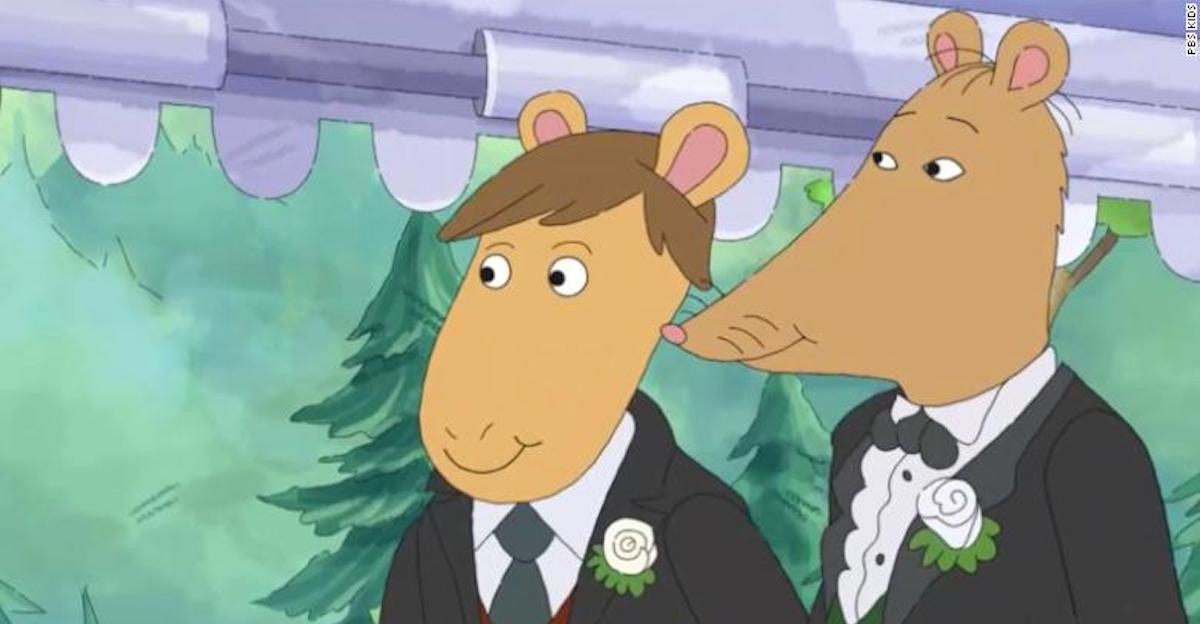
UPDATE: Last week, the world learned that Mr. Ratburn, the shady, big-hearted teacher from "Arthur" was gay. And the world's collective response? "Uh, I didn't even know 'Arthur' was still a thing."

You know what we call that? Progress! Because it's [jubilant swear words bleeped out] awesome that there's more representation on TV and that people are cool with it (although, it's sometimes tiring that you have to celebrate that the high bar of acceptance is "people aren't freaking out about it!") Ā and that the 58 moms who make up "One Million Mom" aren't out here crying and screeching about the sanctity of traditional marriage. (Or, if they are, we just aren't paying attention to them!) (At least I'm not. You shouldn't be either.)


No story is perfect, however, and, today, Alabama, the great state that once attempted to elect an alleged pedophile to power and just signed "the most stringent abortion law in the nation" (it's being fought hard!) is trying to put its foot down on LGBT+ representation, too.

The state's public television channel is refusing to show the episode, referring to it as a "violation of trust" to air the wedding ep — the central messages of which are: 1. Marry whoever you want as long as they're consenting and kind; 2. Just because a rat is gay doesn't mean he's going to be fabulous on the dance floor.

If you're wondering why that's considered and, I quote again, "a violation of public trust," the short answer is that "the vast majority of parents will not have heard about the content," according to Mike McKenzie, the president of Alabama's Public Television.

ā€œParents have trusted Alabama Public Television for more than 50 years to provide children’s programs that entertain, educate and inspire,ā€ read a statement from McKenzie.

ā€œMore importantly — although we strongly encourage parents to watch television with their children and talk about what they have learned afterwards — parents trust that their children can watch APT without their supervision. We also know that children who are younger than the ā€˜target’ audience for 'Arthur' also watch the program.ā€

This is not the first time that Alabama's public television network has pulled an programming featuring gay characters. Ā In 2005, they pulled an episode of "Postcards From Buster" (an "Arthur spin-off), because the show featured a lesbian couple.

Though some may applaud McKenzie's stance, his argument is really weak and also really ignorant (if not outright bigoted). Homosexuality is not an "adult" concept. The same way that heterosexuality isn't. No one's showing the inner working of the straight parents' relationships on a kid's show and it's not going to happen with gay relationships either.

The only thing this "Arthur" is trying to give voice to? That homosexual people exist and they're no different and deserve no less respect than anyone else. That's only adult in that more of us should be on that same page when we grow up. It's certainly not a breach of trust. Kids can learn gay people exist without adult supervision! They learn about straight people existing literally 24/7 and they're totally fine!

Parents are already contacting the network to protest the episode's omission. Misty Souder, an Alabamian substitute teacher and mom told AL.com that she's using this opportunity to teach her daughter about the importance of standing up for marginalized groups.

ā€œThere’s too much going on not to stand up for stuff, even if it’s Arthur," Souder said. "I never thought I’d be going to battle for a gay rat wedding, but here we are.ā€

JUST FYI: The episode is available to watch on-line right here.

This is only the first sentence of my post and you can probably feel that I'm a little annoyed. A little miffed. A little snubbed. I couldn't sleep at all last night. And it's all because Mr. Ratburn from "Arthur" came out as gay, had himself a big old wedding, and didn't invite any of us. (Or even advertise that it was happening.)

On one hand, it's too bad that (due to the lack of aforementioned advertising) I wasn't able to call up my old childhood friends so we could watch the happy sight of two anthropomorphized and consenting rats tying the knot.

On the other it's just as great that pretty much nothing was said about Mr. Ratburn's sexual orientation until he shared the fact that he was getting married (to a dude-rat) with Arthur and Friends during the premiere of the show's 22nd season. Because it's literally not that big a deal! Gay people exist! And some of them are friendly, talking animals who can teach you a thing or two about not skipping school, Francine!

I was thinking of explaining why that's great in just two reasons but I realize that I have a lot to say about a cartoon rat getting hitched, so here's a brief list of reasons why Mr. Ratburn's wedding is great for all of us:

  1. Arthur has always been a show that teaches and challenges kids to be respectful of others and recognize that the world is vast and round and contains a multitude of people all of whom deserve kindness and understanding whether they're straight, gay, or Matt Damon conceptualized as a cartoon aardvark. In that way, Mr. Ratburn's coming out and being accepted is just one more way Ā the cartoon is teaching the kids who watch it regularly that "love is love" and that we all just need to let people live their lives.
  2. This isn't the first time the show has handled what some would view as a "sensitive topic." Aside from broaching the subject of homosexuality in 2005 (Arthur's friend Buster met a lesbian couple to great outrage), the show has navigated a variety of topics that are both difficult and necessary for kids to understand — including cancer, dyslexia, and even what it's like to deal with a tragedy (inspired by the events of 9/11) — in a sensitive way. And while I'd like to say that "some people are gay" shouldn't be a "sensitive topic," it still is. Having kids see a character they trust and love come out without any frills is a nice way for them to learn that there's really not a difference between people (or rats) who have different sexual orientations. They're still the same people you've always loved.
  3. This is exactly the type of nuance those who are always demanding that media add "LGBT+ characters organically" Ā instead of Ā "shoehorning them in" claim they want. While you'll undoubtedly see some criticism from folks who think that this episode was "driving an agenda" and "shoving homosexuality" down kids' throats, the reality is that this is exactly how sexual orientation should be discussed in the media. Mr. Ratburn's character wasn't reduced to just his sexual orientation. It was just something he revealed about himself. And it was no big deal. The kids couldn't care less about the gender of Mr. Ratburn's intended. All they cared about was that he married someone kind. Their biggest worry: That Mr. Ratburn's dance moves are very embarrassing. I wish I had that kind of message when I was coming out in the early '00s. I bet a lot of other people who identify as LGBT+ do, too.

Of course, the biggest surprise for many people isn't that Mr. Ratburn is gay; it's that "Arthur" is still airing new episodes in 2019.

It's also igniting some serious nostalgia vibes.

Today, Mr. Ratburn's marriage is news because he's gay, but the overwhelmingly positive response the episode's gotten shows that we're moving in a new direction. That representation matters. And that more and more LGBT+ characters are becoming people (and rats) rather than just tropes. I just wish they'd invite us all to their weddings.

dance, motherhood, mommy daughter dance, mother daughter relationship, parenting, wholesome
Umi4ika/Youtube

Svetlana Putintseva with her daughter Masha.

In 2005 at only 18 years old, Russian rhythmic gymnast Svetlana Putintseva became a world champion, after which she retired and eventually became a mom. Then, in 2011, Putintseva came out of retirement for one special Gala performance.

Little did anyone know that her then two-year-old daughter named Masha would be the key to making that performance so special.


As the story goes, the young child refused to leave her side that night. But rather than stopping the performance, Putintseva did what so many incredible moms do: she masterfully held space for two different identities.

As we see in the video below, Putintseva simply brought Masha onto the dance floor and incorporated her into the routine—holding and comforting her at times, performing impressive moves while she ran around at others…letting it all become a lively, endearing interaction rather than a rote routine. It became something really touching:

Watch:

Now, a bit of fact-checking as this video has once again started going viral. Despite what many captions say, Putintsevaā€˜s daughter was likely always a planned part of the performance (the tiny leotard is a bit of a giveaway). But that doesn’t really take away from the message behind it: motherhood weaves another soul into one's identity, forever. And one of the biggest lessons it teaches is how to hold someone else steady, all while becoming ourselves.

Every day, moms are engaging in a similar type of ā€œdanceā€: navigating through the world while guiding and nurturing their little ones. It probably doesn't always feel quite as graceful as what Putintseva put out, and, yet, it is just as beautiful.

dance, motherhood, mommy daughter dance, mother daughter relationship, parenting, wholesome A mother hugging her daughter.Photo credit: Canva

Maybe so many thought it was an improvised moment because improvising is a very real parent superpower. That’s certainly the takeaway we get from some of these lovely comments:

ā€œYou cannot control life but you can learn to dance with it. šŸ¤ā€

"This is beyond beautiful. 🄲"

ā€œIf this isn't a metaphor for motherhood. We improvise so much.ā€

ā€œA mother’s unconditional love šŸ„¹ā¤ļø She just made my whole month.ā€

ā€œI do this sometimes while deejaying. My daughter comes up so I hit the slicer and let her chop it up. A few chops and she is happy and goes about her business. šŸ„°ā€

ā€œI can see my daughter doing this to me soon whenever I get up on stage on perform. She already stares long and hard at me whenever I am onnstage singing. She doesn't take her eyes off me. Sure she would be running up to stand with me when she starts walking šŸ˜‚šŸ˜‚ i look forward to it thoā€

ā€œSobbing 😭😭😭😭 As a dancer who hasn’t performed since having a kid, this inspires me in so many ways 🄹🄹 So beautiful and it’s clear that she admires her mom so much šŸ„°ā€

- YouTube www.youtube.com

Though not much is written on Putintseva following this performance, one blog post says that Masha has followed in her footsteps by getting into rhythmic gymnastics. Maybe it all started with this one performance. ā¤ļø

sonder, feelings, life, humanity, human connection, psychology, beauty, mortality, universe

You might experience sonder when you look out a plane window or pass by an apartment building.

In the 1998 film The Truman Show, Jim Carrey's character gradually discovers that his entire life is a lie. The world around him is a television set, and everyone he knows—his friends, family, even his wife—are paid actors. He is the main character, and the entire universe of the show revolves around him.

Though most of us have never genuinely wondered whether we're living in an elaborate production like Truman (well, some have), it can sometimes feel that way. After all, in our own minds, we are the main characters of our own lives. Everyone else becomes a supporting character. When they're "off-screen," we can't say for certain what they're doing, and we tend to think about them only in terms of how their actions might affect us.


That's why the beautiful feeling known as "sonder" can be so profound. It's the strange sensation you get when staring out the window of an airplane, looking at the cars moving along the highway below, and realizing that each dot of light represents a vehicle with a human being inside it—maybe even an entire family. They're all on their way somewhere, perhaps to meet other people who are also living full, rich, complex lives you will never know about. Then, in the blink of an eye, they're gone forever, in a sense.

You might feel this when walking by an apartment building and gazing at the shadows moving behind lit windows, or at an airport, where you wonder where people are going and what their stories might be.

sonder, feelings, life, humanity, human connection, psychology, beauty, mortality, universe There are entire, rich, complex lives happening in those lit windows. Photo by Shalev Cohen on Unsplash

Sonder, explains content creator, software engineer, and writer Felecia Freely, is the sudden "realization that each random passerby is the main character of their own story, living a life just as vivid and complex as your own, while you are just an extra in the background."

Freely explains it beautifully in a now-viral Instagram reel:

"Imagine how big and all-encompassing your experience of your life is. And then imagine that every single person in traffic with you also has that. So does every person in the grocery store. And every person in the world."

It's a breathtaking realization. Of course, we all know this to be true in our minds, but sonder is when that understanding hits you in your body and becomes more than knowledge—it becomes a profound feeling.

Freely's video has received hundreds of thousands of views. Many commenters were surprised to learn there was an actual word for this hyper-specific feeling:

"OMFG THERES A WORD FOR THIS?! i've always wondered."

"I get it in traffic a lot. Just like, where are they all going"

"I get this feeling at the airport"

"Sonder happens when I go for drives down lonely roads in the middle of nowhere where I've never been & see a little house w/ cars & lites on. I wonder what they're like & what's goin on in their lives"

The term was coined around 2012 by writer John Koenig for his project, The Dictionary of Obscure Sorrows.

He writes that it comes from the French word sonder, which means "to plumb the depths." The term began as a neologism, an invented word meant to describe a universal feeling and fill a gap in the English language. But it has since caught on in wider usage and even appears in Merriam-Webster.

Some people describe sonder as a melancholy or even overwhelming feeling—of course, it does have a pretty sorrowful origin. Others, however, have learned to embrace it when it comes.

- YouTube www.youtube.com

Mitchell M. Handelsman writes for Psychology Today that he does not view sonder as a negative emotion. Quite the contrary:

"Sonder becomes even more important as I teach students who are different from me. Most of my students are different on at least some of almost every conceivable dimension—age (this difference grows every year!), gender, ambitions, test performance, grades, place of birth, religion, height, writing ability, intellectual prowess, political beliefs, academic experiences, hair color, sexual preference, family background, etc. Appreciating students' lives as rich, complex, and important may set the stage for greater understanding, relating, and learning."

Appreciating and leaning into feelings of sonder can help us grow our empathy for one another.

One commenter summed it up beautifully: "This used to terrify me but it now soothes me deeply and helps round out my compassion and wonder at the world."

Another said: "Honestly everyone says that this is a depressing reality, but I kinda feel comfort in it. The fact that every person you see all has their own lives means that there is always something good happening in the world, no matter how miserable it seems sometimes."

feel good story, music, rock music, lost and found, musicians
Photo credit: Marcus Pollard on Facebook

Marcus Pollard is reviving a 77-year-old warehouse worker's lost rock music.

In the 1960s, Norman Roth and his band, The Glass Cage, were Canadian indie rockers who played small local shows and built enough of a following to land gigs in bigger cities. When Roth was 18, the band recorded a live performance that was never officially released and was eventually lost after they broke up shortly afterward. Now, thanks to a four-dollar thrift store purchase, the band's music is reaching a wider audience—58 years later.

In 2016, veteran rock music promoter Marcus Pollard bought an unlabeled vinyl record at a thrift store on a whim, despite the album being physically damaged. He fell in love with the six songs recorded on it and spent the next two years trying to track down any band members connected to the record.


"I searched in vain for two years trying to get any clue as to who was on the record, but to no avail," Pollard wrote on Facebook. "Then, in a last ditch effort I posted a clip on the Canadian Artists Records Appreciation FB page and... I got a hit!"

Pollard eventually received a reply that read, "Hey, that's my record!" from Roth, now 77 and working as a warehouse manager. Roth was floored that his band's long-lost recording had resurfaced, and he was able to listen to songs he hadn't heard in more than 50 years.

- YouTube youtube.com

After reuniting Roth with his lost music, Pollard went a step further. After consulting with the other band members, he set out to bring The Glass Cage's music back to life after remaining dormant for generations. Pollard spent the next eight years using his industry connections and expertise to officially release the album. Working with a team of professionals, he refurbished the damaged record, digitally remastered the songs, designed elaborate packaging, and developed a booklet detailing the band's impact on the Vancouver indie rock scene of the 1960s before they broke up.

The finished vinyl album, titled Where Did the Sunshine Go?, is scheduled for release on February 24, 2026.

"I feel like everyone has done something in their life that was dismissed," Pollard told CTV News. "And I wanted them to feel like what they created was actually important."

While Roth and his former bandmates are excited about the album's release, they aren't trying to relive their youth or chase the rock star dreams they once had. They're just happy that others will now have access to their music and are enjoying the ride.

"I'm not looking for accolades or super stardom—that's long gone," Roth told CTV News. "It's just saying to the world, 'I was here.' And I hope they enjoy it."

If you'd like to hear Roth's music, you can stream tracks by The Glass Cage on Bandcamp and purchase the vinyl when it's released.

discussion, debate, disagreement, conversation, communication, curiosity

How do you get someone to open their minds to another perspective?

The diversity of humanity means people won't always see eye to eye, and psychology tells us that people tend to double down when their views are challenged. When people are so deeply entrenched in their own perspectives they're refusing to entertain other viewpoints, what do we do?

Frequently, what we do falls into the "understandable but ineffective" category. When we disagree with someone because their opinion is based on falsehoods or inaccurate information, we may try to pound them with facts and statistics. Unfortunately, research shows that generally doesn't work. We might try to find different ways to explain our stance using logic and reasoning, but that rarely makes a dent, either. So often, we're left wondering how on Earth this person arrived at their perspective, especially if they reject facts and logic.


According to Stanford researchers, turning that wondering into an actual question might be the key.

discussion, debate, disagreement, conversation, communication, curiosity Questions are more effective than facts when it comes to disagreements.Photo credit: Canva

The power of "Tell me more."

Two studies examined how expressing interest in someone's view and asking them to elaborate on why they hold their opinion affected both parties engaged in a debate. They found that asking questions like, "Could you tell me more about that?ā€ and ā€˜ā€˜Why do you think that?" made the other person "view their debate counterpart more positively, behave more open-mindedly, and form more favorable inferences about other proponents of the counterpart’s views." Additionally, adding an expression of interest, such as, ā€˜ā€˜But I was interested in what you’re saying. Can you tell me more about how come you think that?ā€ not only made the counterpart more open to other viewpoints, but the questioner themselves developed more favorable attitudes toward the opposing viewpoint.

In other words, genuinely striving to understand another person's perspective by being curious and asking them to say more about how they came to their conclusions may help bridge seemingly insurmountable divides.

discussion, debate, disagreement, conversation, communication, curiosity Asking people to elaborate leads to more open-mindedness.Photo credit: Canva

Stanford isn't alone in these findings. A series of studies at the University of Haifa also found that high-quality listening helped lower people's prejudices, and that when people perceive a listener to be responsive, they tend to be more open-minded. Additionally, the perception that their attitude is the correct and valid one is reduced.

Why curiosity works

In some sense, these results may seem counterintuitive. We may assume that asking someone to elaborate on what they believe and why they believe it might just further entrench them in their views and opinions. But that's not what the research shows.

Dartmouth cognitive scientist Thalia Wheatley studies the role of curiosity in relationships and has found that being curious can help create consensus where there wasn't any before.

ā€œ[Curiosity] really creates common ground across brains, just by virtue of having the intellectual humility to say, ā€˜OK, I thought it was like this, but what do you think?’ And being willing to change your mind,ā€ she said, according to the John Templeton Foundation.

discussion, debate, disagreement, conversation, communication, curiosity Curiosity can help people get closer to consensus. Photo credit: Canva

Of course, there may be certain opinions and perspectives that are too abhorrent or inhumane to entertain with curious questions, so it's not like "tell me more" is always the solution to an intractable divide. But even those with whom we vehemently disagree or those whose views we find offensive may respond to curiosity with more open-mindedness and willingness to change their view than if we simply argue with them. And isn't that the whole point?

Sometimes what's effective doesn't always line up with our emotional reactions to a disagreement, so engaging with curiosity might take some practice. It may also require us to rethink what formats for public discourse are the most impactful. Is ranting in a TikTok video or a tweet conducive to this shift in how we engage others? Is one-on-one or small group, in-person discussion a better forum for curious engagement? These are important things to consider if our goal is not to merely state our case and make our voice heard but to actually help open people's minds and remain open-minded in our own lives as well.

Learning

Gen Z job seekers are bringing their parents to interviews. A career coach explains the new trend.

77 percent of Gen Z job applicants surveyed admit to bringing a parent to the interview.

Gen Z; Gen Z jobs; job seeking; job hunting; unemployment; Gen Z bringing parents; parents at interviews

A woman being interviewed for a job.

The stress of job hunting crosses generational lines, but Gen Z is doing things a bit differently. Most of Gen Z is either just entering adulthood or has been there for some time. They are the first generation not to grow up with many analog developmental milestones, such as answering a house phone or asking strangers for help reading a map. These are all things that help develop social skills that can be used in other settings.

A recent survey from Resumetemplates.com reveals a shocking trend. According to the resume-building website, of the 1,000 job seekers aged 18-23 surveyed, "77% say they have brought a parent to a job interview when they were job searching. About 13% say they always did, and 24% say they often did."


The idea of bringing a parent to an interview may seem laughably outrageous to older generations, but there are a few things to consider before the giggling sets in. Young adults have long relied on their parents for guidance as they enter the adult world, and this is true of every generation. Parents are often called on for help with locating first apartments, learning how to turn on utilities, figuring out health insurance plans, and more.

Gen Z; Gen Z jobs; job seeking; job hunting; unemployment; Gen Z bringing parents; parents at interviews A business meeting in a modern office setting.Photo credit: Canva

Expecting parents or a trusted adult to help with new life milestones isn't unheard of, but having a parent attend a job interview seems to baffle experts.

Julia Toothacre, chief career strategist at Resumetemplates.com, tells CBS Miami, "I can't imagine that most employers are happy about it. I think that it really shows a lack of maturity in the kids, in the Gen Zers that are doing this." Toothacre added that while some smaller organizations may not see an issue with it, she does not believe it is the norm.

In response to the survey, Bryan Golod, an award-winning job search coach, sees the results differently. Rather than piling on or dunking on a generation still trying to figure out adulthood, he offers a logical explanation for the phenomenon.

In a LinkedIn post, Golod shares:

"The internet is roasting this generation for lacking independence. But here's what everyone's missing: This isn't a Gen Z problem. It's a symptom of a broken system that never taught anyone how interviews actually work. Most professionals (regardless of age) have no idea how to interview effectively. I've worked with 50-year-olds who couldn't land a single offer after 30 interviews. I've coached VPs of HR who could help others but couldn't help themselves. Interview skills aren't taught in school, at work, or by parents. They're learned through trial, error, and usually a lot of rejection. The real issue isn't Gen Z bringing parents to interviews."

The job search coach explains that employers often no longer train managers on how to conduct interviews or what to look for when interviewing candidates. He also notes that many job seekers expect their experience and competence to speak for themselves, but that does not always translate well in an interview setting. Golod encourages people to ask themselves if they know how to predictably turn interviews into job offers before mocking Gen Z adults.

Gen Z; Gen Z jobs; job seeking; job hunting; unemployment; Gen Z bringing parents; parents at interviews A successful meeting with a warm handshake.Photo credit: Canva

"Most don't. And that's not their fault… Nobody taught them. Interview skills are learnable. The professionals landing multiple offers with significant salary increases? They learned the rules of the game," Golod explains.

He adds that what truly matters in interviews is "not your credentials. Not your resume. Not even your qualifications. It's your ability to connect on a personal level and create a memorable experience. People bring you in based on data. They hire you based on emotion."

Maybe some Gen Zers are doing it wrong by traditional standards, but just like riding a bike, unless someone takes the time to teach you, you will never truly learn. Otherwise, you are left with scraped knees and bruises while you try to teach yourself.