
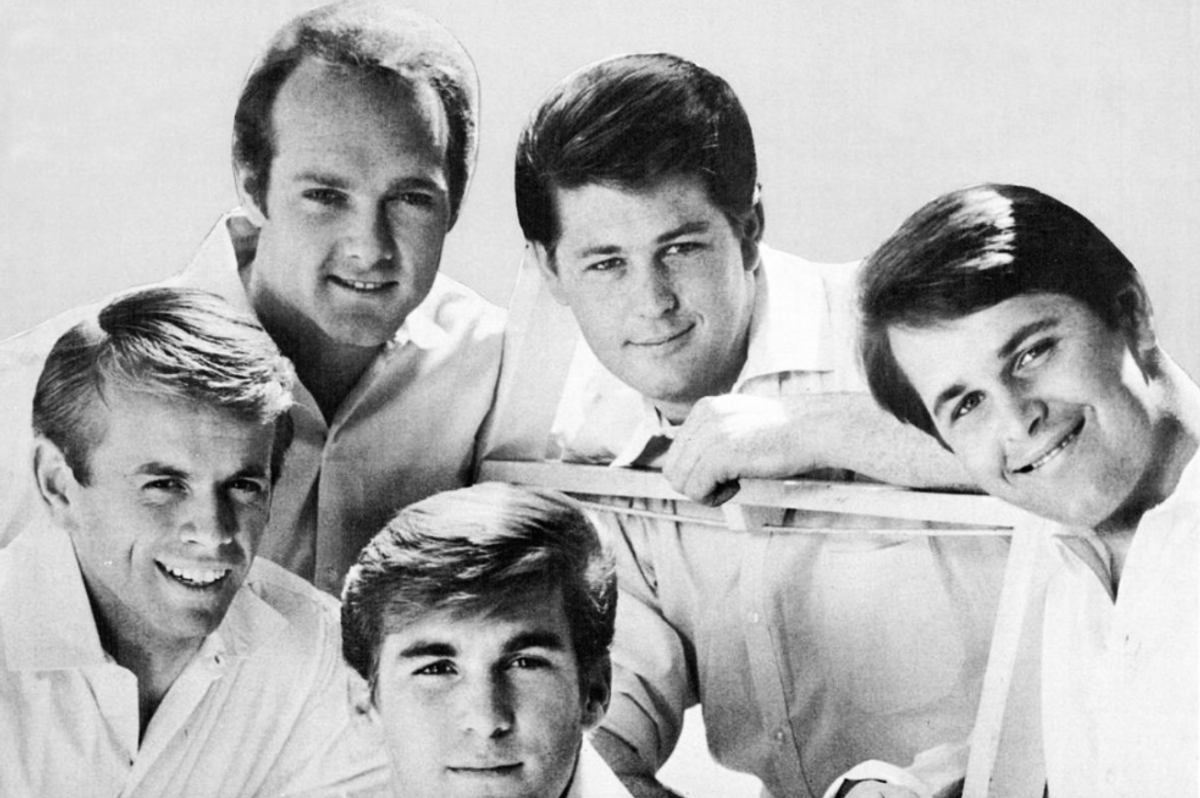
The Beach Boys (1965)
Love songs are where we get our passion, our soul—and most of our worst ideas. Throughout human history, oceans have been crossed, mountains have been scaled, and great families have blossomed—all because of a few simple chords and a melody that inflamed a heart and propelled it on a noble, romantic mission.
On the other hand, that time you told that girl you just started seeing that you would "catch a grenade" for her? You did that because of a love song. And it wasn't exactly a coincidence that she suddenly decided to "lose your number" and move back to Milwaukee to "figure some stuff out."

Love songs are great, but you have to be smart about them.
Photo by Achim Voss/Flickr.
That time you held that boombox over your head outside your ex's house? You did that because of a love song (and let's be honest, a scene in a pretty popular movie). And 50 hours of community service later, you're still not back together.
Love songs are great. They make our hearts beat faster. They inspire us to take risks and put our feelings on the line. And they give us terrible, terrible ideas about how actual, real-life human relationships should work.
They're amazing. So amazing. And also terrible.
Here are six love songs that sound romantic but aren't, and one song that doesn't sound romantic but totally is:
1. "God Only Knows," by The Beach Boys
You can keep your "Surfin' Safari"s, your "I Get Around"s, and your "Help me Rhonda"s.
When it comes to The Beach Boys, "God Only Knows" is where it's at. A lush garden of soft horns and breezy melody. A tie-dye swirl of sound. A landscape of haunted innocence with some of the most heartrending lyrics ever committed to the back of a surfboard.
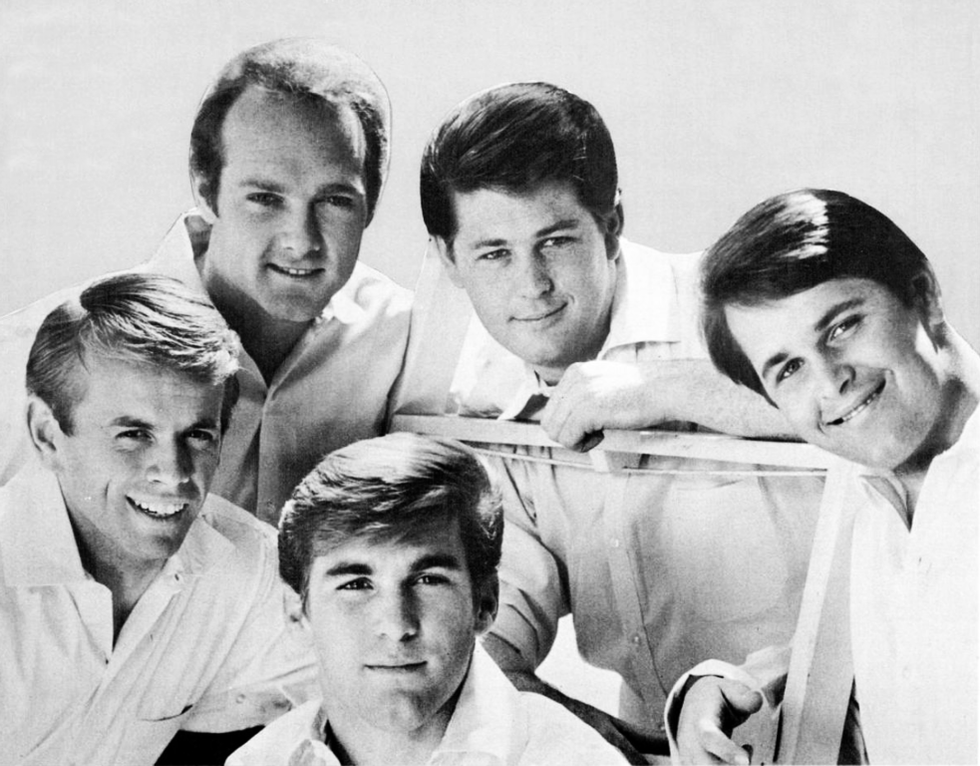
The Beach Boys
Here's why it sounds romantic:
I may not always love you
But long as there are stars above you
You never need to doubt it
I'll make you so sure about it
God only knows what I'd be without you
If you're traipsing through a meadow in a sundress with your beloved and not playing "God Only Knows" on your phone, you should really stop and start over.
If you're lazily bumping a beach ball over a volleyball net and "God Only Knows" isn't playing somewhere in the back of your mind, you need to rethink the choices that got you to this point.
If you're a video editor compiling footage of grainy hippies frolicking in the mud and you're not underscoring it with the opening chords of "God Only Knows," you are doing it wrong.
It's a song that just feels like love. Pure love. Young love. Love with a chill, kelp-y vibe.
What could be wrong with that?
Here's why it's actually really, really unromantic:
There's nothing wrong with loving someone. Sending them flowers. Leaving over-the-top notes in their P.O. boxes. Stroking their hair as they fall asleep while you whisper the complete works of Nicholas Sparks into their ear.

Moody romance vibes.
Photo by Nic Y-C on UnsplashBut there is such a thing as loving someone a skosh too much.
If you should ever leave me
Though life would still go on believe me
The world could show nothing to me
So what good would living do me?
Look, I get it. Breakups suck. There's no getting around that. But good God.
There's a huge difference between saying: "Hey babe, you are my first and foremost everything and I'll be bummed if you go." And saying: "Welp, you accepted that job in Seattle, so I'm just gonna chug a bunch of nightshade and call it a life."
But that's pretty much the gist here. Which makes this line...
God only knows what I'd be without you
...horror-movie creepy. Because the answer, apparently, is: "I'd be a corpse!"
That's not love. That's codependency (to put it mildly). Oh, and hey, threatening to kill yourself if your partner leaves isn't loving. It's a form of emotional abuse.
Investing all your happiness and sense of self-worth in any relationship—one that, by definition, might one day end—is putting a lot of eggs in one basket. Sure, God may only know what you'd be without her, but God probably also hopes you have, I don't know, some hobbies. Take a yoga class. Google some woodworking videos. Try kite surfing. One person cannot be anyone's be-all and end-all. It's too stressful. And it prevents you from doing you, which is a thing that's got to be done before you can do anything else.
No wonder she took that job in Seattle.
2. "Treasure," by Bruno Mars
Sure, it's little too close to sounding like a rip off of every Michael Jackson song (and possibly another song) you've ever heard. But, we don't have Michael Jackson anymore, and as tribute acts go, you could do a lot worse than Bruno Mars.
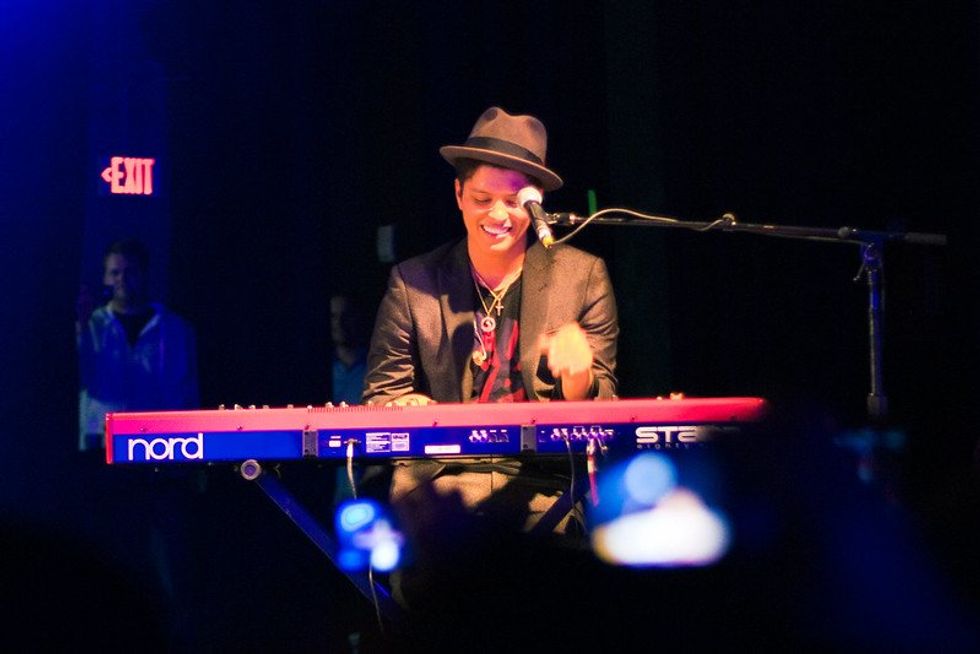
Bruno Mars
Photo by Brothers Le/Flick
Here's why the song sounds romantic:
Treasure, that is what you are
Honey, you're my golden star
You know you can make my wish come true
If you let me treasure you
If you let me treasure you
Pass those lyrics to anyone on a used napkin at an eighth-grade make-out party and you'll likely get an instant toll pass on the highway to tongue-town (ew).
Pass them to your spouse and, chances are, date night is going to culminate in 47 minutes of chaste-yet-passionate frenching.
Pass them to a cop who pulls you over for running a stop sign, and they will think you're weird — but maybe still make out with you?
In fact, Bruno Mars basically has a lifetime pass to make out with America because of this song.
And I'm OK with that.
But, here's why "Treasure" isn't as romantic as it seems:
Everything about "Treasure" is retro. Everything.
Including its attitudes about gender.
Things start to go south right from the very beginning:
Give me your, give me your, give me your attention, baby
I gotta tell you a little something about yourself
Ah yes. Nothing screams "respect" quite like a man lecturing a strange woman on the street about something she "doesn't know about herself."
What could it be? Could it be that her jokes are funny? Could it be that she's got something in her teeth? Could it be that her nonfiction book about early modern German history is extremely detailed and informative?

"Thanks for teaching me all about Martin Luther's bible!"
Photo by Torsten Schleese/Wikimedia Commons.
Spoiler Alert: It's none of those.
You're wonderful, flawless, ooh, you're a sexy lady
But you walk around here like you wanna be someone else
Oh. It's that she's sexy. Cool, bro. Very original.
Word of advice? Regardless of how she's walking, the lady knows she's sexy. Even if she doesn't, it really doesn't affect her day-to-day so much that you, a complete stranger, need to shout it at her (even over a funky disco snare).
So what if she does want to be someone else? I'd love to be someone else! I think being Ryan Gosling would be quite nice. A good way to spend a three-day weekend.
And then later, of course, the narrator can't help himself:
Pretty girl, pretty girl, pretty girl, you should be smiling
A girl like you should never look so blue.
He respects her so much, he's actually straight-up telling her to smile! Much like Mars' character in "Uptown Funk," who appears to get off on angrily exhorting girls to "hit [their] hallelujah." Which, you know, I guess everybody's got a thing.
Yes, in the world of "Treasure," a healthy relationship is an unending stream of a man complimenting a strange woman and said woman being so totally flattered that she immediately dispenses "the sex."
He then proceeds to talk to his potential lover like the world's creepiest pirate:
You are my treasure, you are my treasure
You are my treasure, yeah, you, you, you, you are
You are my treasure, you are my treasure
You are my treasure, yeah, you, you, you, you are
By this point, in his mind, she's a literal thing. An object. Which is fitting.
I suppose it could be worse, though. At least she's not just any thing. That's...something, right?
3. "Don't Think Twice, It's All Right," by Bob Dylan
For as long as humans have been dating each other, humans have been breaking up with each other. And "Don't Think Twice" is a portrait of a relationship going down in flames. Glorious, poetic, acoustic flames.
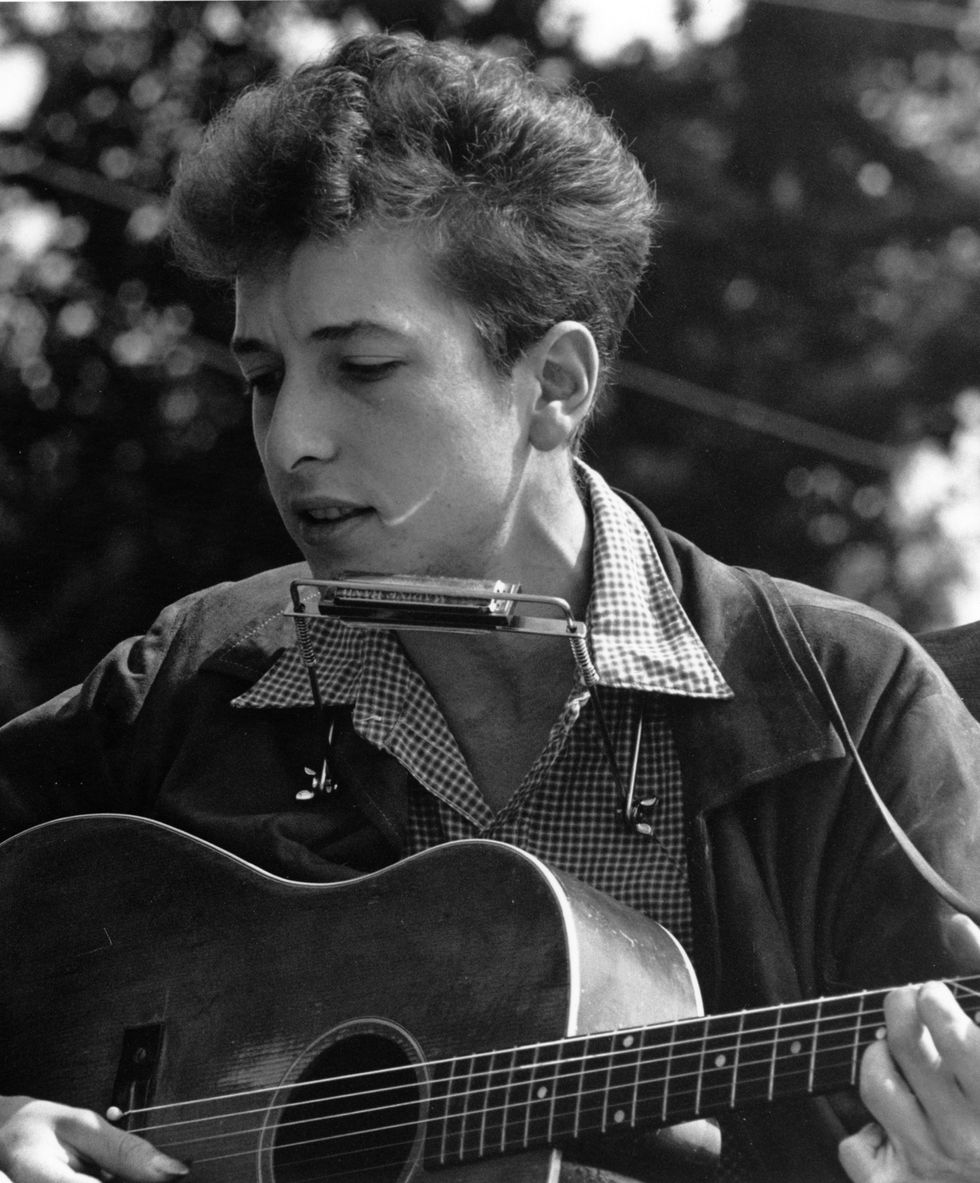
Bob Dylan
Here's why it sounds romantic:
Well, it ain't no use to sit and wonder why, babe
Even you don't know by now
And it ain't no use to sit and wonder why, babe
It'll never do somehow
When your rooster crows at the break of dawn
Look out your window, and I'll be gone
You're the reason I'm a-traveling on
But don't think twice, it's all right.
Boom. Strummed on out of that friends-with-benefits situation like whoa.
"Don't Think Twice" is a raw song. An honest song. A powerful song. It's the song your older sister played on continuous loop for six months after her boyfriend left for college. The song that convinced your Aunt Roslyn to leave her bank-teller job, load her four Australian shepherds into the van, and open a wind chime store in Mendocino. The song your friend's cool dad always wants to play when he invited your high school band over to his apartment to jam.
Sure, it's about the end of a relationship, but it sounds romantic. And at the end of the day, shouldn't that be enough?
Here's why it's actually pretty messed up:
Relationships end. For a lot of reasons. And while there is no right way to call it quits with someone, when the dust settles, both parties can certainly benefit from a difficult, honest discussion about what went wrong.
In "Don't Think Twice," that discussion basically boils down to: "It's your fault."
Let's review the reasons the dude in "Don't Think Twice" is splitting with his lady friend:
I gave her my heart, but she wanted my soul
Ugh, women, right? You're all like, "Babe, I just have so much unspecified love to give," and she's like, "Take out the trash!" And you're like, "But baaaaaaabe, shouldn't my heart be enough?" And she's like, "No, seriously. I already did the laundry, cleaned the whole house, fed the dog, did the dishes, and made both of our lunches for the week. All I need you to do is take out the trash." And you're like, "You're bumming me out. I'm gonna go play guitar." And then she gets all mad! What did you do? Why is she trying to change you? UGH!
You could have done better, but I don't mind
Seems like you do mind since you wrote a whole song about it, no?
You just kinda wasted my precious time
Ah yes. Your time is so precious! Think about all the hours you wasted plumbing the ocean-deep, ecstatic mysteries of human partnership when you could have been futzing around with that home-brew kit.

The home-brew kit in question.
Photo by Bill Bradford/Flickr.
The minute you start breaking it down, the message of "Don't Think Twice" suddenly starts to seem a lot less romantic. Like your sister's ex-boyfriend who worked at the Bass Pro Shop in town for a while and now might be in jail. Like your aunt's wind chime store, which would have closed forever ago had she not received that inheritance from her mom in the '80s. Like your friend's cool dad, who wasn't exactly, technically, paying child support.
Oh yeah, and the song's narrator also point-blank refers woman he's leaving as:
A child, I'm told
So, in addition to being a run-of-the-mill passive-aggressive jerk—turns out, he's also possibly a pedophile.
Even if we are to accept that this is a metaphor and she's not actually a child—which there's no indication it is, but OK, Bob Dylan—the fact that he would willingly choose an immature partner reflects way more poorly on him than it does on her.
Breaking up with anyone in such a cruel, dismissive way is a recipe for sticking them with years of therapy bills.
Which, I suppose, may be the point.
4. "Leaving on a Jet Plane," by John Denver
Who has two thumbs and wrote a bittersweet folk song about hurtling through the stratosphere in a giant aluminum tube at 600 miles per hour?

John Denver
Photo by Hughes Television Network/Wikimedia Commons.
Here's why it sounds romantic:
"Leaving on a Jet Plane" is a lovely song. And impressive in its loveliness because jet planes were still kind of new at the time it was written.
'Cause I'm leavin' on a jet plane
To a modern ear, this would be sort of like singing, "I'm a scoooting away on my hoverboooooard," but in a way that's somehow still folksy and heartbreaking and singable by 9-year-olds at summer camp. Not easy to do!
Oh babe, I hate to go
You see, he hates to go! He just hates it! We know this, because he tells us he hates it. And why would he hate to go if he didn't love his partner just that much?

The jet plane he left on.
Photo by Altair78/Wikimedia Commons.
Why indeed?
Here's why it's actually not that romantic at all:
All the plaintive guitar, loping bass line, and twangy, melancholy warbling in the world can only distract so much from the fact that the song's main character is well, kind of a jerk.
And in reality (surprise surprise!) it doesn't actually seem like he hates being away all that much:
There's so many times I've let you down
So many times I've played around
I tell you now, they don't mean a thing
"Babe, I promise! All the movies I watched alone while you were home nursing the quadruplets. All the times I drained our life savings on pointless purchases. All the random sex I had with other women. Totally meaningless. Certainly fun to do! Really fun. Like, I had a fantastic time. But rest assured—completely empty, in an ontological sense."
Yes, when you break it down, "Leaving on a Jet Plane," is less of a passionate tribute to love overcoming distance and more the deluded ramblings of a guy who needs to convince himself he's "good" despite all evidence to the contrary.
And for all he claims to be broken up about having to part from his one and only, the dude seems pretty excited about the flight.
He continues:
Ev'ry place I go, I'll think of you
Ev'ry song I sing, I'll sing for you
Ah cool. He'll think about her while strumming and making "my love is delicate as the morning dew" eyes at a waif-y grad student in the front row. That pretty much makes up for it all.
Then he demands:
So kiss me and smile for me
Tell me that you'll wait for me
After all the betrayal and heartbreak, after basically revealing himself to be a grade-A sleaze who can't be trusted, he still has the gall to tell her to wait for him?
And here's the kicker:
When I come back, I'll bring your wedding ring
Ah yes. He'll put a ring on it. Finally.
Unlike all the previous trips, where he's cheated a billion times, drained the family bank account, and just been a general screwup and disappointment.
But yeah. This time he says he'll bring back a wedding ring.
5. "When a Man Loves a Woman," Percy Sledge
When you look up "soul" in the dictionary, the book plays you a recording of this song.
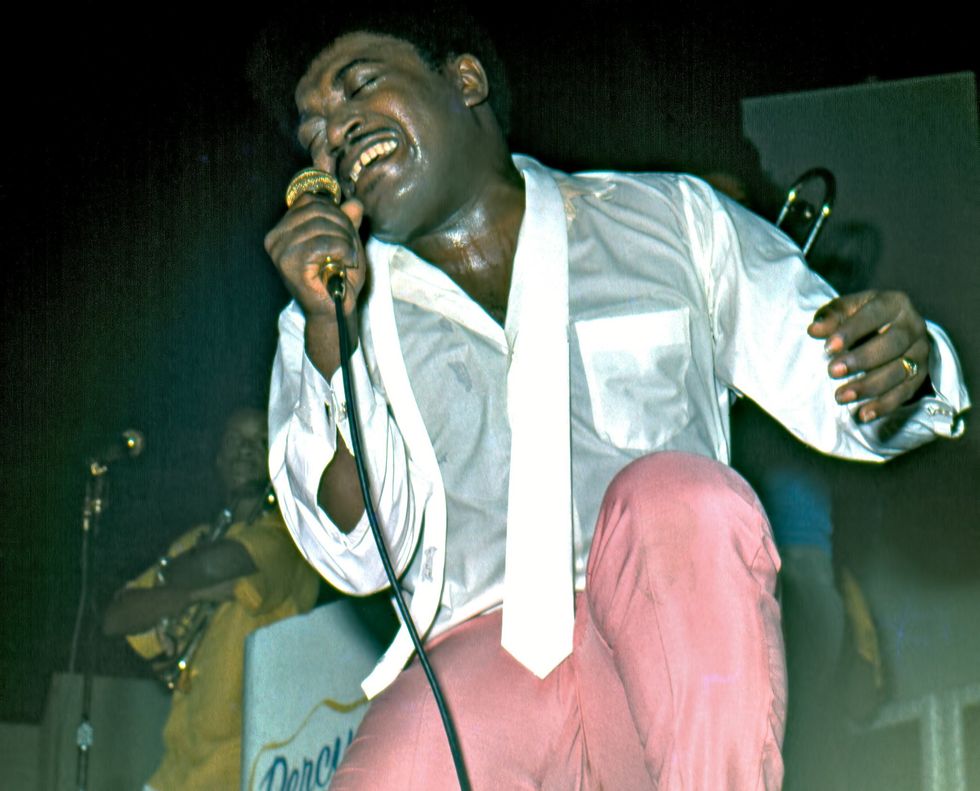
Percy Sledge
Photo by Gene Pugh/Flickr.
Specifically, it plays you the very first line.
Here's why it sound very romantic:
When a man loves a woman
Sure, you can write the lyrics down, but it doesn't even come close to capturing the heartache. The yearning. The delicious, delicious pain-belting:
WHEN A MAN LOVES A WOMAN
Closer...but still no.
WHEN A MAAAAAAAN. LOVES A WOOOMAN!
Yes! Sing it, Percy Sledge!
It's an elemental lyric.
It's a heart-shattering lyric.
It's a lyric that demands you put your back into it.
It's perfection.
As long as you don't keep listening.
Here's why the song is actually pretty horrifying:
From the opening lines of "When a Man Loves a Woman," we know that, at least on occasion, a man loves a woman.
Which raises the question: What happens when said man loves said woman?
He'd give up all his comforts
And sleep out in the rain
If she said that's the way
It ought to be.
Whoa! OK. No. Back up. A man, no matter how devoted, no matter how selfless, no matter how in love, needs shelter. Otherwise, a man will die of exposure and hypothermia.
Turn his back on his best friend if he put her down.
No! Jeez. No. A man can't put up with that kind of isolating behavior. A man needs friends! Once a man's whole support system erodes out from under him, a man will be bitter, ungrounded, and alone. And a man's mental health will deteriorate.
I gave you everything I have
Tryin' to hold on to your heartless love
Baby, please don't treat me bad.
This is not what happens "when a man loves a woman." It's what happens when a man loves a controlling, manipulative woman. An abusive woman. A woman who, in truth, only loves a woman. Herself.

A cosmic connection shouldn't bring harm, friends.
Image by Gerd Altmann from Pixabay
And that's not healthy.
Run, Percy Sledge, run! We're here for you.
(Side note: Lest it go unsaid, there is way more than one way for a man to love a woman. Maybe they spend every waking moment cuddling and booping each other on the nose. Maybe they sleep in separate bedrooms. Maybe they dress up in large, plush cat costumes and refer to each other Mr. and Mrs. Kittyhawk. And when a man loves a man, I imagine it feels much the same. Or when a woman loves a woman. Or when a gender nonconforming person loves a gender nonconforming person.)
Regardless of the depth of commitment, living situation, or combination of genders or sexual orientations, there's no one-size-fits-all love solution. Every relationship is a unique snowflake. Variety is the spice of life. Necessity is the mother of invention. There's more than one way to skin a cat. A spoonful of sugar helps the medicine go down. It doesn't matter if it's the right metaphor, as long as it's a metaphor.
Point being: Generalize at your peril, Sledge. And please, seek help! You can do this! And if you ever find yourself in a similar situation, please give these people a call.

A spoonful of sugar.
Photo by Rosmarie Voegtli/Flickr.
6. "All I Wanna Do is Make Love to You," Heart
This song is perfect. You should always be listening to it. If you're not listening to it now, smack yourself in the face and Google it. It's just that important.
I am singing the phone book. You are weeping like a tiny baby. Photo by

Nancy and Ann Wilson playing at a charity concert
So much passion. So much pain. So much hair.
Here's why it sounds romantic:
Over pounding drums and a soaring melody, Heart sisters Nancy and Ann Wilson deliver a primal tribute to the one true romantic fantasy shared by every living being on Earth: picking up an unnervingly attractive man for one night of mind-blowing sex and then releasing him back into the wild to bone—but never quite as compellingly ever again.
They sing:
It was a rainy night when he came into sight
Standing by the road, no umbrella, no coat
So I pulled up alongside and I offered him a ride
He accepted with a smile so we drove for a while
I don't have to go on because you know what happens next, and it's awesome.
Now, here's why this song is not romantic at all:
The relationship in "All I Wanna Do" seems too good to be true. And it is. Because it's not an equally loving ,or even equally lusty, pairing at all.
It's a...
Well. You know what it is:
For a while, things are humming along just fine, like any wholesome, illicit, anonymous affair should:
I didn't ask him his name, this lonely boy in the rain
Fate, tell me it's right, is this love at first sight?
Sure, many of us might hesitate to pick up a strange leather-jacket-clad man standing on the side of the road for a no-strings-attached screw, but our narrator just has a feeling about this guy, and sometimes, you gotta go with your gut.
I can respect that.
We made magic that night
He did everything right
Great! Seems like it was a good decision.
But then, without warning, the song starts to sound less like an all-time great romance and more like a story men's rights activists tell each other as they vape around a campfire:
I told him "I am the flower, you are the seed
We walked in the garden, we planted a tree
Don't try to find me, please don't you dare
Just live in my memory, you'll always be there"
I'm not a poet. Symbolic language often eludes me. But unless "flower," "seed," "garden," and "tree," suddenly mean wildly different things in the context of human reproduction than they have since sex was first invented in the early-1970s, we're talking about a surprise, non-mutually-consensual pregnancy!

HELLO!
Photo by Avsar Aras/Wikimedia Commons
Of course, metaphors are opaque, interpretations vary, etc., etc., etc. You might be tempted to think, "Maybe Heart meant something else by that."
To that I say, no, they definitely meant it:
Then it happened one day
We came round the same way
You can imagine his surprise
When he saw his own eyes
There are two possibilities here.
One: The narrator of the song is recently-deceased Jerry Orbach from this creepy New York City subway ad from nine years ago:

This was unsettling.
Photo by eyedonation.org
Or two: She totally conned a dude into whipping up a baby on the sly.
I said, "Please, please understand
Ah, sure. Yeah. No worries.
I'm in love with another man
Cool, so this all makes sense and is in no way the nightmarish scheme of a deranged sociopath who has now wrecked not one but two lives.
And what he couldn't give me, oh, no
Was the one little thing that you can"
Wow...
The best you can say about that is that it's not technically illegal, and that leather-jacket man probably should have been responsible for his own birth control. Or, at the very least, asked more questions .
But...it's not cute and it's not romantic.
And at the end of the day, the shadiest character in this song is somehow not the rain-soaked hitchhiker wandering to nowhere in the night.
Which is saying something.
But there is a love song that is truly, madly, deeply perfect. An unassailable track in a sea of problematic faves.
It's a song that does everything right. A song that paints a portrait of a healthy partnership built to last.
A song that can double as a manual for the ideal human romantic relationship.
And that song is...
"Candy Shop," by 50 Cent, featuring Olivia
Here's why you might be—OK, almost definitely are — skeptical:
As catchy as "Candy Shop" is, as fun it is to dance to, and as cathartic as it can be to scream in the middle of a crowded fraternity house at 2 a.m., there's no getting around the fact that the song begins like this:
I'll take you to the candy shop
I'll let you lick the lollipop
I'll post that again, in case you missed some of the nuance:
I'll take you to the candy shop
I'll let you lick the lollipop
Way to take one for the team, narrator of "Candy Shop"!
At first glance, "Candy Shop" is nobody's idea of a classic love song.
The lyrics are...unusually forward. The beat is kind of basic. The hook is like the music they play when Abu Nazir sidles scarily by in Homeland.
It doesn't get played much anymore. When it does resurface, it feels kind of dated. Like watching that DVD of Harry Potter and the Goblet of Fire on your new Xbox 360.
It's not a song you'd put on a mixtape for your crush. It's not a song you'd play for your spouse when the kids are at home with the babysitter and you've got nine hours to tear up the Piscataway Hampton Inn. It's certainly not a song you'd include on the video photo montage you made for your grandparents' silver anniversary.
It's just not.
But it should be.
So here it is. Here's why "Candy Shop" by 50 Cent, featuring Olivia, is actually the perfect relationship song:
The bass drum hits. The MIDI violins whine. The singer starts filling out his fellatio permission slip. It's only been 20 seconds, and you're already getting ready to hang it up with "Candy Shop."
But then...over the square thrum and the mewling strings, a miracle occurs—in the form of a female voice joining the track, cutting through the din like a clarion call.
She sings:
I'll take you to the candy shop (yeah)
Boy, one taste of what I got (uh-huh)
I'll have you spendin' all you got (come on)
Keep going 'til you hit the spot, whoa
It's mutual! It's mutual! They're pleasuring each other!
Ring the bells! Bang the drums! Release the doves!

The doves have been released!
Photo by liz west/Flickr
50 Cent himself may not be the world's greatest partner—for example, according to one of his exes, he's done some pretty unforgivable things.
But the narrator of "Candy Shop"? He gets it:
You could have it your way, how do you want it?
Rather than simply imposing his desires on the person he's with—a la the dude in "God Only Knows ("I'm going to invest my entire sense of self-worth in you!") or the street heckler in "Treasure" ("I'm going to treat you like a chest full of gold doubloons!") or the sociopath in "All I Wanna Do is Make Love to You," ("I'm going to trick you into knocking me up!")—the "Candy Shop" guy actually asks his partner what she wants.
Which, in the world of popular music, is good for about 50,000 trillion points.
And where are they going to do it? The hotel? Back of the rental? The beach? The park?
It's whatever you're into
'Cause consent is sexy!
I ain't finished teaching you 'bout how sprung I got ya
The narrator of "Candy Shop" is certainly assertive about his desires.
But here's the key thing: the lady on the receiving end of those desires? She's clearly into it. And we know this because she says so.
The lines of consent in "Candy Shop" are bright red, highlighted, and soldered into the weirdly sticky club floor.

The club I mentioned earlier
Meanwhile, Robin Thicke is outside trying to convince the bouncer that his uncle is a lawyer.
Girl what we do ...
And where we do ...
The things we do ...
Are just between me and you
No matter how nasty they freak, it will be intimate. It will be private.
If you be a nympho, I'll be a nympho
Sexual compatibility is key to the survival of any relationship, whether years, weeks, or (very possibly in the case of "Candy Shop") minutes long.
She may have a high sex drive, but dude is graciously offering to accommodate her. What a gentleman! These crazy kids just might go the distance after all.
And at the end of the day, what is a relationship but two nymphos, sharing health insurance?
It's like it's a race who could get undressed quicker
Again, everybody is having a great time. And, critically, an equally great time.
I touch the right spot at the right time
Of course, it wouldn't be a pop/hip-hop hit without a spot of random braggadocio, but if we're to take him at his word, "Candy Shop" guy is at least as good at "doing everything right" as the anonymous hitchhiker from "All I Wanna Do is Make Love to You"—except without all the creepy surprise baby nonsense.
The "Candy Shop" guy is a keeper. Because he's not a hero or a stranger in the night or a funky, shimmering love god. He's a good partner.
"Candy Shop" is raunchy. It's dirty. It's not your grandmother's love song.
But when you strip away the swagger, the back beat, and the weird strings from "Best of Public Domain Middle Eastern Music 1993," by the end of the song, both people are satisfied. And at the end of the day, isn't that what a healthy relationship is all about?
Yeah.
This article originally appeared three years ago.
- Doctors say this song is the most relaxing - Upworthy ›
- Beautiful cover of The Beach Boys God Only Knows - Upworthy ›
- Woman surprises husband with custom love song - Upworthy ›
- Thai lounge singer sounds like Louis Armstrong - Upworthy ›
- It "broke me." - Upworthy ›
- American woman has to change her name in Australia - Upworthy ›
- Woman has fool-proof response to the question, ‘Can I buy you a drink?’ - Upworthy ›
- Have we been singing 'Kumbaya' wrong this whole time? - Upworthy ›
- Chicago man saves person electrocuted by third rail - Upworthy ›
- Man breaks down the hilarious red flags in 50 Cent's '21 Questions - Upworthy ›
- Guy's brutally honest breakup text goes viral and reminds everyone that 'ghosting' isn't cool - Upworthy ›
- Comedy rock band use 38 songs to prove how 'every pop song' uses the same four chords - Upworthy ›

 A Generation Jones teenager poses in her room.Image via Wikmedia Commons
 A Target store at night.via
  An aisle at a Target.via

 Which map app is best?
 We've become pretty finicky about our map apps in the modern age.