

Professional artists re-created children's monster doodles. They're hideously cool.
Artist and designer Katie Johnson has a thing for monsters.
Not those of the morbid variety, but the cutesy, kid-friendly kind.
GIF from "Monsters, Inc."
She's always loved the wide-open creative process of dreaming up a new monster and putting it on paper. "It's a fun creative dump," she said. "You can make a monster out of anything. So when I was younger, that was my go-to when I felt like drawing."
Katie Johnson (right) ponders her next monster. Photo used with permission.
Little did she know, monsters would come to dominate her free time as a young adult, too. After college, Johnson started working as a designer with an advertising firm in Austin, Texas. But as a creative at heart, she also wanted to pursue her own projects.
An idea came to her after seeing a photo series called "Wonderland" by artist Yeondoo Jung, who re-created children's drawings as staged, dream-like photographs.
Johnson combined her love of monsters with Jung's idea of building on children's creativity to launch The Monster Project.
Through The Monster Project, Johnson invites elementary students to draw their own monsters. Then professional artists bring their monsters to life.
Getting started wasn't easy because she was the only artist on call. "I did 20 drawings by myself," Johnson said. "It was way too much."
She also wasn't meeting one of her most important objectives: "It was missing multiple artistic perspectives. I wanted the kids to see different ways to be creative."
Image from The Monster Project/Greatest Common Factory/Vimeo.
So Johnson grew a small army of artists to help students discover their own inner artists and see the potential of their ideas. And though they're all volunteers, they definitely get something out of it.
"We have to admit, this isn't just for the kids," says their website. "What a refreshing opportunity it is to be offered a glimpse into someone else's head — especially the fantastically bizarre, unobstructed thoughts of a child. It’s an amazing opportunity."
Here's a sampling from the project's more than 100 re-created drawings:
Re-created by Gianluca Maruotti.
Re-created by Marija Tiurina.
Re-created by Muti.
Re-created by Milan Vasek.
Re-created by Marie Bergeron.
Re-created by JeanPierre Le Roux.
Re-created by Jake Armstrong.
Re-created by Jenya Tkach.
Re-created by Muti.
Re-created by Cream.
Re-created by Charles Santoso.
Re-created by Teodoru Badiu.
Re-created by Eric Orange.
Re-created by Aaron Zenz.
Re-created by Patrick Evrard.
Re-created by Yema Yema.
Re-created by AJ Jefferies.
The project isn't just about drawing monsters. It's about painting a picture of how vital arts are to a good education.
The website explains: "With a decreasing emphasis on arts in schools, many children don’t have the opportunity for creative exploration they deserve. That’s a monstrous trend we would like to destroy."
Image from The Monster Project/Greatest Common Factory/Vimeo.
The National Federation of State High School Associations notes that when state budget cuts are imposed on public K-12 education, "fine arts programs are often an easy victim," especially at the elementary level, when exposure to arts can have the greatest impact on students. That seems pretty counterintuitive when you look at the research.
Image from the President's Committee on the Arts and the Humanities.
A 2011 report by a committee appointed by President Obama explained that a high-quality arts education can enhance a child's performance across subject areas, boost their self-confidence and motivate them to take on greater intellectual challenges, and even help them develop other important competencies in problem-solving, critical and creative thinking, and teamwork.
Johnson wants to make sure it's not just the well-funded schools that have access to her program.
That's why they're working to make The Monster Project a sustainable organization that won't be a cost burden to families or schools, which is especially important since they're targeting schools in lower-income areas that have had to eliminate arts programs to preserve those subjects on standardized tests, like math and science.
In order to fund the project, they're accepting donations and opening an online store, where they'll sell prints and the soon-to-come Monster Project children's activity book. They hope to raise enough money to expand to more schools and launch after-school arts workshops in communities that really need them.
Monsters. Who'd have thought they could be such a force for good?
Watch an introduction The Monster Project:



 A woman is getting angry at her coworker.via
  A man with tape over his mouth.via
  A husband is angry with his wife. via
 a man sitting at a desk with his head on his arms Photo by
  Can a warm cup of tea help you sleep better? If you believe it, then yes. Photo by
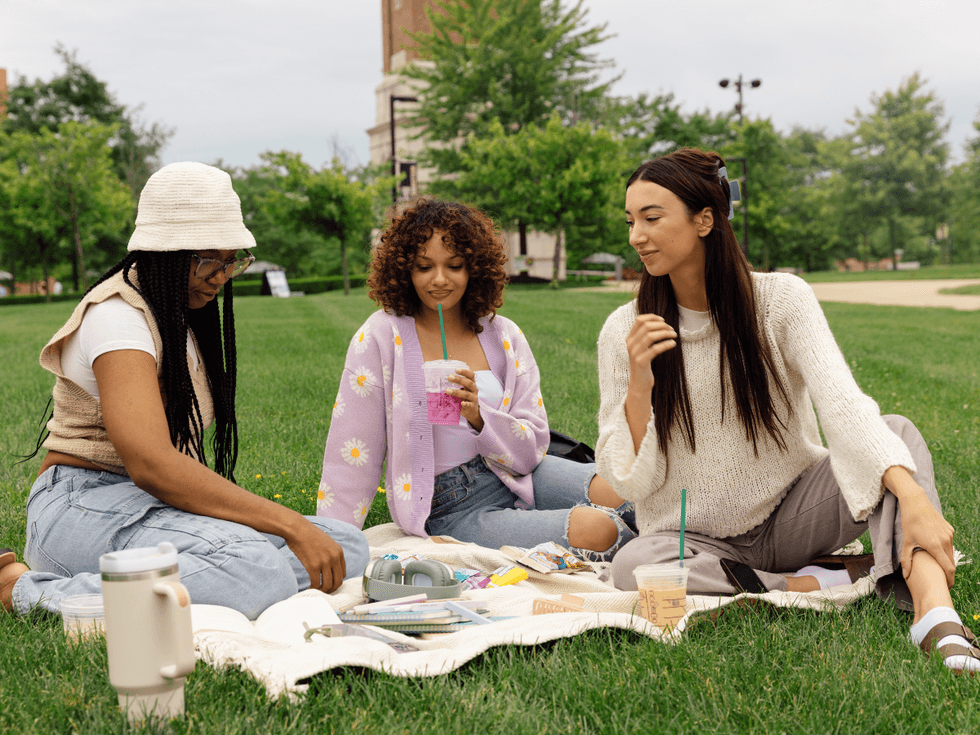 Three women sit on a blanket in the park.
 Two women engaging in a pleasant conversation inside a coffee shop
 Two men engaging in a peaceful disagreement.
Resurfaced video of French skier's groin incident has people giving the announcer a gold medal
"The boys took a beating on that one."
Downhill skiing is a sport rife with injuries, but not usually this kind.
A good commentator can make all the difference when watching sports, even when an event goes smoothly. But it's when something goes wrong that great announcers rise to the top. There's no better example of a great announcer in a surprise moment than when French skier Yannick Bertrand took a gate to the groin in a 2007 super-G race.
Competitive skiers fly down runs at incredible speeds, often exceeding 60 mph. Hitting something hard at that speed would definitely hurt, but hitting something hard with a particularly sensitive part of your body would be excruciating. So when Bertrand slammed right into a gate family-jewels-first, his high-pitched scream was unsurprising. What was surprising was the perfect commentary that immediately followed.
This is a clip you really just have to see and hear to fully appreciate:
- YouTube youtu.be
It's unclear who the announcer is, even after multiple Google inquiries, which is unfortunate because that gentleman deserves a medal. The commentary gets better with each repeated viewing, with highlights like:
"The gate the groin for Yannick Bertrand, and you could hear it. And if you're a man, you could feel it."
"Oh, the Frenchman. Oh-ho, monsieurrrrrr."
"The boys took a beating on that one."
"That guy needs a hug."
"Those are the moments that change your life if you're a man, I tell you what."
"When you crash through a gate, when you do it at high rate of speed, it's gonna hurt and it's going to leave a mark in most cases. And in this particular case, not the area where you want to leave a mark."
Imagine watching a man take a hit to the privates at 60 mph and having to make impromptu commentary straddling the line between professionalism and acknowledging the universal reality of what just happened. There are certain things you can't say on network television that you might feel compelled to say. There's a visceral element to this scenario that could easily be taken too far in the commentary, and the inherent humor element could be seen as insensitive and offensive if not handled just right.
The announcer nailed it. 10/10. No notes.
The clip frequently resurfaces during the Winter Olympic Games, though the incident didn't happen during an Olympic event. Yannick Bertrand was competing at the FIS World Cup super-G race in Kvitfjell, Norway in 2007, when the unfortunate accident occurred. Bertrand had competed at the Turin Olympics the year before, however, coming in 24th in the downhill and super-G events.
As painful as the gate to the groin clearly as, Bertrand did not appear to suffer any damage that kept him from the sport. In fact, he continued competing in international downhill and super-G races until 2014.
According to a 2018 study, Alpine skiing is a notoriously dangerous sport with a reported injury rate of 36.7 per 100 World Cup athletes per season. Of course, it's the knees and not the coin purse that are the most common casualty of ski racing, which we saw clearly in U.S. skier Lindsey Vonn's harrowing experiences at the 2026 Olympics. Vonn was competing with a torn ACL and ended up being helicoptered off of the mountain after an ugly crash that did additional damage to her legs, requiring multiple surgeries (though what caused the crash was reportedly unrelated to her ACL tear). Still, she says she has no regrets.
As Bertrand's return to the slopes shows, the risk of injury doesn't stop those who live for the thrill of victory, even when the agony of defeat hits them right in the rocks.