

A 'Parks and Recreation' star's blunt description of how race works in Hollywood.
Last weekend, "Parks and Recreation" star Aziz Ansari went off the typical press junket script to tackle one of Hollywood's biggest taboos: race.
Photo by Monica Schipper/Getty Images.
In a Q&A session to promote his new show "Master of None," the actor and comedian used the opportunity to speak out against racial quotas on TV...
...as reported by Samuel Anderson in Vulture:
"When they cast these shows, they're like, 'We already have our minority guy or our minority girl.' There would never be two Indian people in one show. With Asian people, there can be one, but there can't be two. Black people, there can be two, but there can't be three because then it becomes a black show. Gay people, there can be two; women, there can be two; but Asian people, Indian people, there can be one but there can't be two."
There's lots more in the interview, including thoughts about white actors playing South Asian characters in "brownface," television's history of offering one-dimensional, stereotypical roles to Indian-American actors, and why "Empire" doesn't mean racism is a thing of the past.
You should go read the whole thing.
Ansari isn't the first to speak out about Hollywood's race problem.
Photo by Mark Davis/Getty Images
TV mega-producer Shonda Rhimes, "Fresh Off the Boat" creator Eddie Huang, "Selma" star David Oyelowo, and many others have recently called out the TV and film industry for selling actors of color short and promoting stereotypes on screen.
The numbers back them up.
A 2014 analysis by the Ralph J. Bunche Center for African American Studies at UCLA found that, in 2011, non-white actors were underrepresented on film by a factor of 3:1 when adjusted for their share of the population. The same analysis also found that more than 50% of films that year featured casts that were less than 10% non-white.
Why does it matter?
Representation matters, and it matters from a very early age. When characters of color are either not represented at all or portrayed as sidekicks, buffoons, and assorted other one-dimensional stereotypes, kids internalize those stereotypes — and the notions that "That's how the world I live in sees me" or "I don't count."
It's hard to overstate the value of seeing someone who looks like you realized as a full human being on-screen. And right now, for people of color in America, that's not happening nearly enough.
What can be done?
Photo by Frederick M. Brown/Getty Images.
Thankfully, the landscape is changing — thanks in large part to shows like Ansari's, "The Mindy Project," "Fresh Off The Boat," and "Empire," which feature characters of color who are front and center rather than tokens in the background, and three-dimensional people rather than stereotypes.
Giving creators who are people of color a chance to make entertainment is the quickest way to make the industry more inclusive. Hopefully, the success of those shows will help convince Hollywood that doing so can be a winning bet.
As for shows that aren't built from the ground up by people of color...
Inclusion should be the goal, not a byproduct of the process.
Photo by Jason Merritt/Getty Images.
Earlier this month, in an interview with NPR, Lorne Michaels was discussing diversity on "Saturday Night Live" when he said something extremely revealing:
"Chris Rock called me about Leslie [Jones] ... said, 'She's the funniest person, or one of the funniest people I know, and she's either going to end up working for you or working for AT&T, so.' And Leslie was 46 and was not in any way what I was looking for, but when I saw her and she just destroyed — and she's, aside from being incredibly funny, she's a wonderful person, and lovely — and you go, 'Right, OK, you join.'"
Here's the thing. It's not like no one knew about Leslie Jones.
Photo by Larry Busacca/Getty Images.
Lots of people knew about her, in fact. She had been doing stand-up since 1987. She toured with Katt Williams. She was good enough that Chris freaking Rock knew about her.
But Michaels didn't.
He didn't know about her because he scouts talent from a few well-worn comedy establishment theaters — many of which predominately attract white (and male) performers. If Chris Rock hadn't gotten in his face about it, Michaels never would have known. And crucially, "Saturday Night Live" would have been not just less diverse, but more importantly, less funny as a result.
For Lorne Michaels, the moral of the story seems to be that talent is talent no matter where it comes from. And that's true! But that's not the real lesson here.
The actual moral of the story?
Look harder. There's lots of talent out there. It just might not be in the places you always look.
And if you don't snatch them up, they might just leave you behind.
Photo by Frederick M. Brown/Getty Images.
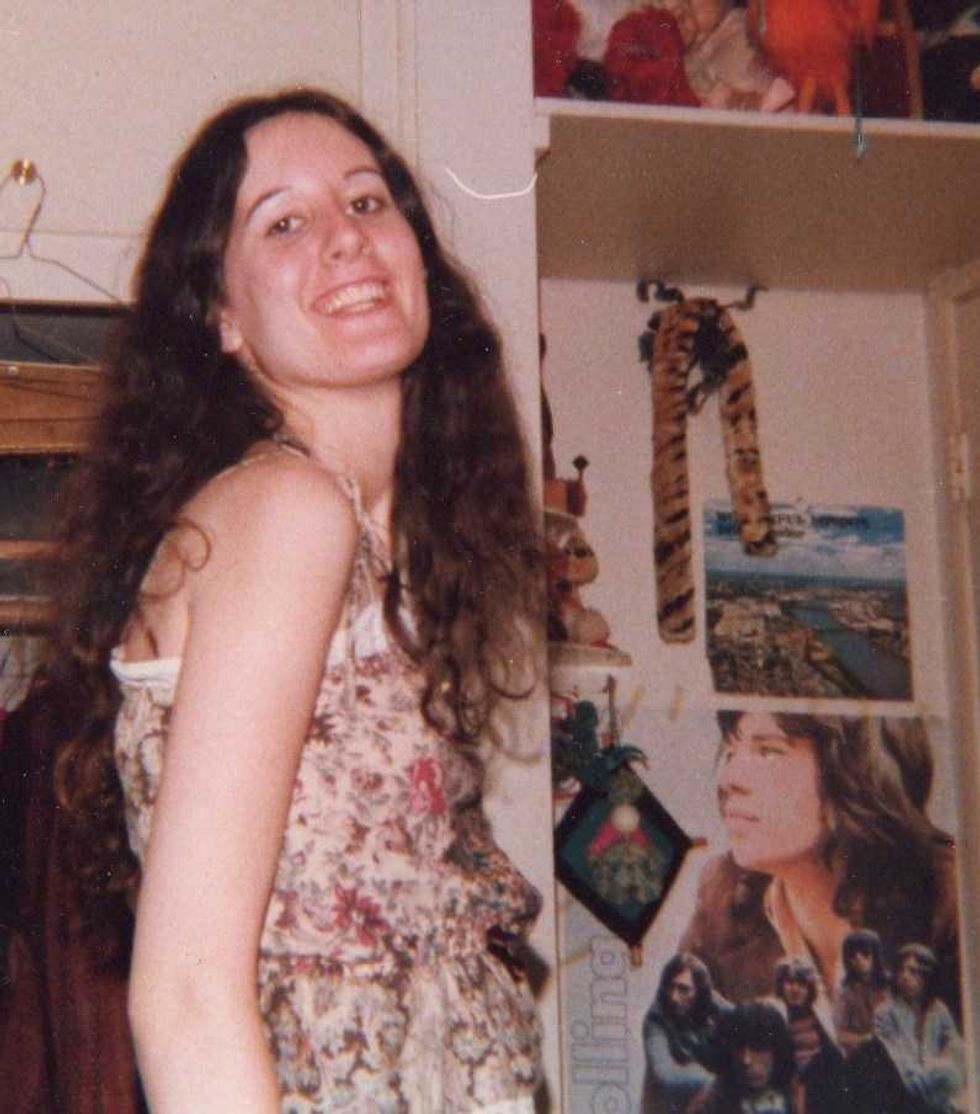 A Generation Jones teenager poses in her room.Image via Wikmedia Commons
 An office kitchen.via
  An angry man eating spaghetti.via


An Irish woman went to the doctor for a routine eye exam. She left with bright neon green eyes.
It's not easy seeing green.
Did she get superpowers?
Going to the eye doctor can be a hassle and a pain. It's not just the routine issues and inconveniences that come along when making a doctor appointment, but sometimes the various devices being used to check your eyes' health feel invasive and uncomfortable. But at least at the end of the appointment, most of us don't look like we're turning into The Incredible Hulk. That wasn't the case for one Irish woman.
Photographer Margerita B. Wargola was just going in for a routine eye exam at the hospital but ended up leaving with her eyes a shocking, bright neon green.
At the doctor's office, the nurse practitioner was prepping Wargola for a test with a machine that Wargola had experienced before. Before the test started, Wargola presumed the nurse had dropped some saline into her eyes, as they were feeling dry. After she blinked, everything went yellow.
Wargola and the nurse initially panicked. Neither knew what was going on as Wargola suddenly had yellow vision and radioactive-looking green eyes. After the initial shock, both realized the issue: the nurse forgot to ask Wargola to remove her contact lenses before putting contrast drops in her eyes for the exam. Wargola and the nurse quickly removed the lenses from her eyes and washed them thoroughly with saline. Fortunately, Wargola's eyes were unharmed. Unfortunately, her contacts were permanently stained and she didn't bring a spare pair.
- YouTube youtube.com
Since she has poor vision, Wargola was forced to drive herself home after the eye exam wearing the neon-green contact lenses that make her look like a member of the Green Lantern Corps. She couldn't help but laugh at her predicament and recorded a video explaining it all on social media. Since then, her video has sparked a couple Reddit threads and collected a bunch of comments on Instagram:
“But the REAL question is: do you now have X-Ray vision?”
“You can just say you're a superhero.”
“I would make a few stops on the way home just to freak some people out!”
“I would have lived it up! Grab a coffee, do grocery shopping, walk around a shopping center.”
“This one would pair well with that girl who ate something with turmeric with her invisalign on and walked around Paris smiling at people with seemingly BRIGHT YELLOW TEETH.”
“I would save those for fancy special occasions! WOW!”
“Every time I'd stop I'd turn slowly and stare at the person in the car next to me.”
“Keep them. Tell people what to do. They’ll do your bidding.”
In a follow-up Instagram video, Wargola showed her followers that she was safe at home with normal eyes, showing that the damaged contact lenses were so stained that they turned the saline solution in her contacts case into a bright Gatorade yellow. She wasn't mad at the nurse and, in fact, plans on keeping the lenses to wear on St. Patrick's Day or some other special occasion.
While no harm was done and a good laugh was had, it's still best for doctors, nurses, and patients alike to double-check and ask or tell if contact lenses are being worn before each eye test. If not, there might be more than ultra-green eyes to worry about.